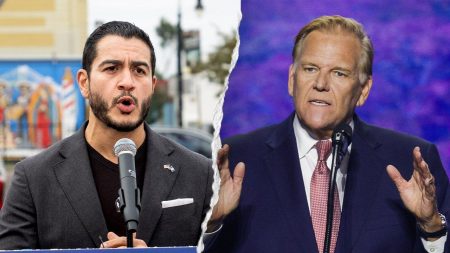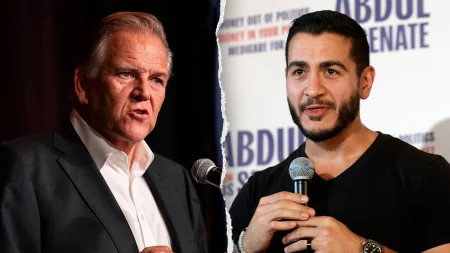
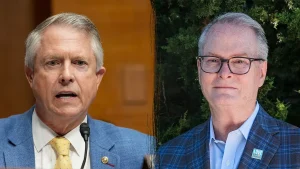



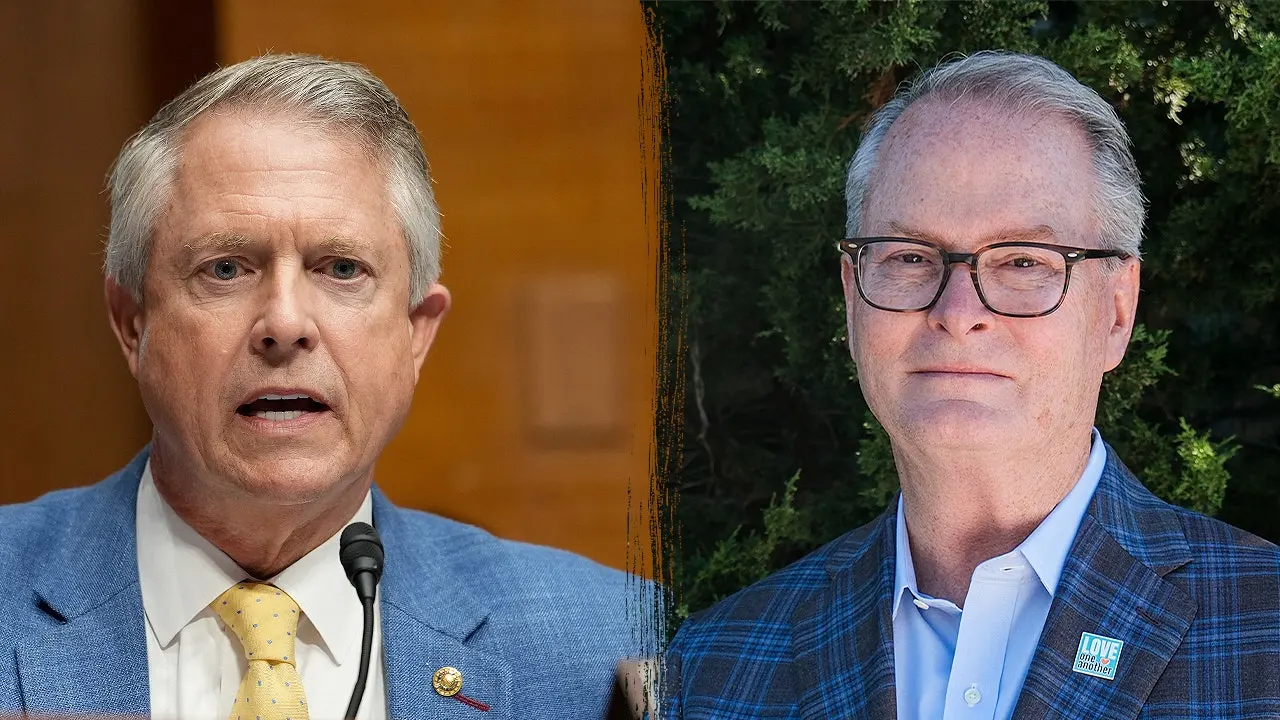
The lights were bright, the stakes were unmistakable, and for one hour in Kansas, two men who have spent most of the year trading insults from a safe distance finally had to look each other in the eye. Senator Roger Marshall, the Republican incumbent, and Adam Hamilton, the Democratic challenger, shared a debate stage Wednesday night in a contest that has become far more competitive than anyone in Washington expected. With control of the Senate hanging in the balance, both men understood that the eyes of the country were on them. They fought over President Donald Trump, immigration, the war in Iran, and the direction of the nation, but what stood out most was how desperately each man tried to escape the gravitational pull of his own party. In a deeply red state like Kansas, that meant Marshall had to reassure Trump loyalists without seeming like a rubber stamp, while Hamilton had to convince moderate voters that he was not the national Democrat they had been told to fear. The debate opened on a personal, almost uncomfortable note, with both candidates pressed over controversies that had fueled attack ads in the closing weeks of the campaign. Neither man looked fully comfortable in the spotlight, and neither could afford to make a mistake. It was a night of political survival, and both seemed to know it.
For Marshall, the first challenge came in the form of a story that has haunted his campaign for weeks. A New York Times review found that his former medical practice had sued more than seven hundred patients over unpaid bills. The image of a doctor taking his own patients to court was a devastating one, especially in a state where rural hospitals are struggling and medical debt is a real fear for many families. But Marshall did not back down. He defended the practice while emphasizing the millions of dollars in free care his practice provided every year. He spoke not like a politician dodging a scandal, but like a small-business owner trying to explain the harsh realities of keeping a clinic open. “Every year we gave away $3 to $4 million of charity, but we also had a business,” he said. “We had 300 employees, we had a mortgage payment, we had electric.” The words were meant to humanize him, to remind voters that there was a real person behind the attack ads, someone who had met payroll and agonized over bills. It was a risky strategy, acknowledging the lawsuits while asking voters to see the bigger picture. Whether it worked was unclear, but Marshall seemed determined not to let the issue define him. For a physician who spent years healing patients, the accusation clearly stung, and he wore that frustration openly. He also hinted that the report had been weaponized by political opponents, suggesting that it was a hit job designed to damage him in the final stretch. In a state where Republicans have dominated for generations, Marshall knew that his path to victory ran through turning out the base, and the medical debt story was a direct threat to that coalition.
If Marshall’s baggage was about money, Hamilton’s was about trust. The Democratic nominee, a longtime pastor, was questioned about his handling of allegations involving a volunteer at his church’s summer camp who had been accused of being a sexual predator. It was the kind of story that cuts to the core of a man who has built his public life around faith and moral leadership. Hamilton did not try to dodge the question. He acknowledged that after an initial investigation, he should have ensured the individual did not return to the camp. “I should have checked to make sure that he wasn’t going back,” he said. “That was a mistake on my part.” It was a raw moment, the kind of admission that does not come easily to someone who has spent decades in the pulpit. Hamilton seemed genuinely pained, and his voice wavered as he spoke. But he also seemed determined to turn the page, to remind voters that he had spent his life serving others and that he had learned from the experience. The debate did not linger on the issue, but its shadows stretched over the rest of the evening. Both candidates were forced to confront the parts of their records they would rather forget, and both emerged somewhat bruised but still standing. In a race this close, personal controversies matter. They are the raw material of campaign ads and the silent voices in voters’ heads on Election Day. Wednesday night gave voters a chance to watch how each man handled the weight of his own history, and neither delivered a flawless performance.
The rest of the debate was dominated by a tug-of-war over national identity. Marshall repeatedly warned that electing Hamilton would hand control of the Senate to Democrats and Senate Minority Leader Chuck Schumer, a name he pronounced with undisguised contempt. He argued that a vote for Hamilton was a vote for a liberal agenda that would raise taxes, weaken borders, and undermine the military. Hamilton, for his part, tried to carve out a space as an independent-minded Democrat, someone willing to defy his party when it mattered. The clearest example came when moderators played footage of Trump campaigning for Marshall in Kansas earlier in the week. In the video, Trump told voters to “pretend, please, that I’m on the ballot.” The question was simple: did Marshall support every part of Trump’s agenda? Marshall’s answer was a careful dance. He said no, pointing to recent disagreements over immigration enforcement in southwest Kansas and beef imports. Then he reached for a folksy metaphor that seemed designed to soften the divide between him and the former president. “Just like with my wife, I can disagree with her. My wife is always right,” he joked. “And President Trump is not always right.” It was a clever line, and it drew laughter, but it also underscored the tightrope Marshall must walk. He needs Trump voters to show up, but he also needs to project enough independence to appeal to moderates. “We need the Trump voters to come out,” he said. “If you want the Trump agenda to continue, if you want secure borders, if you want a strong military, if you want lower taxes, then you — and you voted for President Trump — you need to come out.” Hamilton faced his own test along the same lines, pressing him on his past support for Democrats and his campaign slogan of “leading from the middle.” The pastor turned politician broke with former President Joe Biden over immigration, calling the border policies a disaster and declaring his belief in strong and secure borders. He even said he would not support Schumer as majority leader if Democrats won control of the Senate. It was a bold claim, one designed to convince Kansas voters that he was not beholden to the national party.
Then came one of those rare moments in modern American politics when two opponents actually agreed. Moderators asked the candidates how many genders there are. Marshall answered without hesitation. “There’s two. There’s a boy and there’s a girl,” he said. Hamilton gave the same answer: “There are two genders, male and female.” In a political climate that often turns cultural questions into battlegrounds, the exchange was almost startling in its normalcy. The cordiality continued when Hamilton was asked about transgender athletes in sports. He said he did not want biological males competing against his twelve-year-old granddaughter, calling it “not a fair fight.” But then he added that decisions over athletic participation should generally be handled locally rather than by the federal government. It was a carefully calibrated answer, one that gave cultural conservatives much of what they wanted to hear while still leaving room for local control and individual school districts to make their own choices. Marshall did not press the issue, and for a brief moment, the debate felt less like a partisan blood sport and more like a conversation between two Kansans who shared a common background. It was a reminder that even in the most polarized of times, there are still areas where the two parties can find common ground. Whether that common ground is enough to sway undecided voters remains to be seen, but the exchange stood out precisely because it was so ordinary.
As the debate drew to a close, the larger meaning of the evening began to come into focus. Kansas has not elected a Democratic U.S. senator since 1932. For nearly a century, the state has been a Republican stronghold, and Marshall has been campaigning for a second term as if the seat were his by right. But Hamilton, a charismatic pastor with a moderate message, has turned the race into something unexpectedly competitive. Polls have shown a tighter contest than anyone expected, and national Republicans have poured resources into defending the seat. Trump himself traveled to Kansas on Monday to campaign for Marshall, a sign of how seriously the party is taking the threat. The debate may not have changed the fundamental math of the race, but it did reveal two very different styles of politics. Marshall is a fighter, a scrappy incumbent who believes that the strength of the Republican base is his greatest asset. Hamilton is a uniter, a man of faith who believes that Kansas voters are tired of extremism and want someone who will work across the aisle. Both men spent the night trying to distance themselves from the most unpopular elements of their respective parties. Marshall wanted to show that he could work with Trump without being his puppet. Hamilton wanted to show that he could stand up to Schumer and the progressive wing of his party. Voters will decide which story they find more believable. In a state with so little recent history of Democratic success, Hamilton still faces an uphill climb. But on this night, at least, he proved that he was willing to stand on the same stage, answer the same tough questions, and fight for every vote. Whether that will be enough remains one of the great open questions of the midterms.