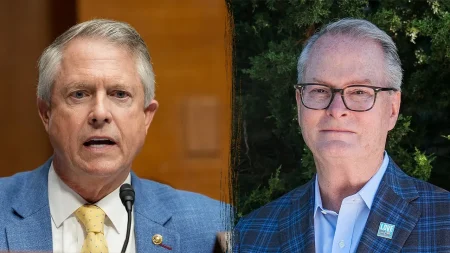



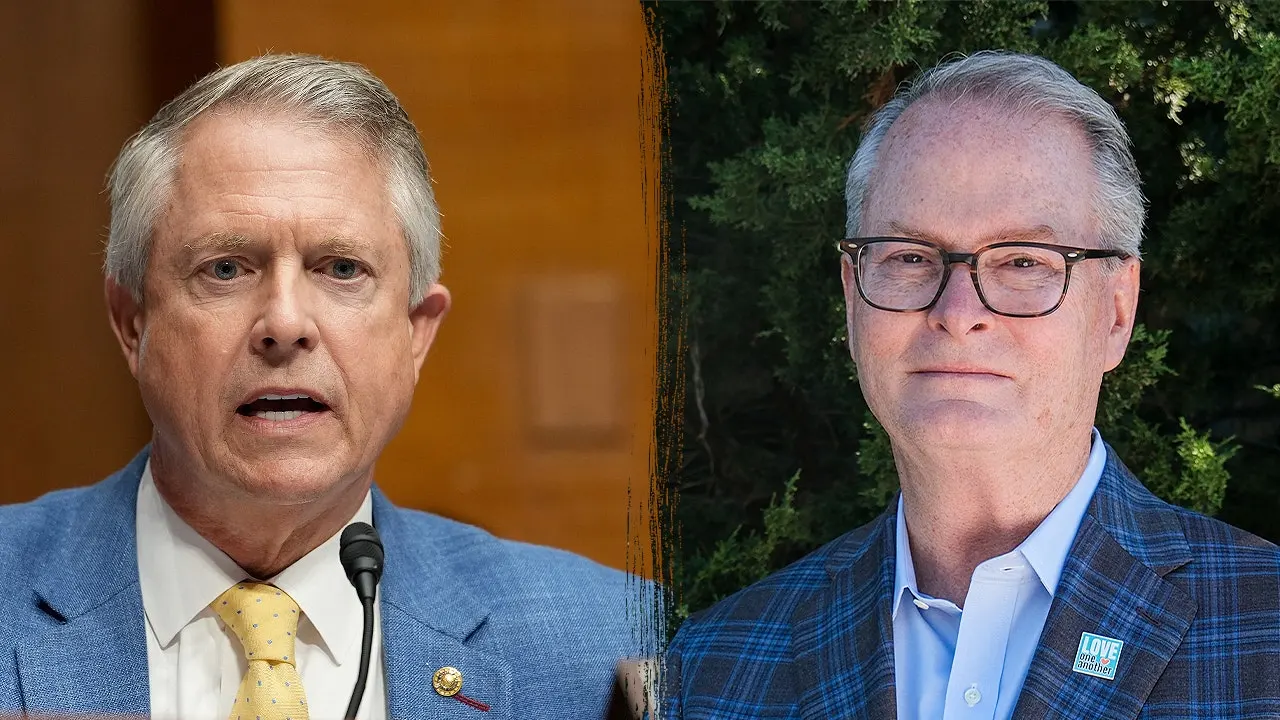
Under the harsh glare of the studio lights in Kansas, the act of political theater took on the weight of a very personal, very raw prizefight. Senator Roger Marshall, a Republican incumbent with the steady, deliberate bearing of a physician, squared off against Adam Hamilton, a silver-tongued Methodist pastor carrying the flag for a Democratic Party that hasn’t won a Senate seat in the state since the age of Franklin Roosevelt. The air was thick not just with policy talk, but with the scent of survival—with national implications hanging over an otherwise local affair. With less than two weeks until the ballots were cast, and the Senate majority hanging in a knife’s-edge balance, the evening was never going to be a dry recitation of issues. Instead, the moderators decided to throw both men into the deep end of the pool immediately, forcing them to account for the most embarrassing moments of their pasts. Marshall was confronted with an ominous New York Times report detailing how his former medical practice had sued over 700 patients over unpaid bills. Rather than backing down, he painted a portrait of a small business fighting to stay alive, stressing that while they gave away millions in charity, they still had mortgages to pay and employees to feed. As he spoke, you could almost see him tearing up the image of a cold-hearted creditor, replacing it with a beleaguered entrepreneur. Across the stage, Hamilton had to face an even darker, more visceral scandal: his own past mishandling of a sexual abuse allegation against a church camp volunteer. He admitted a painful, human flaw—that he should have ensured the accused individual never returned after an initial investigation. It was a moment of staunch vulnerability, a pastor confessing a failure to protect his flock, revealing the cracks in his moral armor just as the cameras rolled.
The specter of Donald Trump loomed over the entire proceeding, a ghostly third participant in the debate. Moderators played a clip of the ex-president’s recent rally in the Sunflower State, where he implored Kansans to “pretend” he was on the ballot. But the tension broke when Marshall was asked directly whether this meant he would rubber-stamp every presidential whim. In a surprising moment of candor disguised as good-old-boy humor, Marshall admitted that “President Trump is not always right.” He steered through the minefield by pointing to previous disagreements—particularly over immigration raids in southwest Kansas that disrupted dairy farmers, and Trump’s tariff policies on imported beef that squeezed local ranchers. It was a delicate political tango: Marshall knew he needed the passionate MAGA base to show up, yet he also needed to project independence to skeptical moderates. He wrapped his defiance in a folksy parable about his wife—saying he can disagree with her because she’s always right—which drew laughter but carried the sharp edge of truth. The moment humanized a politician often seen as just another Washington cog, revealing a man forced to balance the burden of party loyalty against the everyday needs of his home state. But just as quickly as he pushed back, he pivoted, reminding the crowd that electing Hamilton would be a blank check for Democratic control of the Senate, putting the onus on Trump voters to see the bigger picture. It was a clear-sighted frankness that laid bare the impossible tightrope walk of the modern Republican: remaining an agent of a polarizing leader while keeping a distinct, grounded identity.
In a climate where gerrymandered districts and echo chambers have made bipartisan agreement nearly extinct, the single most shocking moment came when both candidates looked the moderator dead in the eye and agreed. The query was as blunt as it gets: how many genders are there? Marshall, leveraging his two decades as an obstetrician, delivered the news with clinical simplicity—he had delivered 5,000 babies, and nearly half were boys and half were girls. “There’s two,” he stated, as if diagnosing a broken bone. Hamilton, the pastor, nodded in total agreement, providing a rare moment of harmony on a stage otherwise defined by bitter division. That harmony, however, shattered the moment the conversation turned to the arena of women’s sports. Hamilton, stepping into the shoes of a protective grandfather, told the audience about his 12-year-old granddaughter, asserting that he didn’t want biological males competing against her in a physically dangerous “fair fight.” It was a calculated move to connect with suburban voters who feel the culture war is encroaching on their children. But Marshall wasn’t about to let the pastor own the playing field. He pushed hard, insisting that by high school, boys belong in boys’ sports and girls in girls’ sports, accusing national Democrats of injecting a toxic “transgender ideology” into schools. The gloves came off when Hamilton accused Marshall of using the issue to simply “pick on” and “bully” a marginalized group for electoral gain. The exchange encapsulated the nation’s broader schism—one side framed it as fundamental fairness, the other as outright persecution—yet their shared absolute stance on human biology served as a poignant reminder of how the cultural revolution has yet to genuinely penetrate the conservative heartland.
The intellectual high-water mark of the night came with a discussion that felt more suited to a science fiction novel than a political debate: the rapacious rise of artificial intelligence. Hamilton tried to elevate his rhetoric to Churchillian heights, comparing AI to the terrifying dawn of the nuclear age. He argued that if we created a Nuclear Regulatory Commission to handle the atom, we must now create an analogous body to handle the microchip, warning that this technology poses a “potential existential threat to the human race.” His voice carried an urgency that was both compelling and disconcerting. Yet, the preacher’s lofty sermon met its congregation in the mud when the moderator pushed him to offer specifics. What regulations would he actually sign into law? The confident facade crumbled, and Hamilton offered one of the most complicated moments of the evening. “You know what? I’m not sure, to be honest,” he admitted, rationalizing that even a genius like Einstein would struggle to comprehend the full scope of the technology’s impact on day one. It was a staggeringly honest but politically damaging response, painting him as a man heavy on rhetoric but light on implementation. Marshall, seizing the contrast, offered the reassuring counter-punch of a pragmatic physician. He distrusted the idea of a massive federal bureaucracy and a “one-size-fits-all global order,” instead advocating a “light touch” approach that centered privacy for kids, national security, and transparency without killing the golden goose of American innovation. The debate highlighted a fundamental philosophical divide on governance: Hamilton’s visceral, fear-driven desire to build a fortress against the unknown, versus Marshall’s free-market optimism that great power can be self-regulating.
Perhaps the hardest fight for Hamilton wasn’t against his opponent, but against the image of his own national party. Moderators forced him to look into the mirror of his past donations to Joe Biden, Kamala Harris, and Rep. Sharice Davids, questioning how a self-described centrist could have bankrolled such prominent progressives. Hamilton knew he had to pivot fast, or risk being tied to a brand that is toxic in the Kansas plains. He did so by effectively throwing the sitting president under the bus, labeling the Biden border policies a “disaster” and demanding strong, secure borders. He practically shouted, “I’m not somebody who favors the Socialist Party,” seeking to quarantine himself from the far-left wing of his own base. He even doubled down, declaring he would refuse to back Chuck Schumer as Majority Leader, a move that would ostracize him from the upper echelons of his caucus if he somehow won. This entire performance was a masterclass in political self-preservation; he was trying to convince red-state voters that he’s a maverick, an independent voice who would check the excesses of his own colleagues in Washington. Yet, it also revealed an almost desperate scramble for credibility. Can a man who pumped money into the national Democratic machine credibly claim to be a party rebel? For Hamilton, this was his greatest human struggle laid bare—the inherent conflict of running as a leader of the middle in a state that prefers its politicians on the right. He was effectively asking Kansans to accept him as an anomaly within his own tribe, a high-wire gamble that put him at odds with the very structure of the Democratic establishment.
When the final gavel fell, the voters of Kansas were left with a vivid, unflinching portrait of two deeply flawed but determined men, rather than just two political brands. The debate felt less like a policy seminar and more like a public therapy session, where the rawest insecurities were aired for the world to see. Marshall survived the opening hit over his medical billing, emerging as the steady, Try-status-quo candidate who promises to keep the boat steady while holding the line against the radical left—provided you can overlook the nagging truth of those lawsuits. He did enough to reassure his base, but his admission that Trump isn’t infallible might just gum up the works of his voter turnout machine. Hamilton, meanwhile, fought valiantly to redefine himself as a small-town, common-sense moderate, a pastor who acknowledges his past mistakes and calls for calm heads in the face of unchecked AI and unfair sports, yet his inability to articulate solid AI legislation and his stained handling of the church abuse case might prove insurmountable burdens. The race, previously overlooked as a lock for the GOP, is now a genuine headache, a barometer of the country’s unpredictable political metabolism. Ultimately, the evening transcended the specific political quagmire, serving as a mirror for the American psyche itself—a national conversation where personal character, religious faith, and the looming voice of Trump all mingle and clash. Kansans must now decide whether they trust the loyal soldier who occasionally argues with his general, or the flawed shepherd who promises to lead from the middle. The clock is ticking, the ads are running, and the true verdict from the Kansas electorate is just around the corner—one that will send a powerful echo throughout the halls of the U.S. Capitol.