


It began with a blunt, almost startling admission from one of Canada’s most powerful provincial leaders. Ontario Premier Doug Ford stood before reporters on Thursday and said out loud what many Canadian politicians had only whispered behind closed doors: he hopes Republicans lose control of both the U.S. House and Senate in the upcoming midterm elections. It was not a policy statement or a diplomatic nicety—it was a raw, human expression of frustration. Ford, who has become one of President Donald Trump’s most vocal critics north of the border, argued that voters should use their ballots to punish Trump for his escalating trade war with Canada. “Hopefully, he’s going to lose the Senate. He’s going to lose Congress. I hope so, and hold him accountable,” Ford said. But even as he made those wishes, he pulled back slightly, adding with a shrug of political realism: “But we’ll see how that goes. We aren’t going to interfere in the U.S. election.” In other words, Ford was not calling for a foreign campaign; he was simply a frustrated leader watching a unpredictable neighbor burn bridges, hoping that democracy itself would deliver a lesson.
That frustration did not come out of nowhere. Ford has spent months watching Trump impose tariffs, break deals, and shift tactics with little warning. To Ford, Trump is not just a tough negotiator; he is someone who cannot be trusted to stick to his word. “He’s not reliable at all,” Ford said. “He could make a deal today and then change his mind. And we’ve seen that over and over again.” There was something almost weary in his voice, as if describing a business partner who signs contracts in pen then erases them in invisibleink. Yet Ford also betrayed a politician’s hope that self-interest might still save the day. He said he genuinely believes Trump would like to reach a trade agreement before the midterms, because a deal would give Republicans something to campaign on—a win, a victory lap, a reason for voters to overlook thea chaos. “I truly believe President Trump wants a deal before the midterms,” Ford said. “I could be wrong, but I think it’s best that we sit down and get a deal.” This is where Ford’s human side shows: he is angry, yes, but he is also pragmatic. He does not want revenge; he wants stability, for the sake of workers, farmers, families on both sides of the border. He wants the shouting to stop and the negotiating to begin.
The trade war itself has already begun to bite in ways that feel personal and concrete, not just abstract lines on a spreadsheet. Just days before Ford’s comments, the United States escalated the dispute in a manner that felt almost like a grocery store shelf being cleared by an angry neighbor. U.S. officials banned certain Canadian dairy products, motorcycles, and most alcoholic beverages—items that carry cultural weight, not just commercial value. The trigger for these new measures was Canada’s retaliatory tariffs, which had taken effect on roughly $20 billion worth of U.S. goods. It was a cycle of blow and counter-blow, with each side claiming the other started it, and everyday Canadians suddenly finding their favorite cheese or bottle of rye caught in the crossfire. But Washington did not stop there. Trump also moved to remove Canadian products from large, long-term U.S. government contracts, a maneuver that goes far beyond retail shelves and into the machinery of federal procurement. For Canadian businesses, that kind of exclusion feels like being locked out of a house they had helped build. Ford, who has repeatedly accusedTrump of trying to lure Ontario’s businesses and jobs across the border, saw this as a pattern: strip awayCanada’s economic leverage, piece by piece, untilnothing remains but americansupply chains. The irony is that Ford once believed this could be avoided. Last year, Trump abruptly ended trade talks with Canada after the Ontario government broadcast an anti-tariff TV ad in the United States—airing quotes from former Republican President Ronald Reagan, of all people, criticizing tariffs. In Ford’s mind, using Reagan’s own words against Trump’s tariff policy made honest, conservative sense;but Trump took it as a personal affront. The talks collapsed, and what followed was not negotiation but retaliation.
The personal dimension of this conflict makes it feel less like diplomacy and more like a bitter family feud playing out in public. Ford does not hesitate to mock Trump, and there is a theatrical, almost schoolyard quality to their exchanges. Ford, for instance, took a jab at Trump for keeping a portrait of Ronald Reagan near his desk while simultaneously pushing tariff policies Reagan had famously opposed. Ford told The Associated Press that Reagan would be “throwing up on him from the picture if he knew what was going on.” It was a vivid, crass, deeply human image—a dead Republican icon haunting the Oval Office, disgusted by the living one. Trump fired back with his own insult, calling Ford “ he “less charismatic, intelligent, and overall unimpressive brother of the late, great, Rob Ford.” The reference to Ford’s late brother, Rob Ford, the former Toronto mayor, added a cruel, personal edge to what might otherwise have been normal political sparring. But trueto form,Trump did not stop at insults. He further escalated tensions with Canada when he signed an executive order to rename Lake Ontario as“Lake America.”” For Canadians, this was not just symbolic—it was a denial of shared geography, a land grab through ink. Ontario is literally named after the lake, famously one of North America’s Great Lakes and a body of water that has shaped the region’s history, culture, and identity. Canada does not recognize the renaming, and neither do other international bodies or U.S. states, but the order still lands like a slap. It tells Canadians: even the water between us belongs to us. Ford, for his part, seemed to usethis moment not to despair but to point out the unintended consequences of Trump’s aggression. He argued thatTrump had inadvertently strengthened Canada by forcing it to confront its overdependence on the United States. “The only two good things Donald Trump has ever done for Canada,” Ford said, “were that he woke us up” and“he united the country like I’ve never seen before.” It is a remarkable statement—a silver lining found in the smoke of a burning bridge. Ford was not praising Trump; he was thanking him, in a backhanded way, for being so blunt that Canadians finally saw themselves clearly. Decades of complacent reliance on American goodwill had been shattered. Canadians were suddenly paying attention to where their goods went, who controlled their supply chains, and how much of their economic sovereignty they had outsourced. The trade war, in Ford’s telling, had done what years of gentle warnings could not: it made Canadians feel their own vulnerability—and then made them angry enough to do something about it. That anger, ironically, became a source of unity. Provinces that usually squabbled over pipelines, carbon taxes, and equalization payments found themselves standing shoulder to shoulder against a common bully. It was not a comfortable unity, but it was a real one.
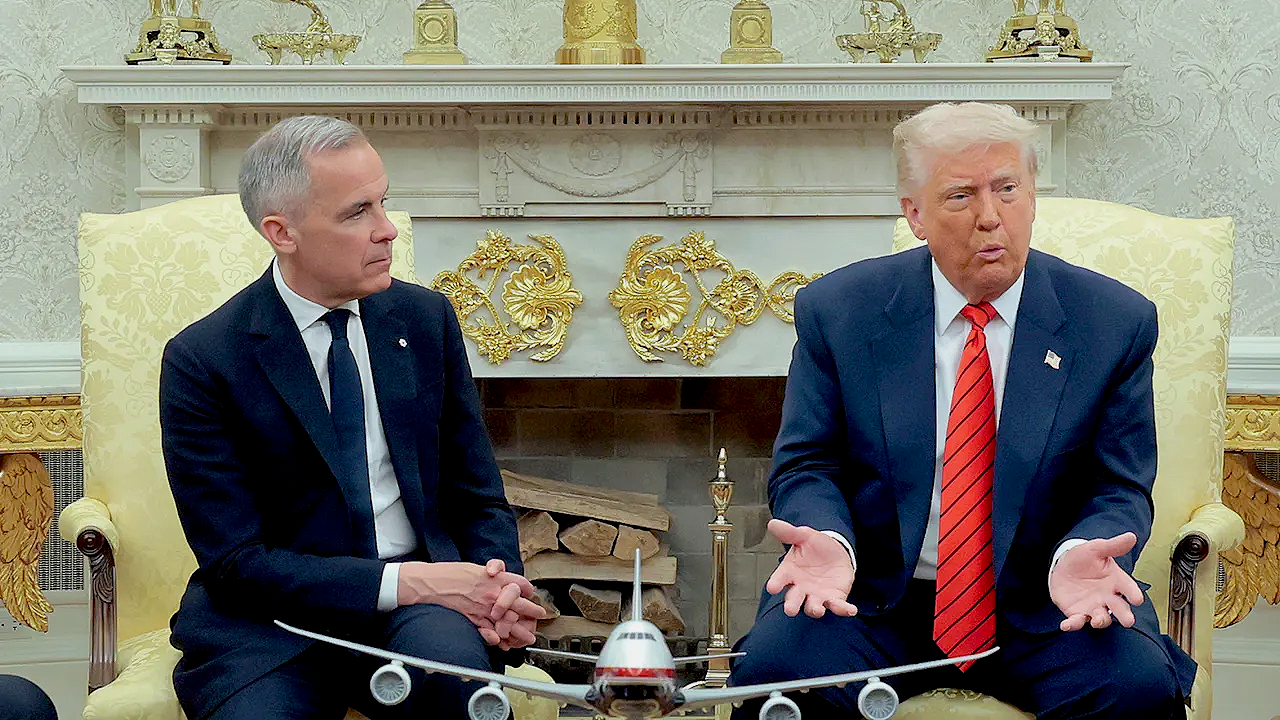
Canadian Prime Minister Mark Carney, meanwhile, offered a more measured, almost clinical response to Trump’s latest trade measures. Speaking at a cabinet retreat in Banff, Alberta, Carney suggested that Canada may hold off on further retaliation against the new U.S. actions, describing them as“relatively modest” compared to earlier American moves. It was a striking counterpoint to Ford’s fiery rhetoric—the calm, analytical voice of a former central banker trying too keep a volatile situation from spinning out of control. Carney acknowledged that his government was still studying the U.S. measures and that they could have significant consequences for individual companies and industries. He did not dismiss the pain that businesses might feel. But he also pointed out, with lawyerly precision, that some of the new U.S. tariffs replaced others that the Trump administration had removed. In other words, the net damage might not be as catastrophic as it first appeared—or at least, not yet. “We also recognize that, in the context of other things that the U.S. administration has done … that these are relatively modest measures,” Carney said. His tone suggested patience, strategic reserve, maybe even a quiet confidence that Canada could weather this storm without frantic overreaction. Where Ford wanted accountability through elections, Carney seemed willing to wait, to study, to choose his battles carefully. Both men, in their own ways, were trying to guide Canada through one of the most turbulent chapters in its relationship with the United States—one that felt less like a trade dispute and more like an identity test.
In the end, what emerges fromFord’s comments and Carney’s response has less to do with tariffs or election forecasts than with something deeper: the human experience of being caught in a relationship with an unpredictable, powerful, occasionally cruel ally. Ford’s hope that Republicans lose Congress is not really about partisanship; it is a cry for consequences, a belief that accountability matters, a hope that one day Trump will face a political cost for treatingCanada like a bargaining chip. Ford’s admission that Trump might still want a deal before the midterms reveals that even a hardened critic cannot fully abandon hope—or strategic calculation. And his observation thatTrump has united Canada suggests something almost paradoxical: that shared opposition to a reckless neighbor can become a kind of glue, turning fear into resilience. Canada, Ford implied, has been given a harsh gift: the chance to learn what it is truly made of. The question now is whether American voters, months from now, will deliver the kind of judgment Ford hopes for—or whether the trade war will grind on, forcing Canadians to keep discovering how strong they can be. Either way, Ford has made it clear that Canada’s patience has limits, that its leaders are no longer willing to pretend everything is fine, and that sometimes, hopingfor another country’s election results is simply what happens when you have tried everything else. The story of this trade war is, at its heart, a story about trust broken and trust rebuilt—not between governments, but between people, communities, and theland itself. And as Ford spoke, one could almost hear the quiet determination of a nation refusing to be defined by someone else’s anger.