





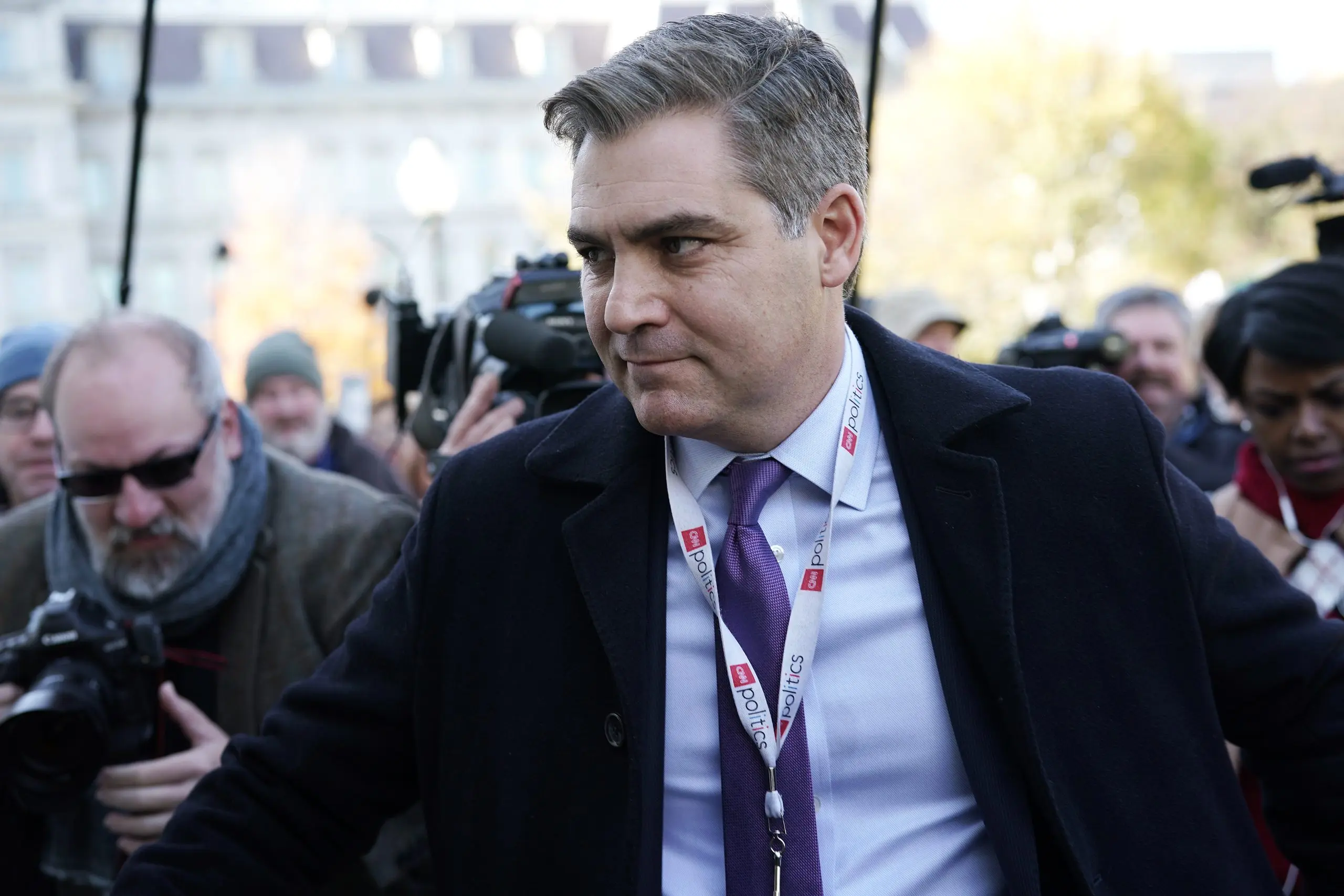
The evolution of modern American journalism has increasingly blurred the lines between objective reporting and highly opinionated commentary, a transformation vividly illustrated by the career trajectory of Jim Acosta. For nearly two decades, Acosta was a central pillar of CNN’s broadcast roster, occupying the prestigious role of chief domestic correspondent and eventually anchoring his own program, “CNN Newsroom,” from 2021 until the dawn of 2025. Throughout the turbulent years of the first Trump presidency, Acosta positioned himself as a fierce, uncompromising defender of the free press, a stance that earned him passionate admirers on the political left and vehement critics on the right. However, his long-standing association with the cable news giant came to an abrupt and unceremonious end when network executives proposed a drastic scheduling shift, offering to move his program to a desolate late-night slot spanning from midnight to two in the morning. Rejecting this apparent demotion, Acosta chose to forge a new path in the decentralized wilderness of independent digital media, establishing “The Jim Acosta Show” as an independent creator on YouTube. This platform transition speaks volumes about the changing nature of public influence, where veteran reporters must now operate as self-starting digital influencers, chasing algorithmic engagement and building raw, unedited connections with their niche audiences. It was this newly adopted role that led Acosta to host an astonishingly protracted, nearly eleven-hour live stream starting on a chilly Friday afternoon and stretching deep into the early hours of Saturday morning. The singular objective of this marathon broadcast was to witness a highly symbolic physical alteration to the Washington, D.C. skyline: the removal of former President Donald Trump’s name from the prestigious John F. Kennedy Center for the Performing Arts. What transpired over those grueling hours became a compelling human drama of endurance, political theater, and the intense polarization that continues to shape how media figures and their audiences perceive the physical markers of political power.
To fully comprehend the deep-seated emotional investment and dramatic tension that defined Acosta’s marathon broadcast, one must examine the complex web of political warfare and cultural identity that had enveloped the John F. Kennedy Center in the preceding months. In December of 2025, the center’s board of trustees sent shockwaves through the Washington establishment by voting to rename the legendary national treasure to the “Donald J. Trump and John F. Kennedy Memorial Center for the Performing Arts.” While the administration’s allies viewed the renaming as a fitting tribute to Trump’s enduring impact on federal policy and national preservation, the decision struck an incredibly raw nerve within the American progressive movement and the broader cultural community of the capital. To many, the juxtaposition of Trump’s populist legacy with the poetic, idealized memory of John F. Kennedy’s administration was an intolerable contradiction, sparking a wave of visceral public anger. The battlefield quickly shifted from the court of public opinion to the federal judiciary when a Democratic congresswoman launched a determined legal campaign to have the renaming nullified, arguing that the board had overstepped its bounds and desecrated a national monument of unity. The mounting tension finally broke when a federal judge ruled in favor of the plaintiffs, decreeing that the original, singular name of the institution must be immediately and fully restored. This legal victory transformed the physical removal of the metal letters from the building’s facade into a moment of immense symbolic weight for the anti-Trump resistance. It was no longer a mere municipal work order; it was a physical manifestation of a broader political restoration, a tangible stripping away of the conservative leader’s brand from the capital’s cultural heart, which explains why a veteran media personality felt compelled to devote his entire night to watching scaffolded workers painstakingly unscrew metal letters in the dark.
The logistical reality of the eleven-hour broadcast, however, stood in stark contrast to the grand, cinematic narrative of political triumph that Acosta sought to project. For the vast majority of the marathon stream, viewers of “The Jim Acosta Show” were treated to an agonizingly static live feed of scaffolding blanketed by a massive, opaque white tarp, which had been erected to shield the construction workers and the facade from the elements and public view. As the minutes bled into hours and afternoon faded into twilight, and eventually into the dead of night, very little actually happened on screen, transforming the broadcast into a test of pure endurance for both the host and his loyal online audience. By the time the clock crept toward the early morning hours, the sheer exhaustion of hosting a virtually eventless live show caught up with the veteran reporter. Resigning himself to the possibility that the letters might not actually come down until well after sunrise, Acosta made the deeply human decision to abandon his post, retiring to his home to seek some much-needed sleep. He left the arduous task of monitoring the silent tarp to his dedicated producer, who remained behind to keep a lonely vigil over the streaming feed. It was not until the stream had crossed the ten-hour-and-eighteen-minute mark that the producer noticed a subtle shift in activity behind the scaffolding, as workers finally began to manipulate the structure. Recognizing the imminent arrival of the moment they had spent half a day waiting for, the producer cautiously announced to the remaining late-night viewers that progress was finally being made. Acknowledging that the letters were officially being loosened and removed, the producer jokingly lamented that he would now have to wake up his boss, knowing that Acosta would be furious to have missed the actual climax of his own self-styled historic broadcast.
Roused from his brief slumber by his producer’s urgent call, a sleep-deprived but energized Acosta rushed back to the scene in Northwest Washington, D.C., arriving just in time to witness the final stages of the dismantling. Stepping back in front of the camera under the cover of a pitch-black night, he delivered a commentary that would soon echo across the social media landscape for its sheer rhetorical grandiosity. Around 3:30 a.m., standing before the dimly lit, tarp-shrouded building, Acosta made an extraordinary leap in historical comparison, declaring the removal of the plastic letters to be a moment of monumental global significance. “This is very much like watching the Berlin Wall coming down,” Acosta proclaimed to the small fraction of his audience still awake, his voice filled with a gravity usually reserved for the collapse of oppressive geopolitical regimes. He went on to assert that the event was a powerful testament to the resilience of the human spirit, calling it “a sign that mankind, that human kind can stand up against tyranny.” He expressed a profound sense of duty and pride in his makeshift broadcast, emphasizing that despite the physical toll of the overnight vigil, he felt a deep obligation to keep the cameras rolling because of how much the moment meant to so many people across the country. In Acosta’s mind, the quiet, middle-of-the-night removal of a temporary plastic sign was a direct analog to the joyous, historic day in November 1989 when millions of East and West Germans physically tore down a concrete barrier of communist oppression. This dramatic framing captured the intense, almost surreal emotional environment of the modern political commentator, where everyday administrative actions are elevated to the status of world-historical triumphs of freedom over dictatorship.
Following his initial declarations, Acosta’s broadcast pivoted into a passionate, multi-minute tirade aimed directly at the former president, revealing the deep personal animosity that has long characterized his political coverage. He expressed profound irritation at the logistics of the removal process itself, focusing his ire specifically on the giant white tarp that the National Park Service or the center’s management had erected around the scaffolding. To Acosta, this protective weather barrier was not a standard construction precaution, but rather a calculated, emotional shield designed to protect Donald Trump’s fragile ego from the public humiliation of seeing his name physically removed from the building under the gaze of news cameras. “To make it—the icing on the cake, the chef’s kiss in all of this for Donald Trump—is that they had to put up a giant white tarp to shield Trump and his feelings from the humiliation of seeing this all come down,” Acosta complained, weaving a complex narrative of psychological vulnerability around the former leader. He went on to characterize Trump’s initial renaming of the center as an act of petulant, illegal vandalism, asserting that the president had “slapped his name illegally and obnoxiously on the exterior of the Kennedy Center.” To further drive home his point, Acosta deployed a metaphor that reduced the entire complex federal administrative dispute to the level of playground dynamics, comparing the former head of state to “a small child [who] doesn’t wanna give his toy away, doesn’t want to hand over his toy after his mommy and daddy have told him it’s time to go to bed.” This highly personal, emotionally charged rhetoric highlighted the degree to which the physical building had been entirely eclipsed by the personalities involved, transforming an architectural correction into a deeply personal victory lap.
The grandiosity of Acosta’s historical comparisons and the sheer intensity of his eleven-hour vigil did not escape the notice of the digital public, sparking an immediate and ruthless wave of mockery across the internet. When clips of the early morning broadcast were shared on platforms like X, they rapidly went viral, drawing sharp criticism and comedic disbelief from both conservative commentators and neutral observers who found the Berlin Wall comparison utterly absurd. One popular social media user dryly noted the historic irony, pointing out that the Berlin Wall famously fell to “throngs of elated prisoners,” whereas Acosta’s revolution consisted of “one guy talking to himself” in the dark of night. Conservative commentator Matt Whitlock joined the chorus of detractors, expressing disbelief that anyone could have so little occurring in their daily life that they would stand outside an empty building for half a day to watch letters get removed, jokingly accusing Acosta of desperately trying to become the “final boss” of online leftist outrage. Other users focused on the sheer historical disproportion of the comparison, highlighting the vast chasm between decades of brutal Soviet-era communist oppression and the removal of a temporary plastic sign from a performing arts complex. The overwhelming public reaction to the broadcast highlighted a persistent reality of the modern, digitized public square: when media figures operate within intense ideological echo chambers, their sense of perspective can become profoundly skewed. What Jim Acosta envisioned as a historic defense of democracy and a triumphant journalistic milestone was ultimately viewed by the rest of the world as a humorous, deeply eccentric display of political obsession, leaving the veteran broadcaster to face the cold light of a Saturday morning under a mountain of online ridicule.