

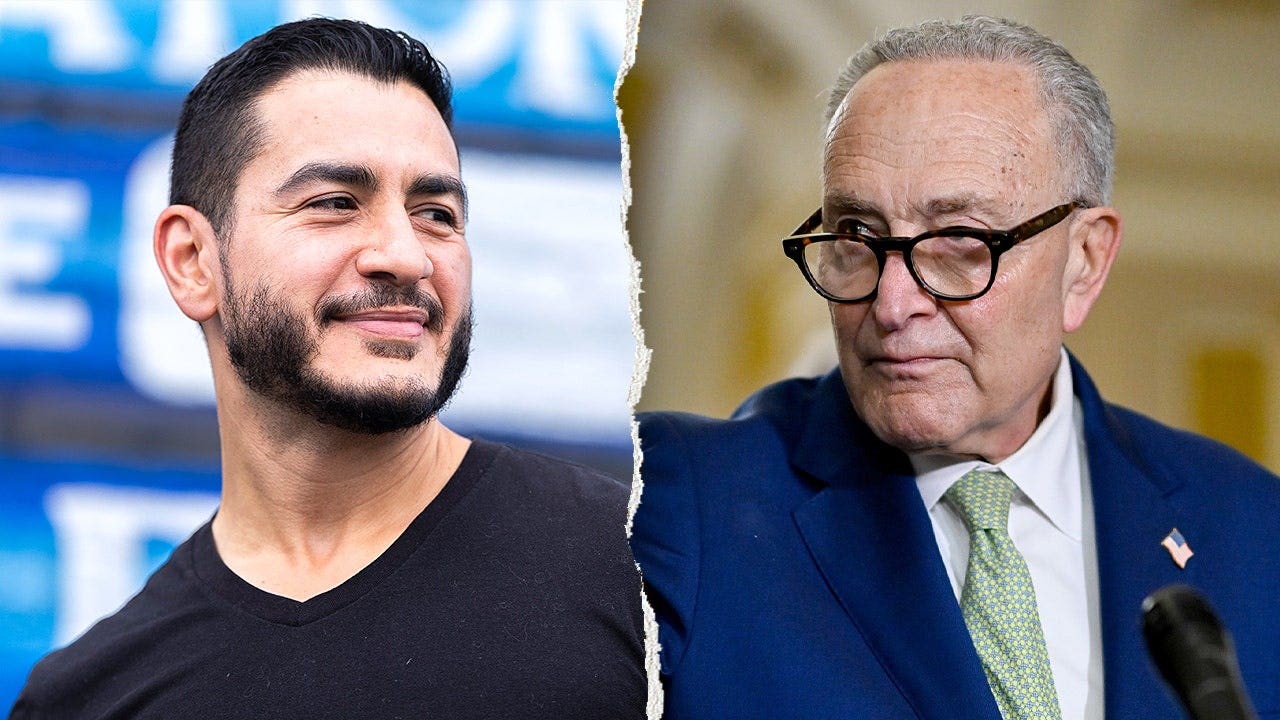
There is an old joke in politics that every campaign is local, but the ones that really matter always end up in Washington. Abdul El-Sayed spent his entire primary trying to prove he was not like the Democrats who linger in the capital—an outsider, a doctor, a progressive insurgent with a plan to remake his party from the ground up. Yet on Wednesday morning, there he was, walking into the headquarters of the Democratic Senatorial Campaign Committee, just yards from the Capitol, to sit down with the very establishment he had spent months defying. The meeting was closed-door, but the message was impossible to miss: Michigan is too important, the Senate is too close, and El-Sayed has suddenly become one of his party’s most valuable players. Senator Chuck Schumer, the minority leader, emerged from the session with the careful language of a man who has survived every kind of political weather. “Look, we have to win Michigan, and we had a great and friendly meeting,” he said, sidestepping the question everyone was really asking—whether the damage from the bruising primary had actually healed. It was a scene full of symbolism: the candidate who ran away from Washington sitting in Washington, surrounded by the people he once kept at arm’s length. There were handshakes, laughs, and the kind of calculated optimism that fills rooms when a party is trying to convince itself—and everyone else—that it has finally come together. For a few hours, at least, the Democrats tried to look like a family that had stopped fighting long enough to win an election. But the smiles only went so far. Few senators were willing to say whether they would actually hit the campaign trail with El-Sayed, and even Schumer dodged a direct question about whether the fences broken during the primary fight had been mended. The meeting was friendly, he insisted. But friendly, in Washington, can mean many things.
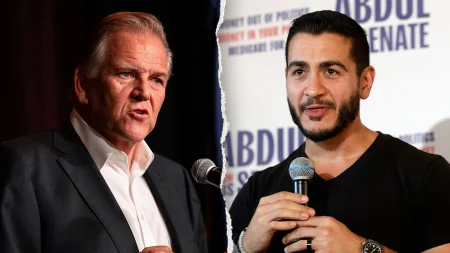
The stakes behind all the careful choreography were enormous. Republicans currently hold a 53-47 edge in the Senate, and Democrats believe that with the right candidates in the right states, they can flip the chamber. Michigan is one of the biggest pieces on the board. Losing it to former Republican Representative Mike Rogers would be a mortal blow to their hopes, a nearly impossible hole to climb out of before Election Day. That is why so many powerful Democrats made their way to the DSCC headquarters on Wednesday, why they huddled with El-Sayed for hours, and why they came out talking about victory. Senator Kirsten Gillibrand, the New York Democrat who chairs the DSCC, was blunt: “He’s gonna win.” The phrase hung in the air like a dare. Senator Gary Peters, the retiring Michigan Democrat whose seat El-Sayed is running for, went even further, saying he was endorsing El-Sayed and that Democrats across the state were coming together. “We understand how important this election is,” Peters said. It was a striking shift, given that Peters had initially backed Representative Haley Stevens in the primary. But in politics, math has a way of healing wounds. The Democratic path to the Senate majority runs through Michigan, and El-Sayed is now the vehicle. There was no shortage of talk about independents and Republicans on the fence, about affordability and kitchen-table economics, about the need to cross over and win voters who might not normally pull the Democratic lever. The meeting was not a rally, and no one was shouting. It was quieter than that—a strategic conversation about how to translate a narrow primary win into a general-election victory. The mood, according to Senator Elizabeth Warren, was genuinely cheerful. She described a crowded, laughing room full of people asking, “What can we do next?” and “What can we do to lower costs for families?” It was, she said, a very enthusiastic group. Whether that enthusiasm survives the long, grinding months ahead is another question.
The primary fight between El-Sayed and Haley Stevens was one of the bitterest Democratic contests of the cycle, a clash between the party’s old guard and a progressive movement that has been gaining momentum across the country. Stevens was backed by some of the most powerful figures in Michigan and Washington; El-Sayed had the energy of the left and a social-media machine that made his name a national cause. The race got hot, as Senator Chris Murphy of Connecticut put it—and Murphy, who had initially endorsed another candidate, state Senator Mallory McMorrow, before she dropped out, knows just how hot. “This is what you do after a primary is you try to unite the party and then you do the work to reach out and cross over to independent voters and Republican voters,” Murphy said. He did not seem surprised that El-Sayed was trying to build bridges. That, he said, is what winning candidates do. Still, the old divisions did not disappear just because everyone was in the same room. There were allies and skeptics milling in and out of the DSCC building throughout the day, and the atmosphere was more carefully managed than genuinely warm. El-Sayed, for his part, played the role of the gracious nominee. He talked about Michigan voters and their concerns, about the need to focus on the future rather than the past. But the lingering question was whether the Democratic establishment would fully embrace him—or simply hold its nose and do what was necessary to keep the seat blue. Senator Ed Markey of Massachusetts, a progressive stalwart, was unequivocal. “I’m helping him. I think we’re all gonna help,” Markey said, adding that El-Sayed’s message on affordability was exactly what the party needed. Senator Mark Kelly of Arizona went further, revealing that he would be heading to Michigan in a couple of weeks. The support was real, at least on paper. But for a candidate who built his reputation on challenging the party’s leadership, accepting that support is its own kind of challenge.
The Democratic strategy, to hear the senators tell it, is about economics—plain and simple. They believe that voters in Michigan are sitting at their kitchen tables, looking at their bills, and asking how they are going to make it through the month. That is El-Sayed’s message too, and he repeated it with the kind of discipline that suggests he has said it many times before. “That’s not a middle, right, left issue, that’s a basic affordability issue,” he told reporters. It is a message that Democrats hope can unite progressives, moderates, independents, and even some Republicans who are tired of the culture wars. But there was an awkward thread running through the day: the specter of Hasan Piker, the controversial Twitch streamer who helped amplify El-Sayed’s campaign during the primary. Piker is a polarizing figure, known for his left-wing commentary and his enormous online following, and his presence in El-Sayed’s orbit has raised questions about whether Democrats are lurching too far to the left. When asked whether Piker came up during the meeting, Senate Minority Whip Dick Durbin of Illinois seemed genuinely puzzled. “Hasan what?” he said. “I don’t even know who that is.” Senator Andy Kim of New Jersey, who was still getting to know El-Sayed, said the streamer’s name never came up in their conversation. El-Sayed, when pressed, initially dodged the question about whether he would campaign with Piker. Then he grew more direct, telling reporters that the conversation was “so far removed from what people are talking about” and that Michigan voters “really don’t care about that.” He said it with the practiced weariness of a candidate who has been asked the same question one too many times, and he clearly wanted to move on. But the question did not go away easily, because it represents a real tension for Democrats: how to harness the energy of the online left without scaring off the suburban swing voters who decide elections.
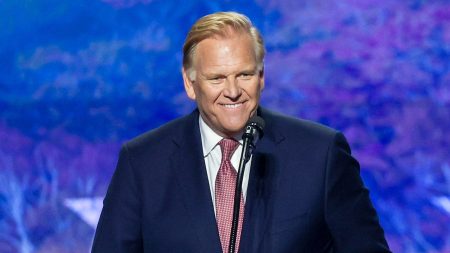
The closed-door meeting at the DSCC headquarters was, in many ways, a study in controlled messages. The senators who emerged spoke in the smooth, repetitive language of a party that knows it has no margin for error. They talked about winning Michigan, about coming together, about lowering costs for families. They smiled, they shook hands, and they tried to project the confidence of a team that has already run the play. But underneath all the talk, there was an undeniable uncertainty. Few senators were willing to say that they would personally campaign with El-Sayed. Fewer still would acknowledge the divisions that made the primary so painful. The meeting was a necessary step, not a magic solution. It gave El-Sayed the appearance of institutional backing, and it gave Senate Democrats a chance to show that they could work with a candidate who spent months criticizing them. Whether that will be enough to hold Michigan remains unclear. The state has become a political battleground, a place where the old blue wall has cracks and where the GOP has invested heavily in turning discontent into votes. Mike Rogers, the Republican nominee, is not a fringe figure; he is a former congressman with a formidable campaign and the national party’s support. The race will be close, and both sides know it. El-Sayed’s strength is his authenticity—the sense that he is not a typical politician, that he speaks like a doctor and a public-health expert rather than a poll-tested candidate. His challenge is that authenticity sometimes makes him a target. The same progressive positions that energized his primary coalition could be used against him in a general election where the suburbs will decide the outcome.
In the end, Wednesday’s meeting was about one thing: survival. El-Sayed left Washington the way he came, as the insurgent who still has to prove that he belongs. But he carried with him the endorsements and the quiet, conditional support of the party’s most powerful figures. The road ahead is not easy. He will have to balance the demands of the progressive movement that made him famous with the realities of a statewide electorate that has little patience for ideological purity tests. He will have to answer questions about Piker, about his relationships with the party’s left flank, and about whether he can work with leaders like Schumer and Peters, who once represented the very establishment he ran against. He will have to do all of this while staying true to the message that brought him here: that ordinary people, sitting at kitchen tables, deserve a government that works for them. Whether he succeeds is an open question. But on Wednesday, in a room full of Democratic heavyweights, Abdul El-Sayed looked less like an outsider and more like the future—or at least like a man willing to make peace with the present. The party left the meeting boasting that Michigan would not turn purple. Time will tell whether that boast becomes reality. For now, the candidate and the establishment are on the same page, at least for a day. In a city built on handshakes, that might be enough.