




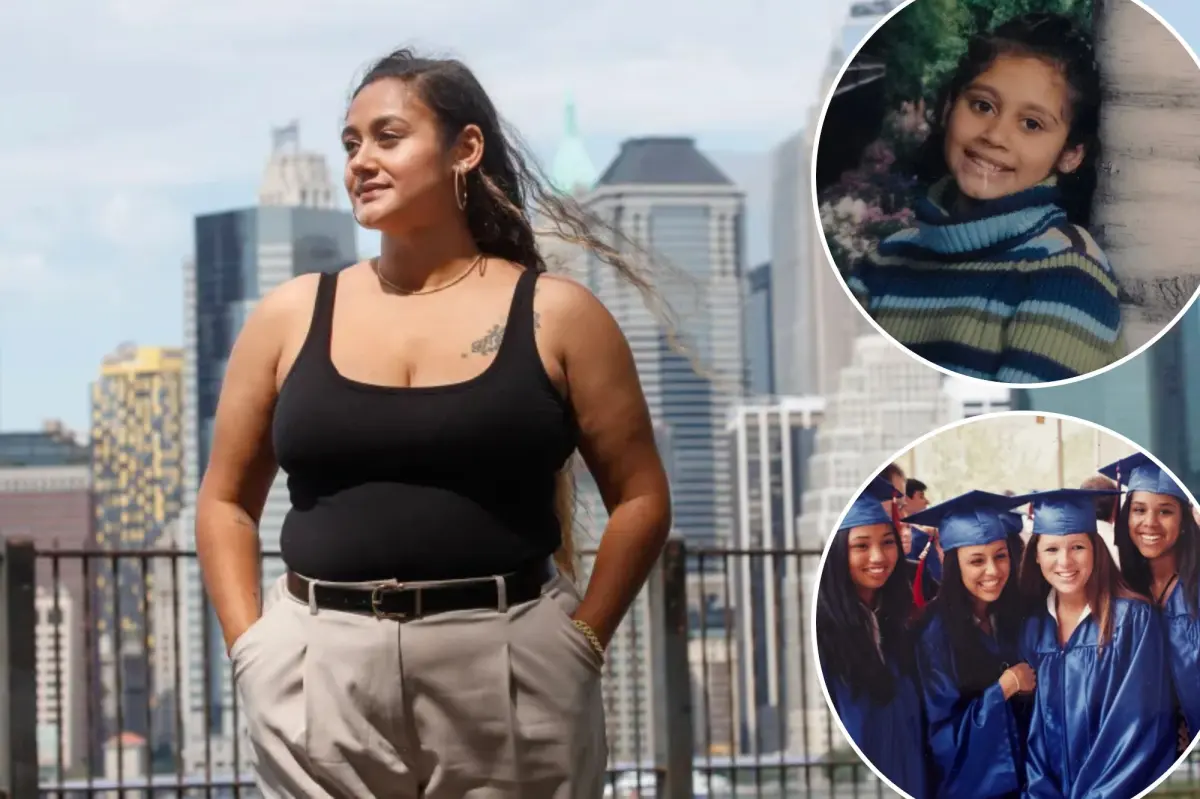
On a bright September morning in 2001, Alexandra Minaya was just a ten-year-old girl standing on a school playground in Lower Manhattan, her world still small and safe and full of ordinary childhood concerns. Then a cloud of white smoke came barreling toward her, and in an instant, everything changed. Her small body shook with fear as she and her classmates at P.S. 19 ran screaming into the school building, teachers shrieking alongside them, all of them gripped by a terror they could not name. They did not yet understand that just a few blocks away, the Twin Towers were collapsing. Minaya remembers being covered in white ash, her clothes and hair dusted with the remnants of a catastrophe, the air thick with the smell of burning chemicals. What frightened her even more than the smoke, she later recalled, was looking to the adults for comfort and finding only confusion and panic. There was no steady hand, no reassuring voice. Her mother was somewhere in the city, unreachable. She had no cell phone, the landline service was down, and she was left completely helpless. Twenty-five years later, now a mother living in Brooklyn, Minaya still carries the emotional weight of that morning. She has never been formally diagnosed with any post-9/11 health condition, but she does not need a label to know that the catastrophe left an invisible scar. The screams, the ash, the chaos, the desperate fear for a parent she could not contact—all of it remains close to the surface, a reminder that the children who survived did not simply walk away unscathed. They walked away changed, carrying a weight that would take years to understand and a lifetime to manage.
Minaya was not alone. Across New York City, thousands of children stood in the eye of the storm that day, separated from their parents, stumbling through streets transformed into a surreal nightmare. They were not among the nearly three thousand people who lost their lives, nor among the thousands who have since died from 9/11-related illnesses like lung cancer. But they witnessed the largest terrorist attack in American history, and that experience shaped them in ways many are still trying to articulate. For years, the public conversation around 9/11 focused rightly on the victims, the first responders, and the heroes who ran toward danger. The children who watched from school windows, who walked through ash-covered streets, who waited in terror for news of their families, were often overlooked. Yet their trauma was real and lasting. As they entered adulthood, many of these millennials began to struggle with anxiety, hypervigilance, survivors’ guilt, and insomnia. Diana Bejasa, now 42, was a senior at Stuyvesant High School in Lower Manhattan, just blocks from the World Trade Center, on the morning the first tower fell. She remembers the concrete shaking beneath her feet as a full-body experience, lights flickering and then going out completely, and administrators telling students to leave the building and walk up the West Side Highway without explanation. As she walked, she saw people covered in ash, their faces pale and ghostlike, and when she looked back, she watched the second tower collapse. The world she knew had become unfamiliar. She was on a street she walked every day, but nothing looked or felt recognizable. The hours-long walk home to Forest Hills—a journey of roughly ten miles—became a trudge through grief, confusion, and emotional shutdown. She could not reach her parents, could not find her friends, and completely dissociated. She would later be diagnosed with complex post-traumatic stress disorder and depression, conditions that would ripple through her career, her relationships, and her sense of self for years to come.
Bejasa’s memory of that day is fragmented, as trauma often fragments memory. She does not remember getting home, even though she knows that hugging her parents and seeing her family should have been a significant moment. The blank spaces in her mind are themselves a kind of scar. For a long time, she did not identify as a 9/11 survivor because she felt that others had endured so much worse. Some of her teachers and classmates were stricken with 9/11-related cancers in later years; she felt that her own experience did not deserve the same weight. That perspective is common among survivors, who often minimize their own suffering in the face of greater tragedy. But over time, Bejasa has come to understand that her pain is valid. She has spent much of her adult life navigating the lingering effects of complex PTSD and depression, which contributed to multiple career changes and made an already painful divorce even harder. She has also faced the strange and painful experience of having her survivor status challenged online, as though surviving meant being at the very center of the destruction. Yet she has found a way to reclaim her story. Now a public speaker, Bejasa says she can honor and remember those who died that day and still consider herself a survivor, without diminishing anyone else’s experience. Her journey from silence to speaking is not just about healing; it is about refusing to let the past define her in narrow terms. The day she watched the second tower fall from the West Side Highway remains one of the defining moments of her life, but it is not the only thing she is. She is also a mother, a woman who has rebuilt herself, and a voice for the often invisible population of young witnesses who grew up in the shadow of that terrible morning.
Vanessa Collazos was also a child on 9/11, just ten years old and starting middle school at I.S. 73 in Maspeth, Queens. She looked out her classroom window and saw the towers engulfed in flames. Young and innocent, she thought someone had set off fireworks inside the buildings. But when she turned to her teacher, she saw his face go pale. He walked out of the room without a word, leaving the students alone, and she never saw him again. That moment—silent, unexplained, and profoundly unsettling—became the shape of her memory of the day. Alone and confused in a room full of peers, Collazos sat in stunned silence until her great-grandmother arrived to pick her up. Then she went home and spent hours watching repeated footage of people jumping to their deaths from the burning towers. She could not believe her eyes. She could not process what she was seeing. She was in a state of shock, and that shock did not fully wear off. In the decades since, Collazos has lived with anxiety and an elevated state of hypervigilance, conditions she attributes largely to witnessing the horror as a child. She and her family temporarily relocated to Los Angeles in the aftermath, desperate for distance from the trauma. But distance did not erase it. Now back in Queens, she still experiences pangs of anxiety that she believes stem directly from 9/11. She walks through the city wondering whether everything will be okay, scanning her subway car for abandoned bags, bracing for the possibility of violence. She did not have airplane anxiety before 9/11; now she does. These are not abstract fears. They are the daily residue of a childhood interrupted by terror, and they are shared by thousands of her generation.
Lesley Koeppel, a New York City psychotherapist, explains that it is not uncommon for young people who witnessed catastrophic events to begin experiencing mental health struggles as adults. When something catastrophic happens without warning, a child learns that the world is not predictable or safe. That lesson is destabilizing, particularly for children whose sense of security depends on the belief that the adults around them can protect them. Years later, Koeppel says, that destabilization can show up as anxiety, hypervigilance, a need for control, difficulty tolerating uncertainty, or an intensified sensitivity to loss and danger. The event may be long over, but the sense of stability can take much longer to return—if it ever fully returns. For thousands of 9/11 victims, witnesses, and mourners, that stability would be a welcomed luxury. The lingering trauma, grief, and unshakable memory of the unprecedented pandemonium is just as palpable now as it was on the day the world changed forever. The children who lived through that morning are now adults, raising their own families, navigating their own careers, and still finding that certain sounds, smells, or images can pull them back to the smoke and the screams. They have learned to function, to build lives, to love and laugh and dream. But beneath the surface, the memory of the day when the earth shook beneath their tiny feet remains alive. It is a reminder that trauma is not simply a moment in the past. It is a presence that can echo through a lifetime, shaping how a person sees the world, how they trust, how they love, and how they protect themselves.
Yet amid the pain, there is also a story of resilience and giving back. Many of the millennials who experienced 9/11 as children have channeled their trauma into service. Bejasa, living in Hawaii with her three-year-old daughter, volunteers to help victims of natural disasters, including the recent wildfires in Oahu. She knows what it means to lose everything in an instant, and she wants to be a steady presence for others in their moments of catastrophe. Minaya, inspired by the selflessness of the first responders and everyday heroes she saw on 9/11, pursued a fourteen-year career in emergency healthcare services. She did not always know she wanted to be an emergency responder, but she knew she wanted to help others the way those men and women did during and after the attacks. For her, the tragedy was absolutely devastating and unforgettable, but it also united New Yorkers in a way she will never forget. That unity, that sense of collective care, became the unexpected gift of a terrible day. The children of 9/11 were not just victims of a tragedy; they were witnesses to the best and worst of humanity. They saw people covered in ash and people running toward danger. They saw fear and confusion, but they also saw courage and compassion. And in their own lives, many have tried to carry that courage forward. They have become parents who try to create safety for their children in a world that can feel unstable. They have become advocates, speakers, healthcare workers, and volunteers. They have learned to live with their scars, but they have also learned that healing is possible, not by forgetting the past, but by transforming it into something that helps others. A quarter century later, the smoke has long cleared, but the memory has not. It lives in the hearts of those who were children on that September morning, in their anxieties and their triumphs, in the way they hold their loved ones a little tighter and pay attention to the world a little more carefully. They are not defined by the worst day of their lives. They are defined by what they have made of it.