




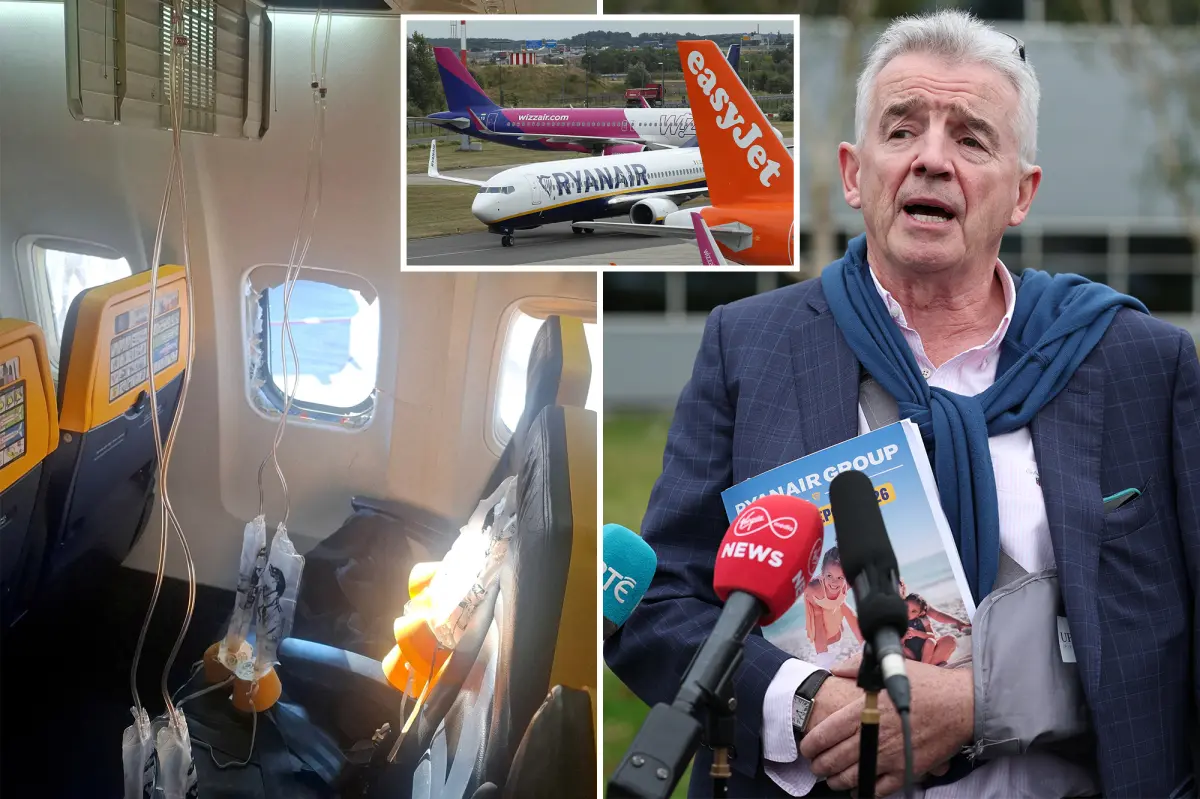
It was supposed to be an ordinary summer flight, a short hop from Greece to Germany that would carry travelers home after days in the sun. But on July 10, the cabin of a Ryanair plane became the setting for a nightmare no one on board could have imagined. Ljubisa Karović, a 61-year-old Serbian businessman, has told investigators and the media that he was partially sucked out of the aircraft after a window shattered at cruising altitude. According to his account, the sudden loss of cabin pressure created a violent, almost unthinkable suction that pulled his head and right shoulder through the opening, leaving him pinned against the frame while the plane tore through the sky. His wife, Svetlana Grković Maksimović, was seated beside him and, along with fellow passengers, desperately grabbed hold of him, trying to keep him from being pulled out entirely. The terrifying struggle reportedly went on for minutes, with Karović losing consciousness again and again as the air rushed out of the cabin and the pilots descended to a safer altitude. By the time the ordeal ended, he had suffered serious injuries to his neck and shoulders, and his family was left not only with pain but with a gnawing question: why did the crew seem to do so little to help? To imagine that scene is to feel a chill. One moment you are looking out at the clouds, the next you are fighting for your life against a force no human can resist, held down only by the hands of people who love you and strangers who happened to be nearby. This was not a routine delay or a lost bag; it was a brush with death at thirty thousand feet.
In the days that followed, the physical pain was only the beginning for Karović. His legal team accused the Ryanair crew of neglecting to come to his aid during the crisis, a charge that, if true, paints a troubling picture of an airline unprepared for an emergency. The Serbian businessman’s lawyer insisted that Karović was not merely the victim of a freak accident but a man who was left to fight for his life while those responsible for his safety stood by. The emotional toll, too, cannot be overstated. Surviving such an experience would leave anyone shaken; to be partially ejected from an airplane at altitude, held only by the hands of loved ones and strangers, is the kind of trauma that lingers long after the physical wounds heal. His wife, who watched her husband nearly disappear into the sky, has also had to live with that memory. In their telling, the incident was not just a mechanical failure but a profound betrayal of trust. When you board an airplane, you place your life in the hands of the airline and its crew. You assume that if something goes wrong, they will be ready, that they will move with urgency and care. To hear that the crew did not come to a passenger’s aid during a life-threatening emergency would shake anyone’s confidence. The family wants answers, accountability, and some acknowledgment that what happened to them was real and serious. Instead, they found themselves in a public fight with one of the most combative men in the aviation industry, a man who seemed less interested in compassion than in winning the argument.
That man is Ryanair CEO Michael O’Leary, and he did not disappoint those who expected him to push back. At the airline’s annual general meeting in Dublin on Thursday, O’Leary faced reporters who asked about Karović’s claims. His response was blunt and dismissive. He denied that the passenger had been partially sucked out of the window, saying that Karović was “certainly sucked towards the window, but he didn’t get out the window.” He repeated the point several times, as if to hammer it into the record: “He wasn’t partially out the window. No, no, no. Part of his face didn’t get out the window.” He even suggested that the man was “belted into his seat,” implying that the entire story was exaggerated. O’Leary concluded that Ryanair would “certainly be at the end of the process disputing that he or any part of his anatomy will bend out the window.” It was a remarkable statement, not only because it contradicted the passenger’s account but because of the way it was delivered. There was no softness, no careful choosing of words, no visible sympathy. Instead, there was a corporate chief executive doing what he does best: defending the brand, downplaying the damage, and framing the victim as someone with an inflated story. To be fair, O’Leary did insist that he was not trying to “downplay” the man’s suffering. He acknowledged that Karović was entitled to “some compensation.” But the overall message was clear: Ryanair was not going to accept the version of events that had been presented to the public, and it would fight any claim that demanded serious money. The company said it was awaiting a report from the National Transportation Safety Board in the United States, which is investigating the incident, and that it would let the facts guide its response. But for anyone watching, the tone felt less like a careful wait-and-see approach and more like an attempt to discredit a victim before the investigation even concluded.
The compensation dispute is where the human and corporate worlds collide most painfully. Karović’s legal team has reportedly demanded millions, a figure that reflects not only his injuries but the trauma of nearly being sucked out of an airplane. O’Leary, however, dismissed that demand out of hand. While he admitted that the traveler was entitled to “some compensation,” he saw no grounds for forking over the kind of money that would truly acknowledge what Karović endured. It is a familiar story. An ordinary person suffers a terrifying, life-altering event. A massive corporation, armed with lawyers and insurance policies, treats the incident as a financial negotiation rather than a human tragedy. The gap between the two sides is more than just dollars; it is a difference in how they understand what happened. For Karović and his wife, the event was a nightmare that they will carry with them forever. For Ryanair, it appears to be a liability problem, a claim to be minimized, a narrative to be managed. O’Leary’s comments suggested that he saw the passenger as someone trying to cash in on an unfortunate accident, not as a man who very nearly died. That kind of attitude is not unique to Ryanair, of course. Airlines have a long history of fighting injury claims, and O’Leary has never been one to soften his stance. But the contrast between the gruesome details of the incident and the CEO’s dismissive tone was stark. At some point, the math of settlements and the rhetoric of public relations have to give way to a simple question: what is a life worth when it has been put at risk by something that should never have happened? For the Karović family, the answer is not a number. It is the acknowledgment that they were not lying, that their fear was real, and that no one should have to go through what they went through.
If O’Leary’s comments about the window were controversial, what came next was even more so. During the same press conference, the billionaire weighed in on the broader state of the airline industry, particularly the high fares charged by competitors. In an attempt to criticize airlines like Aer Lingus, Lufthansa, and British Airways, he compared them to sex offenders. “You might find some people will choose not to fly with Ryanair,” he said, “but you know they’ll be overrun with the people abandoning Aer Lingus, Lufthansa, BA, and others desperate to get to Ryanair’s low fares because they can’t afford to fly with the high-fare rapists around Europe.” The words were so jarring that reporters immediately asked whether he was trivializing rape. O’Leary’s response was not an apology or an explanation. He doubled down, saying, “That’s what I call high-fare airlines like Lufthansa, BA, and others.” It was classic O’Leary, a man who has built his public persona on provocation, on saying the thing that no other CEO would dare to say, on grabbing headlines even if it means offending nearly everyone. But this was not a joke about baggage fees or a jibe at airport security. Rape is a violent crime that devastates survivors and their families. Using it as a metaphor for high ticket prices is not edgy; it is callous and deeply disrespectful. It also reveals a pattern. When O’Leary should have been addressing a serious safety incident involving a passenger who may have been seriously injured, he chose to turn the spotlight onto himself with an outrageous comment. It was a distraction, a way to change the subject, and a reminder that for some executives, attention is more important than accountability. The irony is that by making such remarks, O’Leary ensured that the conversation about the Ryanair window incident would be overshadowed by his own lack of judgment. Instead of explaining what happened to Karović, the world was left debating the ethics of a CEO’s vocabulary.
In the end, this entire episode is about more than one passenger, one airline, or one incendiary comment. It is about the way power treats ordinary people when things go wrong. Karović boarded a flight expecting to arrive safely in Germany. Instead, he found himself fighting for his life, held by his wife and strangers as the air screamed past him. The fact that he survived is a miracle. The fact that he now has to defend his own story against a billionaire CEO who calls him a liar is almost too cruel to process. O’Leary’s insistence that Karović was not partially sucked out of the window may be proven true or false by the investigation. The NTSB report will offer facts, and those facts should matter. But regardless of the final conclusion, the way O’Leary has handled the situation says something uncomfortable about the culture he represents. Rather than expressing empathy, he chose confrontation. Rather than waiting for the facts, he decided the passenger was exaggerating. Rather than showing humility in the face of a terrifying accident, he compared his rivals to rapists and mocked the very idea that his words could be harmful. None of this helps Ryanair, and none of it helps Karović. What the passenger and his family need now is not a media battle but a measure of peace. They need to know that their suffering has been heard, that their trauma is respected, and that the airline will do everything in its power to make sure such a thing never happens again. That is the least any human being deserves. It is a shame that, so far, the person in charge of Ryanair seems more interested in winning a war of words than in offering a simple, honest, and compassionate response to a man whose life was nearly torn away in the sky.