




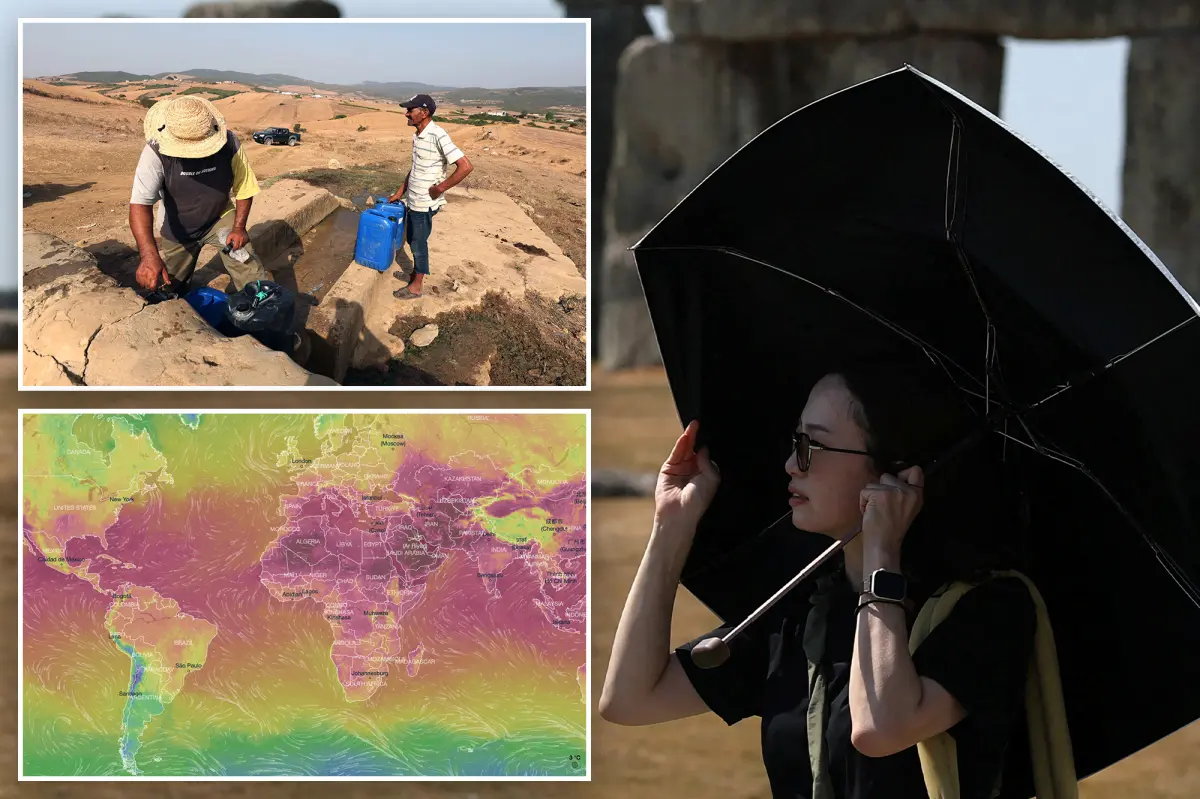
August just made history, and not in a way anyone should celebrate. The European climate service Copernicus reported that the planet averaged 62.53 degrees Fahrenheit (16.96 degrees Celsius) last month, tying with July 2023 as the hottest month ever recorded. That single difference—one-hundredth of a degree Celsius—is within the margin of uncertainty, but the fact that we are even arguing over hundredths at the top of the charts is alarming. More importantly, August ran 1.65 degrees Celsius (nearly 3 degrees Fahrenheit) above pre-industrial levels, blowing past the 1.5-degree threshold that world leaders set as a guardrail in the 2015 Paris climate agreement. The cause is not mysterious. It is the combination of a powerful El Nino and, far more significantly, the relentless burning of coal, oil, and gas that has been loading the atmosphere with heat-trapping gases. As Texas A&M climate scientist Andrew Dessler said, this is exactly what scientists predicted decades ago. We are not dealing with a surprise; we are dealing with a choice. Every record broken is another reminder that the climate train is moving, and we can either jump on board with serious action or stand on the tracks and get run over. For most people, a global average temperature doesn’t mean much. It’s not like checking a local forecast. But when the entire planet’s temperature is elevated, it means that heat waves are hotter, storms carry more moisture, oceans are warmer, and glaciers melt faster. It means that air conditioning in Phoenix struggles to keep up, that fish are moving to cooler waters, that farmers face longer droughts. The record is not just a statistic; it’s a measure of how much energy has been added to the climate system. And because that energy is accumulating, the records are not stopping. The eight hottest months on record have all occurred since July 2023. That is not a coincidence. That is a trend.
August’s heat did not happen in isolation. It capped the hottest Northern Hemisphere summer ever measured, according to Copernicus, and it pushed the United States into record territory as well. For the first time, summer in the Lower 48 states was hotter than the infamous Dust Bowl summer of 1936. That comparison matters because the Dust Bowl was a natural disaster made worse by poor land management, and it remains a benchmark of extreme American heat. To beat it now, with modern technology and data, is a sobering milestone. The US average for June through August was 74.37 degrees Fahrenheit (23.54 degrees Celsius), nearly four-tenths of a degree warmer than the 1936 mark. August itself averaged 75.58 degrees Fahrenheit (24.21 degrees Celsius), smashing the old record by more than half a degree, and the average daytime high was a blistering 88.56 degrees Fahrenheit (31.42 degrees Celsius). July was similarly record-hot, erasing another long-standing Dust Bowl mark. Globally, the summer tied with 2024 as the hottest on record. The oceans were just as extreme: global monthly ocean temperatures in August tied the all-time record set in March 2024, and August 22 set a record for the hottest day ever recorded in the world’s seas. This is not just about numbers. It’s about schools closing because classrooms are too hot, hospitals overwhelmed with heatstroke, roads melting, train tracks buckling. It’s about people who have never needed air conditioning suddenly needing it to survive. Samantha Burgess, strategic climate lead at Copernicus, said the climate system is operating well outside the range we would have expected just a decade ago. She spoke from a United Kingdom beset by heat waves, noting that climate change has transitioned from an abstract concept affecting distant places to something disrupting daily lives. The reality, she said, is that we will see more of these conditions. That is the human face of the data.
To understand why this summer felt so extreme, it helps to look at the bigger picture. Copernicus data goes back to 1940, and NOAA data for the United States goes back to 1895; global records extend to 1880. Never in that entire history have we seen eight consecutive hottest months like we have since July 2023. That streak is a clear signal that the climate system is being pushed beyond its natural variability. Berkeley Earth climate scientist Zeke Hausfather said that the fact records are regularly being broken—and that August, which is normally slightly cooler than July because the Northern Hemisphere is starting to lose sunlight, set an all-time record—shows that human-caused climate change is accelerating. It used to be that a record month was a rare event. Now it feels like every month is a candidate. The baseline has shifted so much that what used to be a once-in-a-century heat wave is now a normal summer day. The phrase “climate change” can sound abstract, but the weather is becoming less predictable, more violent, and more dangerous. Scientists like Texas Tech’s Katharine Hayhoe point out that as temperatures continue to rise, heat waves, storms, floods, and wildfires will become more frequent and more dangerous. We are not heading toward a cliff; we are already on the slope, and the ground is getting steeper. The records are not just a curiosity for scientists. They are a warning to everyone who has felt the sting of smoke-filled air, watched a neighbor’s home wash away in a flood, or wondered why the summer heat feels so much worse than it did when they were young.
One of the most important points scientists want people to understand is that El Nino is not the main villain. Yes, El Nino is a natural and temporary warming of parts of the Pacific Ocean that warps weather patterns around the globe. It adds heat to the atmosphere and can push a warm year over the top. But the overwhelming majority of the heat comes from greenhouse gases produced by human activity. Friederike Otto, a climate scientist at Imperial College London, put it bluntly: “While El Nino is starting to ramp up the heat, the underlying driver remains our relentless burning of fossil fuels. Climate change makes every El Nino hotter, and until we stop burning coal, oil, and gas these record-shattering months will simply keep on coming.” Burgess said El Nino typically adds only one or two tenths of a degree Celsius (two to four tenths of a Fahrenheit) to the global temperature. The rest is from fossil fuels. That is a crucial distinction because it means we are not helpless victims of natural cycles. We are the primary cause, and we can be the primary solution. The current El Nino is forecast to strengthen in the coming months, which means more records are likely. Hausfather projects that it is increasingly likely that the coming years will beat current records, potentially reaching as high as 1.8 degrees Celsius (3.2 degrees Fahrenheit) above pre-industrial levels if a very strong El Nino develops. Some individual days may even cross the 2-degree Celsius threshold. Think of it this way: if you are already running a fever and someone turns up the thermostat in the room, the fever gets worse. El Nino is that thermostat nudge. The underlying fever is the warming caused by carbon pollution. That is why the same El Nino that might have caused a slightly warm year in 1997 now produces a record-shattering year in the 2020s. The natural cycle is riding on a much hotter ocean and atmosphere. And every fraction of a degree matters. The difference between 1.5 and 2 degrees of warming is not just a number; it means more coral reefs dying, more ice sheets melting, more people displaced by sea-level rise and extreme weather.
The future projections are sobering. According to Hausfather, it is increasingly likely that 2026 will beat 2024 as the warmest year on record, and almost certain that 2027 will beat both, potentially reaching as high as 1.8 degrees Celsius above pre-industrial levels on the back of an unprecedentedly strong El Nino event. Burgess noted that some days may hit an even higher threshold—2 degrees Celsius above the mid-1800s. Crossing these thresholds, even temporarily, is a warning sign. The Paris agreement aimed to keep long-term warming well below 2 degrees and ideally at 1.5 degrees. We are already seeing months above 1.5, and if the trend continues, the long-term average will follow. The consequences are not abstract. United Nations climate chief Simon Stiell said: “Until humanity stops burning colossal amounts of coal, oil and gas, the pollution this causes will keep baking our planet, and extreme heat will keep smashing all-time records, killing millions and costing trillions, hitting transport and health systems, and pushing up prices for household basics like food.” He called it “the spiraling price of humanity’s fossil fuel addiction.” That is a powerful way to frame it. We are not just paying at the pump; we are paying with our health, our homes, our food supply, and our future. Already this summer, we saw what that price looks like. Wildfires forced evacuations, floods killed hundreds, heat waves sent people to emergency rooms. The economic costs are staggering, from crop failures to infrastructure repairs. But the human cost is even greater. Every record-breaking month is a reminder that the poorest and most vulnerable people, who did the least to cause the problem, are suffering the most. Yet the wealthy nations that have burned the most fossil fuels are also feeling the heat now. No one is immune.
Humanizing this story means recognizing that behind every temperature record is a person trying to live a normal life. It is the parent checking the air quality index before letting kids play outside. It is the farmer watching crops wither in the field. It is the nurse treating heatstroke in a city that has never seen temperatures this high. It is the family fleeing a wildfire that moved faster than anyone expected. Climate change is not a distant issue for future generations; it is happening now, in our neighborhoods, in our weather, in our bodies. But the story does not have to end in despair. Scientists have been clear that every fraction of a degree of warming avoided matters. The tools to reduce emissions exist: solar and wind power, electric vehicles, energy efficiency, reforestation, and policies that put a price on carbon. What is missing is the collective will to use them at the speed and scale required. As Dessler said, the interesting question is not whether we will keep breaking heat records—we will—but whether we are going to do anything about it or just stand there while the climate train runs us over. We still have a choice. We can listen to the scientists, acknowledge the human cost, and act with the urgency this moment demands. Or we can let the records keep falling, and let the suffering keep growing. The Earth will keep warming as long as we keep treating fossil fuels as the only option. But we have other options. The future is not yet written. This summer’s heat is a warning, not a verdict. How we respond will determine what kind of world we leave to our children. It is easy to feel small in the face of a problem this large, but individuals, communities, and governments all have power. Voting for leaders who take climate seriously, supporting clean energy projects, reducing waste, and demanding accountability from corporations all matter. The next time you hear about a record-breaking month, remember that it is not just a statistic. It is a call to action. And it is not too late to answer.