





Every time you ask an AI assistant to write an email or generate a picture, a data center somewhere hums a little louder. Inside those vast warehouses, the real work isn’t just computing—it’s moving information. Data has to travel between chips, between servers, and between storage systems, and in modern systems that travel happens using pulses of light guided through tiny optical pathways. The faster and more efficiently that light can carry data, the faster your AI answers feel, and the smaller the electric bill becomes. This is the battlefield where NLM Photonics is competing. The Seattle-based startup, spun out of the University of Washington, announced on September 9, 2026 that it has added two new investors: Pangaea Ventures and Diamond Edge Ventures, the investment arm of Mitsubishi Chemical Corp. The two joined as part of a funding round that totals $13 million, according to a Form D filed with the SEC. The company has now reported at least $26 million in funding since 2018, a steady accumulation of capital that suggests patient support for a hard technical problem. The round was described as a Series A2, and it brought together five existing investors—Emerald Technology Ventures, Oregon Venture Fund, Idemitsu, Tokyo Ohka Kogyo and StoryHouse Ventures—along with private investors and company employees. Pangaea’s David Weekes is joining the board, adding a materials-focused investor to a group that already includes Frank Balas of Emerald. For a company that was once running a small production lab on a university campus, this is a major step toward becoming a serious player in the semiconductor supply chain.
At the heart of NLM’s pitch is an elegant twist on a familiar problem. In a data center, information is carried from one chip to another by light. But light doesn’t just carry data on its own; it has to be modulated, a process of varying the light’s properties to encode the ones and zeros of digital information. The component that does this is called a modulator, and in most of today’s equipment it is made of silicon. Silicon is cheap, reliable and familiar, but it has a weakness: it is not a particularly efficient way to modulate light. It limits how much data a link can carry and how much power is required to move it. NLM’s solution, sold under the name Selerion, is an organic electro-optic material with a simple but powerful idea. It is applied as a liquid and then hardens in place on the chip, essentially taking over the modulator’s job from the silicon underneath. Instead of being manufactured as a separate component, it becomes part of the chip itself. The company says Selerion does the work 10 to 15 times more efficiently than silicon. That is not a small improvement. In a large data center, the energy used by optical interconnects can rival the energy used by the processors themselves. Cutting that in half—or better—would not only lower costs but could also allow more computing to fit inside a constrained power envelope. The technology is aimed at fiber-optic networking equipment and the high-speed links between servers in AI data centers, where performance demands are growing faster than ever. NLM also says the material could have applications in quantum computing, where precise control of light is essential. For now, the company’s focus is on making the existing infrastructure faster and more efficient, not on inventing a completely new kind of computer.
The new investors are a sign that NLM’s story is resonating beyond the usual startup circles. Pangaea Ventures has offices in Canada, the United States and Japan, and it has spent more than twenty years backing startups built on advances in materials, chemistry and biology. Its portfolio includes more than forty companies, and its thesis is that the next wave of innovation will come from atoms and molecules, not just software. Diamond Edge Ventures, led by president Curtis Schickner, manages $200 million to invest through 2030, and it focuses on Mitsubishi Chemical’s core markets: advanced materials, polymers and electronics. Its portfolio includes Boston Materials, DigiLens and Eridan. Having Mitsubishi Chemical’s investment arm in the cap table gives NLM a direct connection to one of the world’s largest chemical companies—a potentially invaluable partner when you are trying to scale the production of a specialized organic material. It also sends a message to other potential customers and partners that NLM’s technology is credible enough to attract strategic money, not just financial speculation. The round was not entirely new money from new names. Five existing investors also came back, which is often a stronger vote of confidence than a fresh check from someone new: Emerald Technology Ventures, Oregon Venture Fund, Idemitsu, Tokyo Ohka Kogyo and StoryHouse Ventures all participated, along with private investors and company employees. Hamamatsu Photonics, a previous investor, did not take part in this round, but the company says it remains a shareholder. All these relationships suggest a startup that has built a coalition of supporters with different reasons to care: some want financial returns, some want access to a promising technology, and some want to make sure that if photonics does change the industry, they are on the right side of the change.
NLM Photonics has been quiet for a long time, but its roots go deep. The company was incorporated in 2018 as Nonlinear Materials Corp., and it licensed its patents from the University of Washington, building on more than 25 years of research in the labs of chemists Larry Dalton and Bruce Robinson. Those two scientists spent decades working on organic materials with unusual optical properties, trying to understand how molecules can be engineered to manipulate light in ways that silicon cannot. One of their former collaborators, Lewis Johnson, is a co-founder and the company’s chief technology officer. Robinson is also a co-founder. That long academic lineage matters in a field where many materials have failed during the journey from lab bench to commercial product. The UW connection also brought in Pack Ventures, the university-affiliated venture fund, which is an investor in NLM and has served as an advisor to its board. When GeekWire first covered NLM in 2019, the company was just getting started: a $1.25 million seed round, a small production lab on campus, and a long road ahead. The leadership has evolved significantly since then. Brad Booth, who spent nine years at Microsoft, joined the board in 2023 and took over as CEO in 2024. He replaced co-founder Gerard Zytnicki, who remains involved as a corporate advisor. Booth brought a mix of software industry experience and operational discipline, and under his watch the company has moved from developing a promising material to shipping sample products to customers. In 2023, NLM raised $1 million from Tokyo Ohka Kogyo and Hamamatsu Photonics, two companies with deep expertise in materials and photonics. That early support from established industry players helped set the stage for the larger Series A2 round announced this week.
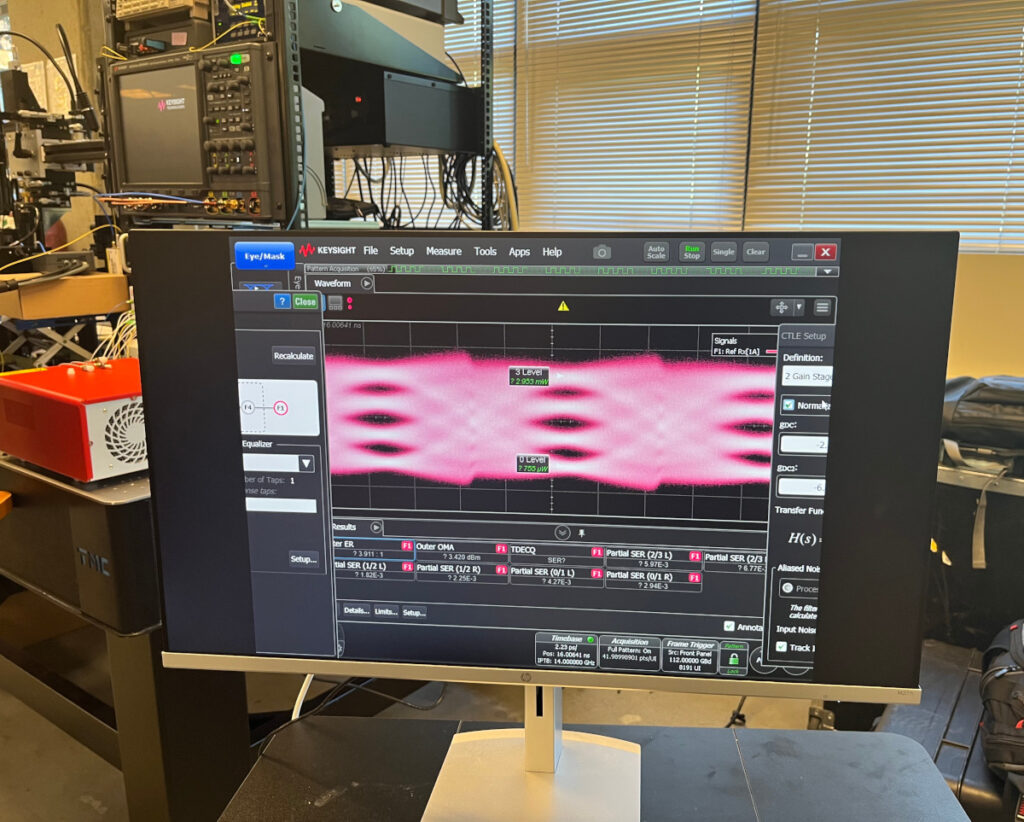
Startups in this space often talk a good game about what their technology can do, but NLM has started to put numbers on the table. Last year, the company said outside testing confirmed that a 1.6-terabit chip combining silicon with its materials ran at 224 gigabits per second on each of eight channels. To put that in perspective, eight channels at that speed adds up to well over a terabit of data flowing through a single chip every second—and the efficiency gain was maintained while doing it. In March, NLM began sending samples of its 1.6- and 3.2-terabit chips to customers. It also took a pragmatic approach to manufacturing. Rather than trying to build its own fabrication plants, the company has worked to get its materials onto production lines that already exist. The chips sent to customers were made at GlobalFoundries, and NLM has built modulators using Tower Semiconductor’s high-volume silicon photonics process. That approach is much faster than building a new factory, and it means the company can focus on what it does best: developing the material and helping partners integrate it. But NLM is not working in a vacuum. Lightwave Logic, a publicly traded Colorado company also developing organic modulator materials, named NLM among its smaller competitors in its 2024 annual report. HyperLight, a Harvard spinout using a crystal called lithium niobate instead of an organic material, has raised $117 million, including an $80 million round in June led by MediaTek. The existence of well-funded competitors validates the market opportunity, but it also means NLM cannot afford to rest. Its answer is to combine the performance advantages of its material with manufacturing partnerships that allow fast scaling.
The real story behind this funding round is the race to build a more sustainable AI infrastructure. The AI boom has created a seemingly insatiable demand for computing power, and data center operators are struggling with two problems at once: they need more capacity, and they need to keep power consumption under control. For a typical AI training run, moving data between chips and servers accounts for a large share of the total energy consumed. If NLM’s Selerion material can deliver the promised order-of-magnitude efficiency improvement, it could help break that bottleneck. The company is still early in its commercial journey, and there are plenty of challenges ahead. Scaling up production of a specialized organic material is hard; convincing chipmakers to adopt a new material in a high-volume process is even harder. There will be technical hiccups, skeptical engineers and well-funded rivals. But NLM now has the pieces in place to give it a real shot: a strong scientific foundation, a leadership team with experience in both startups and large companies, manufacturing partners like GlobalFoundries and Tower Semiconductor, test results that back up its claims, and a round of funding that brings in both financial and strategic support. It has gone from a university lab project to a company sending terabit-scale chips to customers. The next year or two will be a critical test. If Selerion lives up to the hype, it could become a hidden hero inside the machines that power the AI era. If it stumbles, another material will likely take its place. Either way, the journey of this Seattle startup says a lot about how innovation happens—slowly, patiently, and with the help of many hands.