







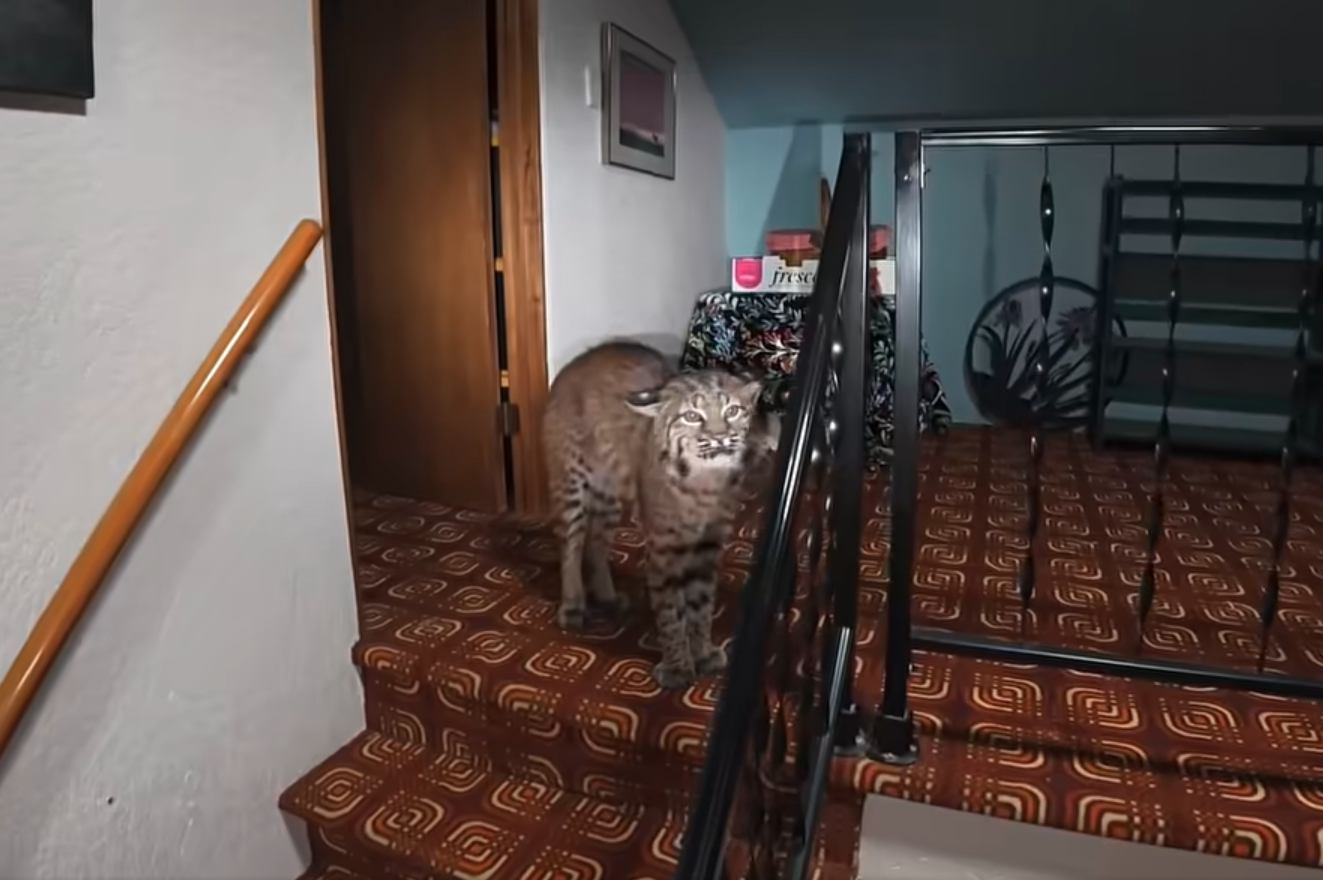
On a seemingly ordinary morning in the quiet Moss Bay neighborhood of Kirkland, Washington, residents were startled by a commotion that sounded far too heavy for a squirrel or a stray cat. Loud banging echoed from inside a home, prompting a worried resident to call 911 and report what they believed was a break-in. Police officers rushed to the scene, fully prepared to confront a human intruder, perhaps a burglar or a disoriented stranger. But when they arrived and peered into the home, they found something far more unexpected, and far wilder: a live bobcat, perched confidently at the top of the staircase, looking less like a criminal and more like an uninvited guest who had decided to make itself comfortable. The initial tension of a potential home invasion quickly dissolved into a moment of sheer disbelief, as officers realized their suspect had four legs, tufted ears, and a short, stubby tail. It was a scenario that no amount of training could have fully prepared them for, and one that would soon require a creative, high-tech solution to resolve safely.
The Kirkland Police Department, like many modern law enforcement agencies, has embraced drone technology as a critical tool for high-speed pursuits, search-and-rescue operations, and documenting complex scenes. But deploying a drone inside a home to track a bobcat was a first even for them. With the wild animal at the top of the stairs, officers knew that approaching too closely could spook the cat and trigger a dangerous defensive reaction. A frightened bobcat, though not typically aggressive toward humans, is still a powerful predator with sharp claws and teeth, fully capable of inflicting serious injury if cornered. So instead of rushing up the stairs, the officers stepped back, launched a small unmanned aircraft, and guided it through the front door. The drone hummed quietly as it ascended the staircase, its camera feeding live video back to the officers outside. From a safe distance, they could monitor the bobcat’s every move without adding to its stress. The surreal sight of a high-tech police drone hovering in a suburban living room, illuminating a wild cat with its lights and camera, must have felt like a scene from a science fiction movie, yet it was a practical and compassionate way to handle a delicate situation.
The standoff continued for a short while as officers used the drone to gently steer the bobcat away from open areas and toward a more contained space. Their goal was not to harm the animal but to keep it safe and isolated until the right authorities could arrive. Eventually, the bobcat was corralled into a separate room, where it waited, likely confused and anxious, for the Washington Department of Fish and Wildlife to take over. When the wildlife officers arrived, they brought the tools and expertise needed to handle the situation with minimal stress to the animal. A sedative was carefully administered, and once the bobcat was calm, it was transported to a nearby natural area and released near Forbes Creek, a habitat closely matching the one it had wandered from. The entire ordeal ended peacefully, with no injuries to the resident, the officers, or the animal itself. It was a reminder that wildlife encounters in suburban areas are increasingly common, and that patience, technology, and collaboration between law enforcement and wildlife experts can lead to outcomes that respect both human safety and animal welfare.
How the bobcat got inside remains a bit of a mystery, but investigators believe they have pieced together the most likely sequence of events. The wild cat probably climbed a tree near the home, spotted an open window, and decided to leap through it, perhaps drawn by movement or scent from the resident’s pet cat. That household feline, fortunately, was later found hiding and unharmed, likely terrified by the sudden appearance of a much larger and wilder cousin. It is not unusual for bobcats to venture into residential areas, especially in the Pacific Northwest where human development increasingly overlaps with natural wildlife corridors. They are curious, opportunistic hunters, and prey like rodents or small pets can lure them closer to homes. In this case, the resident’s cat may have unintentionally acted as bait, catching the bobcat’s attention from outside and prompting the dramatic entry through the window. Once inside, the bobcat probably explored the unfamiliar space, knocking things over and causing the loud banging that had initially been mistaken for a burglary in progress.
This unusual indoor mission is a testament to how far Kirkland’s public safety drone program has come since its launch in 2022. What began as an experimental effort to give first responders a bird’s-eye view of emergencies has grown into a central component of the city’s public safety infrastructure. The program is managed collectively across the Police, Fire, and Public Works departments, ensuring that resources are shared and that no single agency bears the full burden of operating the technology. Currently, the program maintains five aircraft and relies on 17 FAA-licensed pilots who have undergone specialized training for tactical searches, search-and-rescue missions, and scene documentation. These pilots are not just remote-control enthusiasts; they are trained professionals who understand how to fly in challenging environments, read real-time footage, and coordinate with ground teams. The bobcat incident showcased a new dimension of that training: precision flight indoors, in tight spaces, while maintaining a non-threatening presence. It proved that drones are not only useful for wide-open aerial views but also for close-quarters situations where human safety and animal welfare are both at stake.
While the story of the wandering bobcat has a happy ending, it also serves as a useful reminder for residents in areas where wildlife is common. The Kirkland Police Department, drawing on this experience, has offered simple advice for anyone who finds a wild animal inside their home: move people and pets away from the area immediately, do not attempt to corner or capture the animal, and call 911. Keeping a safe distance is important, because even animals that appear calm can act unpredictably when frightened. Closing internal doors to isolate the animal can help, as can opening windows or exterior doors to give it an escape route, but only if doing so does not put anyone at risk. In the end, this strange encounter is less about a bobcat in a staircase and more about the evolving relationship between humans, technology, and the natural world. As cities continue to expand into wild habitats, moments like these will only become more common. But with thoughtful response protocols, well-trained drone pilots, and a spirit of cooperation, communities like Kirkland are showing that it is possible to handle the unexpected with skill, compassion, and a touch of wonder.