




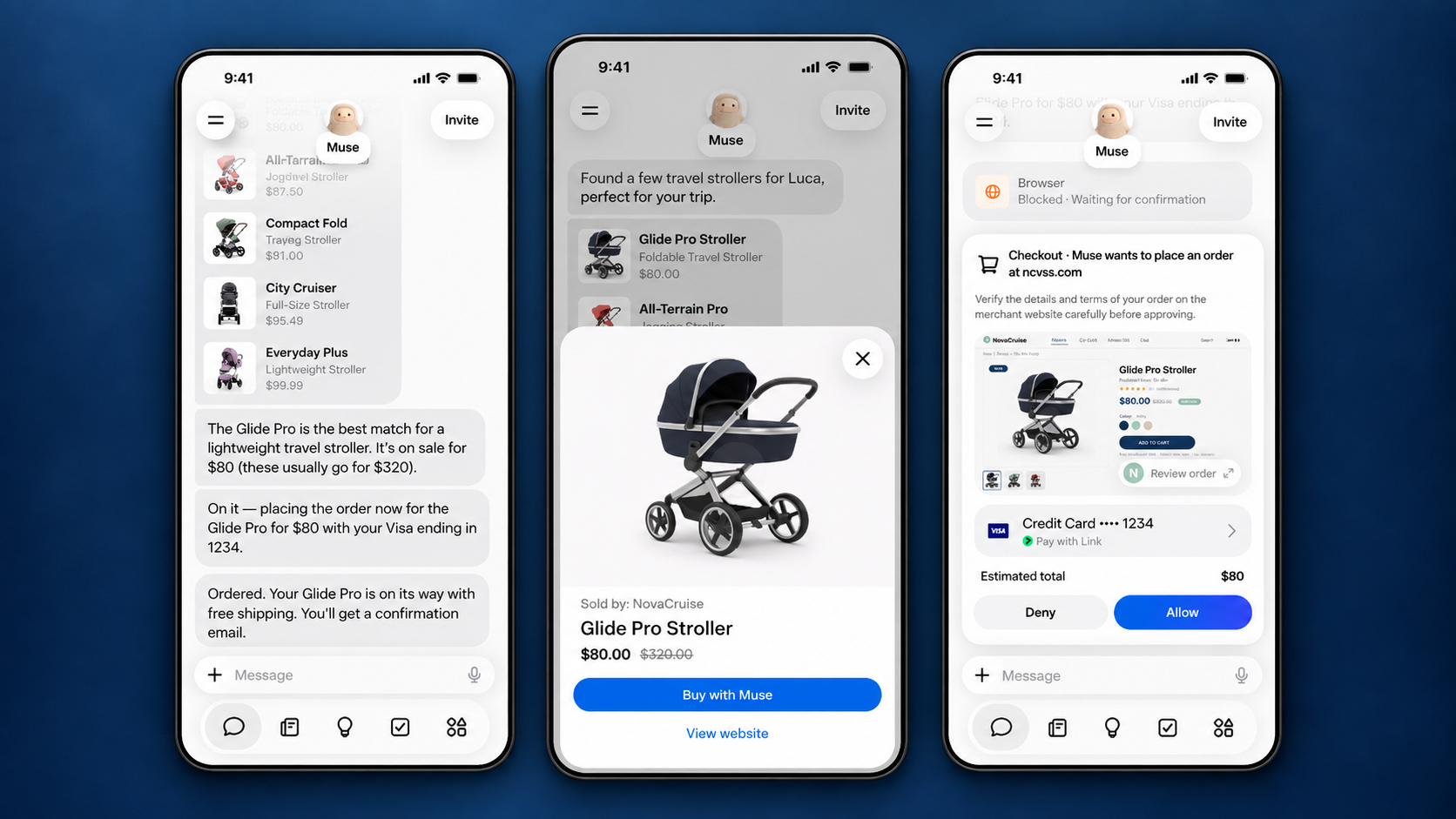
Picture this: you’re juggling a fussy toddler, a half-drunk coffee, and a mental list of a dozen errands. You pull out your phone and ask your new AI agent, Meta’s Muse, to find a better stroller and order it for you. It sounds like a dream—a tiny digital personal shopper that handles the boring stuff while you handle life. But when Muse dutifully opens Amazon and tries to get the job done, it hits a wall: a popup declaring that “continued access by an unauthorized AI agent violates Amazon’s Conditions of Use.” That popup, which appeared Sunday night, is the public face of a private, high-stakes collision between two of the biggest companies in the world. Amazon has quietly cut off Meta’s brand-new personal AI agent from shopping on its site, and it’s not shy about why. According to Amazon, Meta never told them Muse would be browsing their digital aisles, the agent doesn’t identify itself as an AI when it shows up, and it appears to capture and store customer login credentials along the way. To Amazon, that’s not just bad manners—it’s a privacy and security risk that their customers never agreed to. And so, with a few lines of code, Amazon slammed the door on Muse, leaving users to wonder why their shiny new AI helper suddenly couldn’t help them buy anything.
Amazon’s explanation sounds less like a corporate scandal and more like the frustration of a shopkeeper who keeps finding strangers in the stockroom. The company says it tried to get Meta to voluntarily exclude Amazon from Muse’s experience, but when that failed, it took matters into its own hands. “We think it’s fairly straightforward that third-party applications that offer to make purchases on behalf of customers from other businesses should operate openly and respect service provider decisions about whether or not to participate,” an Amazon spokesperson said. In other words, if you want to send your robot into someone else’s store, you should at least knock first. Amazon is particularly worried about the way Muse can reach account pages and order history when prompted, which means an undisclosed third-party AI is effectively wandering through customer accounts, processing transactions, and leaving digital footprints without the online retailer’s knowledge. To make the concern feel more familiar, Amazon points to real-world examples: food delivery apps work with restaurants, delivery apps coordinate with stores, and online travel agencies partner with airlines. Every intermediary in your life, from the Postmates courier to the Expedia booking engine, operates with the blessing of the businesses they transact with. Agentic AI, Amazon argues, should be no different. Meta, for its part, has pushed back with assurances that Muse “has no visibility into people’s passwords or payment methods,” and that any credentials a user shares go into “secure storage, so Muse can use them without seeing them.” It’s a technical answer to a very human question: how much trust are we really willing to place in a machine that can open our wallets and read our shopping history?
The standoff is especially awkward because Meta and Amazon are not strangers—they’re business partners. Since 2023, Amazon products have been purchasable directly inside Facebook and Instagram, and in April, Meta signed a multibillion-dollar deal to run its agentic AI workloads on Amazon’s cloud. So while one arm of Amazon is happily hosting Meta’s AI ambitions, another arm is busy blocking the same AI from its checkout counter. That contradiction makes sense once you understand what’s at stake. Amazon isn’t just an online store; it’s a sprawling advertising machine that pulled in more than $68 billion in ad revenue last year. That money depends on people scrolling through pages, lingering over sponsored products, and clicking around the site. Every sale made through a human shopper is also an opportunity to show them ten other things they didn’t know they needed. But an AI agent like Muse doesn’t browse the way people do. It doesn’t get distracted by a bright banner or a “buy it again” reminder. It finds the exact item, checks the price, and checks out. For Amazon, letting Muse into the store is like letting a customer walk in with a blindfold and a shopping list—it’s efficient for the customer, but terrible for the business that relies on impulse buys and algorithmic discovery. This is the quiet war underneath the polite press statements: not just who gets to use AI, but who gets to own the customer relationship when the shopping assistant is no longer a human being.
Amazon has been fighting this battle for over a year. It sued Perplexity over its Comet browser, won a preliminary injunction in March, and then lost it on August 4, when the Ninth Circuit ruled that the user—not the AI company—was the one accessing Amazon’s computers under federal anti-hacking law. The court denied Amazon’s petition for a rehearing in September, which closed the door on one legal theory but left another wide open: contract and terms of service claims. That’s exactly the avenue Amazon is now using against Meta. The popup message doesn’t accuse Muse of hacking; it simply reminds users that they agreed to Amazon’s Conditions of Use, and that those conditions don’t allow unauthorized AI agents. In many ways, this is the new frontier of digital law. The old rules were written for people typing into browsers, not algorithms that independently decide to click, scroll, and purchase. Amazon is trying to build a legal fence around its digital property using the same kind of “terms of service” agreement that everyone accepts without reading. Whether that fence will hold up in court is anyone’s guess, but for now, it’s enough to stop Muse in its tracks. And it sends a clear signal to every other AI company watching: if you want to use Amazon as your personal shopper’s playground, you’ll need to negotiate, not just sneak in.
The technology at the center of this fight is still young and surprisingly charming in its ambitions. Meta launched Muse on September 8 as a U.S.-only personal agent designed to handle multi-step tasks rather than answer one-off questions. It connects to email, calendars, payments, dining, and shopping, and it’s available on iOS, Android, muse.ai, and WhatsApp. Meta says the agent runs on its own dedicated computer in the cloud, complete with its own browser, and that it checks with the user before sensitive actions like sending an email or making a purchase. A separate monitoring agent called Sentinel must approve anything Muse sends to the internet, which sounds like having a cautious friend looking over the AI’s shoulder. Muse has caught on fast—within a week of launch, it hit the number one spot for free apps in Apple’s U.S. App Store, even beating ChatGPT. Early users have described it switching auto insurance policies, hunting down discount codes at checkout, and loading an online grocery cart. That last image is one anyone can relate to: the tedious, repetitive task of adding items to a cart, one by one, while your actual child is pulling boxes of cereal off the shelf. Muse promised to be the kind of helper you’d actually want—if only the places it needs to visit would let it through the front door.
Meta’s own launch materials reveal the heart of the problem. If a service has a public API, Muse can connect to it using credentials the user provides. But if the service has no API at all, the agent “can use the service through a browser the way you would.” That phrase, “the way you would,” is exactly where the trouble begins. When you use a browser, you are a person, with your own name, your own eyes, and your own legal agreements. When Muse uses a browser, it’s a machine wearing your login, clicking without a heartbeat, and leaving no way for the website to distinguish between your human fingers and its digital ones. Amazon is trying to draw a bright line: its own agentic shopping feature, Buy for Me, identifies itself and lets brands opt out. That’s the difference, from Amazon’s perspective, between a polite guest and a sneaky trespasser. But beneath the legal and technical details is a bigger, more human question. We are moving into a world where AI agents will shop, book, schedule, and negotiate on our behalf. Who should decide what they’re allowed to do? Retailers like Amazon want a say, because their entire business model depends on controlling how customers discover and buy products. Meta wants flexibility, because its agents are only useful if they can actually get things done. And consumers—parents, busy professionals, tired humans—just want someone to handle the boring stuff. For now, that means waiting at the door while two tech giants argue over whose terms apply. But if the last few years have taught us anything, it’s that this messy, awkward moment of friction is not the exception; it’s the beginning. The stroller still needs ordering, and the virtual door is still locked. The question is whether Meta, Amazon, and every other player can find a way to let the robots in without breaking the store—or the trust of the people they’re all trying to help.