





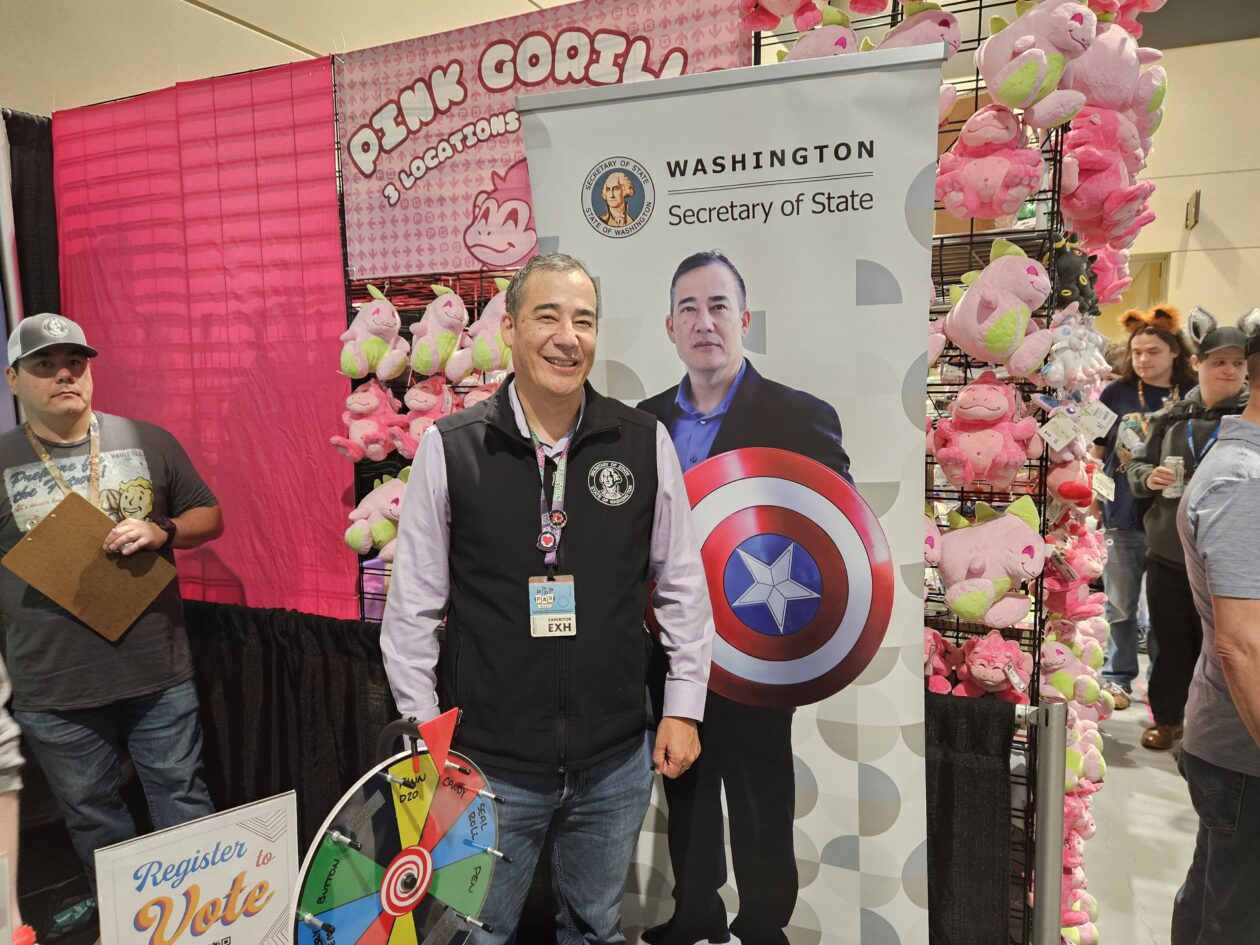
If you wander into the main expo hall during the Penny Arcade Expo, you quickly learn that the real show is often at the edges of the room. The big aisles are packed with major publishers, flashing screens, and long lines for demo stations, but the periphery is where you find the strange and wonderful: rare imports, designer T-shirts, blind boxes of collectible merchandise, and, if you’re lucky, an elected official with a prize wheel. At the 2026 PAX, held over Labor Day weekend at the Seattle Convention Center, that official was Steve Hobbs, Washington’s secretary of state since 2021. For three days, Hobbs stood in a booth that looked more like a festival activation than a government outreach effort. Visitors could spin a wheel and win buttons, collectible pins featuring the office’s official mascot Finn, custom 20-sided dice with Finn on the 20 face, and free snacks. It was a cheerful, slightly surreal sight: a serious civic leader surrounded by gamers, dice, and candy. But Hobbs had a clear answer for anyone who wondered what he was doing there. “It’s twofold,” he told me. “One, this is a great opportunity for me to reach out to the gaming companies here in the state of Washington and look for opportunities for them to go overseas, linking up some of these indie game developers with major publishers. The rest of it is civic engagement. Just reminding people, hey, don’t forget to vote. Don’t forget to check your registration.” That mix of trade policy and voter outreach was unusual, but it made a certain kind of sense in a room filled with thousands of people who might otherwise never think about what their secretary of state does.
The civic engagement side of Hobbs’s PAX appearance was perhaps the most straightforward. Washington state runs a vote-by-mail system, which means every registered voter automatically receives a ballot. Those ballots can be returned by mail or deposited in official drop boxes, and Hobbs was using his time at PAX to urge people to choose the drop-box option. He described it as “a low-key fight with the USPS,” and he wasn’t exaggerating. In August, Washington and 24 other states had sued to block a U.S. Postal Service rule that would have required new barcodes on ballot envelopes, arguing that it could delay delivery and confuse voters. The Supreme Court kept the rule from taking effect on Sept. 14, a few days after the PAX interview, but the underlying tension remained. For Hobbs, showing up at a gaming convention was one way to remind people that voting is not an abstract concept. “Look, PAX is where all the young people are at, right?” he said. “This is a very diverse, young community, and this is where we need to engage people.” That’s a savvy observation. Government outreach often happens in community centers, libraries, and online town halls, but those places don’t always reach a younger, more diverse audience. PAX, by contrast, is a gathering of exactly the kind of people who will shape the next few election cycles. By putting his booth in the middle of the chaos, Hobbs was doing something quietly radical: treating gamers as citizens first, not just consumers. And if the prize wheel got them to check their voter registration, then the free dice and pins were doing real democratic work.
But the more interesting story was the one that happened behind the scenes. On the Thursday night before PAX officially opened, Hobbs’s office hosted a networking event in Seattle that had nothing to do with voting and everything to do with economic development. Local companies in the tabletop gaming industry were invited to meet with international game publishers from Japan, Poland, and other countries. It was a closed-door event, and only a few exhibitors even knew about it, but it was the clearest signal yet that the secretary of state’s office is thinking about games as a serious industry. Washington doesn’t make nearly as much noise about this as it could, but the state is one of the biggest centers for tabletop and board game design in the United States, if not the biggest. The industry ranges from Renton-based Wizards of the Coast, the powerhouse behind Dungeons & Dragons and Magic: The Gathering, to one-person indie creators who make card games as a hobby. According to Hobbs’s office, tabletop gaming in Washington is a $2 billion industry. That’s a remarkable number, and it explains why the secretary of state would take an interest. The office is best known for its core duties of running elections and registering businesses, but state law also directs the secretary of state to develop a citizens’ exchange program that promotes ties with other nations, which “may result in increased tourism, business relationships, and trade.” In other words, international trade promotion isn’t a side project for the office; it’s part of the actual job description. Hobbs has embraced that mandate with a focus on dice and game boards, and the Thursday-night event was the latest example of how he’s turning that legal authority into real business connections.
The mechanics of Hobbs’s trade mission are surprisingly hands-on. When Washington indie game developers want to break into international markets, one of the biggest barriers is cost. Flying to another country, setting up a booth, and pitching to foreign publishers can be prohibitively expensive for a small studio. So Hobbs’s office helps in concrete ways. “What we do is help these indie game developers get access to foreign markets by putting on these trade missions,” Hobbs explained. “What we’ll do is provide the booth [at international gaming conferences, such as Game Market in Tokyo], which is the most expensive thing. We will also help them navigate through the federal grant process in order to mitigate some of the costs over there.” Once the booth is secured, the office works its connections with the U.S. State Department and the host nation’s commerce department to set up meetings with major publishers and distributors. “We have really strong ties with the German and Japanese governments,” Hobbs said, “and we actually get these people to do their pitches with the major publishers in Europe and Japan.” The results are already tangible. Hobbs pointed to Lethal Shadows, a Snohomish County business that specializes in premium tabletop miniatures. With help from his office, Lethal Shadows formed a partnership with a Lithuanian company, and the extra business has transformed the company’s operations. According to Hobbs, the business moved from a garage to a warehouse and is now hiring more employees. That’s the kind of success story that doesn’t make headlines, but it matters. It shows that a state government can play matchmaker for small businesses in unexpected industries, and that a little bit of diplomatic support can go a long way for a company that might otherwise never think about selling its products overseas.
Given Washington’s massive video game industry, though, it is fair to ask why the secretary of state’s office is focusing on tabletop games instead of the much larger digital gaming sector. Washington is home to major studios and a deep talent pool, and the economic opportunity there is enormous. Hobbs acknowledged the gap without hesitation. “It’s more of a lack of bandwidth,” he said. “We want to take baby steps. We didn’t want to take a big step into it. And frankly, I didn’t realize that it was important to go to these conventions. In Japan, Germany, and Poland, we’re seeing if there might be an opportunity to do the same thing on the digital side.” It’s a candid answer, and it suggests that the tabletop focus is not a rejection of video games but a deliberate starting point. Tabletop gaming is more relationship-driven and easier to navigate in terms of trade missions; a single booth at a Tokyo game fair can introduce a dozen small publishers to the right partners. Digital games, by contrast, involve complex distribution platforms, international licensing, and a global online marketplace that doesn’t necessarily require the same kind of hands-on matchmaking. But Hobbs is clearly thinking about the next step. “I believe trade must go two ways,” he said. “We need to support each other.” That philosophy could eventually turn the office’s attention to Washington’s video game ecosystem, helping local developers find partners in Europe and Asia just as it has done for tabletop creators. For now, the tabletop industry is serving as proof of concept—a way to learn how trade missions work, what kind of support small creators actually need, and how a state office can be genuinely useful to an industry that doesn’t usually think of government as a partner.
In the end, Hobbs’s booth at PAX was a small, friendly reminder that government doesn’t have to be distant or intimidating. A 20-sided die with Finn the mascot on the 20 face is not just a piece of swag; it’s an invitation to engage. It says that the secretary of state’s office is willing to meet people where they are, even if that means setting up shop next to a booth selling limited-edition plushies. Hobbs was at PAX for two reasons: to help Washington’s game companies grow internationally, and to remind a young, diverse crowd that their votes matter. Both of those goals are about building something larger than a single transaction. The trade missions are designed to create long-term relationships between local creators and international partners, and the voter outreach is designed to build a more engaged electorate. It’s an unusual combination, but it might be exactly the right one for a world where attention is scarce and trust in institutions is fragile. By showing up at a gaming convention, spinning a prize wheel, and talking about drop boxes and foreign publishers with equal enthusiasm, Hobbs demonstrated that public officials can be both useful and approachable. The PAX-goers who walked away with a button or a custom die may not remember every detail of Washington’s election procedures, but they’ll remember that the secretary of state was there, listening and talking to them like fellow humans. In an age when politics often feels like a distant, bitter spectacle, that’s a surprisingly hopeful message. For Hobbs, it’s not just about one weekend in Seattle; it’s about building a bridge between the state government and the creative communities that make Washington a special place. And if that bridge is paved with dice and good intentions, so be it.