





Paragraph 1: The Shocking Revelation on a Quiet Evening
It began, as so many epoch-shifting moments in the modern age do, not with a formal phone call, a sealed letter, or a knock on the door, but with the cold, flickering glow of a television screen. Sylvester Stallone, the 80-year-old titan of American cinema, the man whose chiseled jawline and weary eyes have defined the underdog archetype for generations, was engaging in a pastime as ordinary as any other: watching TV. It was a moment of pure domestic stillness, a rare pause in a life that has been a relentless barrage of scripts, sequels, and rigorous physical transformation. And then, in a flash of breaking news chyron, his world tilted on its axis. The newscaster, with the casual cadence of delivering a weather report, rattled off a list of names that included Stallone’s own. They were being appointed as special ambassadors to Hollywood by the newly re-inaugurated President Donald Trump. As the words sank in, a wave of utter bewilderment washed over the veteran actor. He had not been consulted, not been warned, and certainly had not sought the position. In his recollection, he sat there, mouth agape, a singular, incredulous thought pounding in his skull: “What?” It was a visceral, human reaction—the jarring collision of a private life with a colossal public spectacle. There was no time to prepare, no carefully crafted press release or diplomatic smile. Just the stark, unfiltered realization that his name had been thrust into the political arena, a realm he had spent decades studiously attempting to avoid. He later admitted that had the president’s team approached him beforehand with the offer, his answer would have been an immediate and absolute refusal. The very foundation of the proposal felt fundamentally impossible to him, a mismatched puzzle piece that could never fit the reality of how the industry, or he himself, actually operated. The shock wasn’t flattery; it was pure, unadulterated disbelief that his quiet evening had been hijacked by the chaotic machinery of Washington D.C.
Paragraph 2: The Mandate and the Immediate Pushback
The official decree, issued by the President in January 2025, was grandiose in its typical, unfiltered style. Trump, also 80, celebrated the appointment of Stallone, alongside fellow Hollywood legends Mel Gibson and Jon Voight, as his “Special Envoys” tasked with a monumental, almost mythic mission: to bring Hollywood, which the president claimed had lost significant business to foreign countries over the previous four years, back—and to make it bigger, better, and stronger than ever before. The language was characteristically bold and declarative, positioning these three cinematic titans as his “eyes and ears” in the industry, promising to execute whatever suggestions they proffered. For a president who revels in the spectacle of celebrity—who built a career on the synthesis of fame and power—the selection made a kind of raw, strategic sense. It harnessed the star power of three men who were unapologetic in their conservative leanings, using them as cultural battering rams to penetrate a notoriously liberal bastion. Yet, for Stallone, the offer was less an honor and more of a logistical and existential paradox. He immediately recognized the immense chasm between the theatricality of politics and the gritty, financial pragmatism of Hollywood. The president’s vision, as compelling as it sounded in a rally speech, ignored the fundamental complexity of an industry governed by billion-dollar conglomerates, global tax incentives, and the fickle whims of streaming algorithms. Stallone, the action hero who made his name portraying characters who fought against corrupt systems, recognized a losing battle when he saw one. He realized that accepting the role would be akin to walking into a boardroom as a decorative fixture rather than an executive. The phrase “impossible” was not an excuse but a clear-eyed assessment of reality. He understood that the corporate structures of Hollywood do not respond to celebrity ambassadors; they respond to spreadsheets, profit margins, and shareholder value—areas where an actor—even one as iconic as Rocky Balboa—holds no dominion.
Paragraph 3: The Political Atheist and the Maverick’s Code
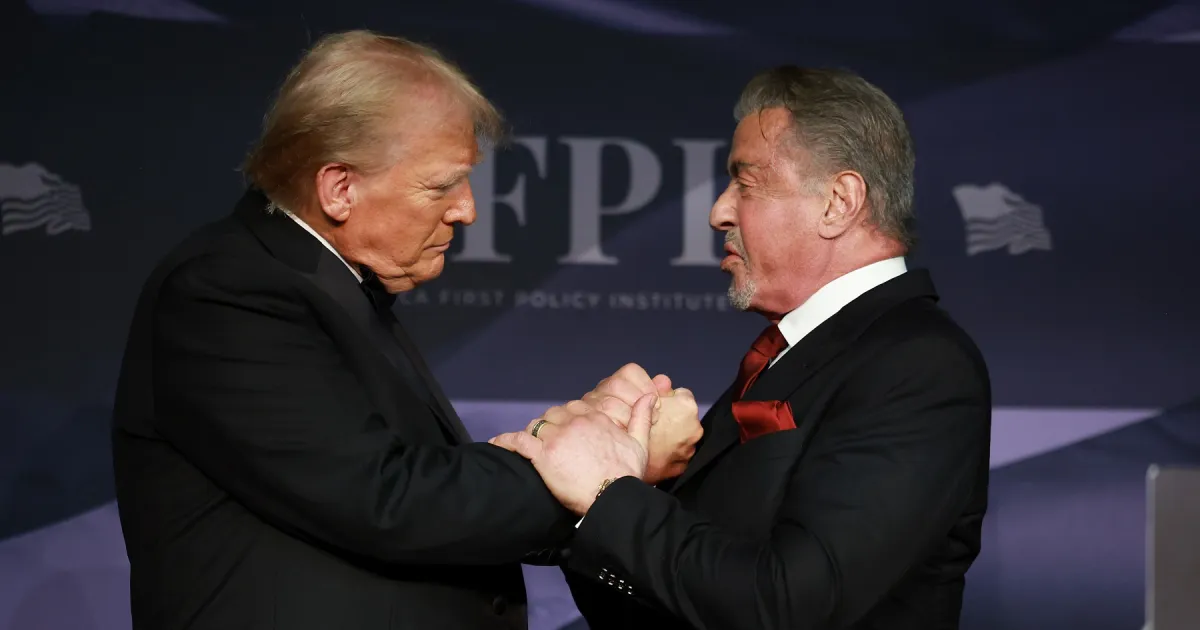
Stallone’s public declaration that he is “not a political animal” but rather “almost a political atheist” serves as the foundational key to understanding his reaction. It is a profound insight into the mind of a man who has spent fifty years navigating the treacherous waters of public opinion. Unlike many of his peers who wear their political affiliations on their sleeves—or, in the case of some, tattoo them on their foreheads—Stallone has historically maintained a quasi-mystical distance from the partisan fray. He has stood alongside Donald Trump at Mar-a-Lago, offering a heartfelt introduction following the 2024 election, yet he has also expressed admiration for leaders on the other side of the aisle over the years. He has donated to various candidates, backing the person over the party, often prioritizing competence and perceived strength over ideological purity. This is a man who believes in the individual, the self-made hero, the isolated warrior fighting for a cause, not the bureaucratic machinations of a party system. Viewed through this lens, the ambassadorship was a square peg being forced into a round hole. Stallone’s identity is built on the bedrock of autonomy; his most famous characters, Rocky and Rambo, operate outside the system, achieving victory through sheer grit, suffering, and personal sacrifice. The idea of becoming an institutional envoy, a conduit for governmental policy, violated a core tenant of his public and personal persona. He wasn’t rejecting Trump specifically; he was rejecting the very concept of a political title being grafted onto an artistic soul. He acknowledged that Hollywood is a highly territorial, factional environment. In his own words, it operates like “feudal states,” where powerful studio heads rule their respective fiefdoms. To think that a trio of actors—self-confessed “do-our-own-thing people”—could commandeer these kingdoms with governmental backing was, to him, a fantasy of the highest order.
Paragraph 4: The Feudal Kingdoms and a Humble “Ciao”
Expanding on his feudal analogy, Stallone painted a picture of an industry that is less a united front and more a fragmented assembly of fiefdoms. He did not view himself as a lord or a conqueror, but rather as a veteran craftsman who knew his place within this complex hierarchy. He confessed that telling six massive studios how to conduct their business was an exercise in futility. These are entities that have weathered strikes, pandemics, and the decimation of the theatrical release model; they are not likely to turn their decision-making over to a committee of actors, no matter how beloved. The humility in his rejection was striking. He didn’t view the title as a validation of his status; rather, he saw it as a futile gesture that would ultimately result in frustration for all parties involved. He envisioned the inevitable stalemate: corporate executives listening politely to his ideas about creative integrity while simultaneously ignoring his suggestions about revamping financial structures or tax rebates. He understood that the power in the film industry resides with the suits in the executive suites, not the stars on the call sheet. With a poignant finality, Stallone stated that he effectively told the White House, “Thank you and ciao,” because it was simply impossible. He gracefully extracted himself from a situation that promised endless frustration. There was no bitterness in his tone, only the resigned wisdom of a man who has survived in the industry for half a century. He knows the business of show business. He recognizes that while artists provide the soul, the heart of the industry beats to the rhythm of finance. To suggest that he could go in and lecture the “corporate people” on their own domain was a conflict he refused to step into, preferring instead to retreat to the familiar, comfortable ground of his own acting and writing.
Paragraph 5: Jon Voight’s Counterpoint and the Hope for Revival
While Stallone retreated from the political frontlines, his fellow appointee, Jon Voight, embraced the challenge with a distinctly more optimistic, forward-looking perspective. In a separate interview with The Hollywood Reporter earlier in the month, Voight, 87, displayed a palpable excitement regarding the potential to revitalize the industry under the Trump administration. He posited that a golden age is not only possible but imminent, provided the correct economic policies are implemented. In stark contrast to Stallone’s pragmatic skepticism, Voight articulated a vision focused on the rollback of corporate taxes and the introduction of beneficial tax breaks that would level the playing field against other countries. He confidently asserted that if the industry achieved an “even keel with the rest of the world’s tax benefits,” there would be an immediate explosion of energy. Voight used the phrase “shovel-ready business” to describe the entertainment industry, suggesting that the apparatus is fully intact, just waiting for the signal to begin production again. He painted a vivid picture of an industry on the precipice of a massive hiring spree, where calls would be made the very next day, and crews would mobilize instantly across the country. His belief was not just in the studios, but in the communities that rely on production—the grips, the electricians, the caterers, the craftsmen—who have suffered from the exodus of filming to overseas locations. He saw the role not as a diplomatic mission to dictate to studios, but as a legislative advocacy group, pushing for the impenetrable economic incentives that would make Hollywood the logical choice for production again. It is a fundamental difference in approach: Voight sees the problem as a fiscal one, easily solved with pen strokes on a tax bill, while Stallone sees the problem as an immutable cultural and corporate edifice.
Paragraph 6: The Human Resolution and the Two Faces of Hollywood
The divergent reactions of Stallone and Voight encapsulate the complex, often paradoxical, relationship between celebrity and power in America. We are left with two men of remarkable talent, looking at the same political offer and arriving at opposite conclusions. Stallone, the man who embodies the strident, self-reliant individualist, ultimately chose to remain on the sidelines, guarding his autonomy fiercely. His “ciao” was not a rebuke of patriotism or a rejection of the President, but a quiet, dignified retreat to authenticity in the face of a theatrical spectacle. He prefers to let his work speak for him, rather than a title. He embodies the blue-collar grit of his characters, understanding that real change in an economic powerhouse like Hollywood requires more than star wattage; it requires a massive bureaucratic redrawing that he feels ill-equipped to manage. Meanwhile, Voight’s burning hope serves as a testament to the enduring allure of American exceptionalism—the belief that a fix is always possible, that the machine can be mended with the right turning of a screw. He represents the optimistic, patriotic elder statesman, longing for the industry of his youth to flourish once more on home soil. Neither man is wrong. Stallone’s humility is as compelling as Voight’s vision. The entire episode—the unexpected TV announcement, the frantic rush of headlines, the interview clarifications—reveals a deeply human truth: even the most powerful figures in entertainment are often swept up in the currents of a political landscape they cannot control. In the end, Stallone remains the reluctant icon, an artist who accidentally found himself drafted into a war he had no intention of fighting. His story is a reminder that true strength often lies in knowing one’s limits and having the courage to politely decline the crown, opting instead for the quiet peace of one’s own convictions, even as the cameras flash and the titles are handed out. He chose to be the artist, not the ambassador, proving that some heroes, even when offered the world, prefer to remain on the outside looking in.