





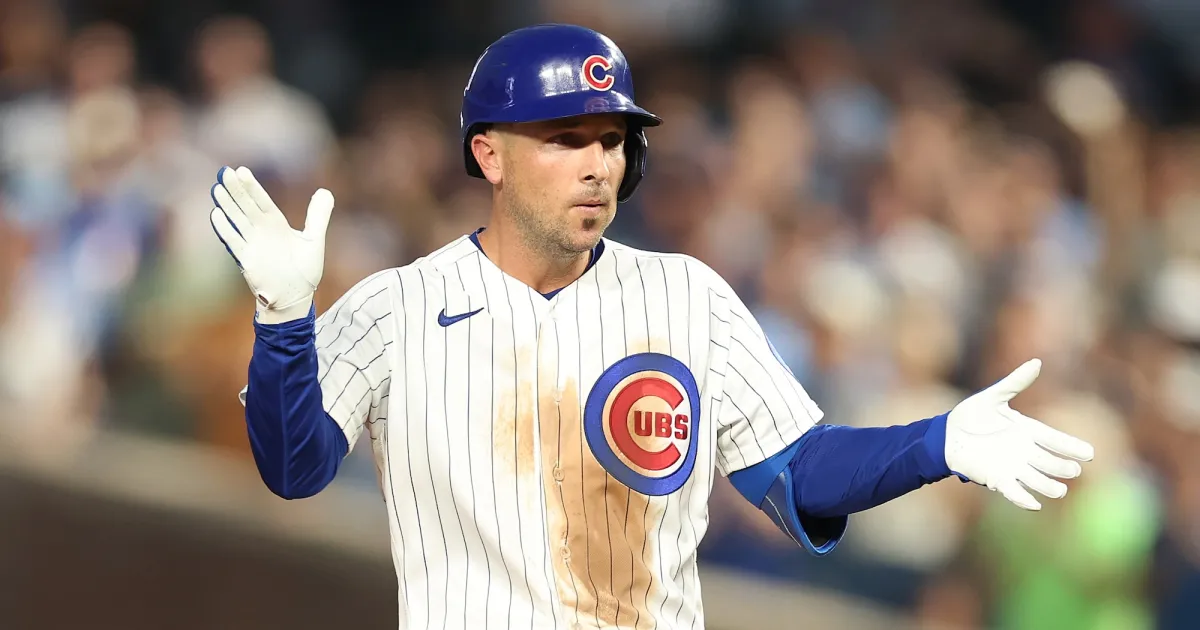
In the fourth inning of what would become a 9–1 victory for the Chicago Cubs in Cincinnati, the raw and frightening randomness of baseball arrived without warning. Alex Bregman, the Cubs’ veteran infielder, was standing in the on-deck circle watching teammate Michael Busch work an at-bat against Reds pitcher Luis Mey. The pitch was delivered with serious velocity, and Busch, trying to hold up on a swing, made contact that sent the ball screaming foul. Where it went was something no one ever wants to see. The ball struck Bregman flush near his left cheekbone, just below his eye, a violent and direct hit that instantly dropped him. Bregman’s hands went to his face as the ballpark sound shifted from the crack of the bat to a collective, stunned hush. Cincinnati fans, Cubs fans, players on both sides, umpires, and dugouts all stopped. Busch, realizing what had happened, dropped to his knees in visible distress. Bregman was surrounded by athletic trainers and coaches within seconds, and after a long, anxious moment, he was helped to his feet and guided carefully off the field. Later, Bregman tried to ease the worry that had rippled through baseball with two words. He took to his Instagram Story, sharing photos of his swollen, bloodied face, his left eye almost entirely shut, his cheek bruised and marked, and gauze tucked into his nose. “Thanks for all the messages yall,” he wrote. “I’ll be back.”
The image was hard to look at, but it also spoke to something deeper. In a sport that often celebrates toughness and the ability to shake things off, this was a reminder that real injuries can be terrifying. Bregman was heading to the hospital for X-rays and a CT scan, and the initial report from the Cubs was necessarily cautious. Manager Craig Counsell, a former major league infielder himself, stood before reporters after the game with a heavy expression. “He got hit in the left cheekbone essentially, under the eye,” Counsell said. “I don’t know anything more than that right now. He was bleeding from his nose a little. There’s some swelling. It’s a terrible, terrible accident. We hope he’s OK.” Counsell repeated the underlying sentiment several times, noting that the team hadn’t yet determined whether Bregman would travel with the club or be ready for the next game. For him, this wasn’t a question of lineup construction or playoff rotation. It was about a man’s health. “You know, we’ve got to get good results from the hospital,” he said. “He got hit in the face, so you’re worried just about his general wellbeing first. I want to get a good report first.” There is no cheer louder than a player walking off under his own power, and while Bregman’s exit from the field was assisted, the fact that he was upright and conscious offered some comfort.
What made the moment even more unsettling was how incidental it appeared on the surface. Busch, the Cubs first baseman, had not hit a line drive into the seats or a screaming comebacker to the mound. He was attempting to check his swing on an offspeed pitch, and the ball came off the bat awkwardly, knuckling and slicing toward a place no one expected. “It just happens so fast,” Busch said afterward. “[Luis Mey] is throwing the ball hard and it comes off hard. Any time it enters the head area, it’s always a scary thing. We try to focus on the game, but it’s tough. Hopefully he’s OK, first and foremost.” Those words came from a teammate who felt a kind of survivor’s guilt in that instant. Busch was not at fault, and no one would ever blame him, but baseball is a game of odd angles and split-second decisions. A foul ball that travels at ninety miles per hour and strikes an unprotected face can happen without intention, without malice, without warning. The human brain struggles to reconcile the calm of a summer diamond with the reality of blood on the ground. Busch’s body language, his knees buckling as he watched the trainers work, said more than any quote could. He was not thinking about the at-bat anymore. He was thinking about his friend.
Bregman, 32, is no stranger to the grind or expectations of big-league baseball. He signed a five-year, $175 million contract with the Cubs in January after a remarkable resurgence with the Boston Red Sox in 2025, when he reminded everyone why he was once an All-Star and a World Series champion. His arrival in Chicago was seen as a missing piece, a professional at-bat machine who could anchor an infield, provide leadership to a young core, and deliver in the moments that define October. He had been through slumps, injuries, playoff failures and triumphs, and the weight of his contract never seemed to bother him. But no amount of experience prepares you for the feeling of a baseball breaking through your defenses and hitting your face. The cheekbone is one of the most vulnerable parts of the body, a thin bone that protects the sinus and sits just below the eye. A direct impact can cause fractures, bleeding, vision problems, and swelling severe enough to close the eye completely. Bregman’s decision to share his face looking battered and bruised was quietly brave. He did not have to do that. He did not have to offer proof that he was hurting. But that small gesture, posting his own image with a message of gratitude and resolve, was his way of telling everyone who cared that he was still here, still fighting, and still planning to come back.
The Cubs immediately rallied around him, both emotionally and in the baseball sense. By the end of the night, the final score had been secured, but no one in the visiting clubhouse treated it as a comfortable win. “You just hope your friend is OK,” Cubs outfielder Pete Crow-Armstrong said. “That’s the news that I’m hoping for. But scary stuff. Such a rarity.” Crow-Armstrong is one of the most exciting young players on the team, and his reaction underscored how much Bregman meant to the club beyond his OPS or defensive metrics. In a baseball season that stretches from April to October, players spend more time with one another than they do with their own families. They watch each other hit in the cage, travel on planes, eat clubhouse meals, and talk late at night after bad games. When a teammate goes down, especially in such a sudden and violent way, it does more than ruin a good mood. It shakes the foundation. The Cubs had a larger context to consider too. They were not in the division race, but they were on the verge of clinching a wild card spot, and the postseason was set to begin on September 29. That meant the team could afford to be patient with Bregman, to let him heal, to prioritize his long-term health over any urgent need to win one game in late September. Still, at that moment, those considerations felt secondary. The only number that mattered was a player’s well-being.
In the days that followed, the cricket-chirping silence of a hospital hallway, the cold patience of waiting for CT scan results, and the enormous uncertainty of a facial injury hung over everything. X-rays could tell them whether the bone was fractured or merely bruised. A CT scan could reveal more subtle damage near the eye socket, the nasal passage, or the delicate structures that govern vision. The Cubs announced nothing official immediately, choosing their words with the care of a ballclub that understood the gravity of the situation. Manager Craig Counsell repeated his mantra about wanting good news, and everyone in the organization echoed that. Tuesday, September 22, was the next time the Cubs were scheduled to play, a home game against the Miami Marlins, but whether Bregman would be in the lineup was irrelevant in the bigger picture. No one was going to rush him. No one was going to ask if he could tough it out. The baseball calendar would move forward, the wild card race would tighten and loosen, and somewhere in the back of every player’s mind was the realization that this game can humble you at any moment. Bregman’s own words, “I’ll be back,” carried a quiet defiance. He would wear his black eye like a badge of honor. He would wait for the swelling to subside, let the doctors and trainers do their work, and return to the field when it was safe. His face would heal, and perhaps after a little time, so would the collective fear. Alex Bregman had been hurt, but he was not broken. He was already talking about the next at-bat, which is exactly what baseball wants to hear, and exactly what his teammates were hoping for when they asked for the best possible news.