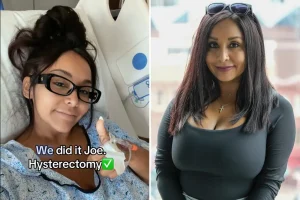







In the wake of a major, life-altering surgery, reality television star and entrepreneur Porsha Williams has chosen to step out of the spotlight’s glare and into a more vulnerable, deeply personal space. The former Real Housewives of Atlanta cast member recently underwent an emergency hysterectomy, a procedure that led to the removal of her uterus. Instead of retreating into private recovery, Porsha has decided to use her platform to share her experience, hoping to dismantle the silence and stigma that often surrounds women’s reproductive health. Her initial announcement on social media was met with an outpouring of support, and in subsequent reflections, she has opened up about the physical pain she endured, the emotional weight of the decision, and the profound gratitude she now feels for her life and her family. It is a story that begins with a health crisis but has evolved into a powerful testament to resilience, advocacy, and the importance of listening to one’s own body.
In a heartfelt statement posted on her Instagram account, Porsha expressed her sincere thanks for the wave of love and support that flooded her timeline following the revelation of her surgery. Her message was not one of despair, but of connection and purpose. She acknowledged the courage it took to share such a private medical battle, but framed her transparency as a potential lifeline for other women who might be suffering in silence. Porsha revealed that the hysterectomy was not a choice made lightly, but a necessary step to save her life after doctors discovered fibroids—noncancerous growths in the uterus—that had been causing her immense, unseen distress. By opening up about her “loss” and her journey through surgery, she aimed to inspire other women to take charge of their health. Her narrative pivoted from a tale of personal medical intervention to a broader call to action, encouraging women to advocate for themselves in doctor’s offices and to seek out the information they need to make empowered decisions.
The specifics of Porsha’s condition paint a clearer picture of the severity of her situation. In a candid essay for Glamour, the 45-year-old detailed how her quality of life had been deteriorating, all while she was unaware of the root cause. She had been battling migraines, dealing with persistently low iron levels, and feeling an inexplicable stress on her body from everyday activities. It wasn’t until the discovery of the fibroids that these disparate symptoms began to make sense. When the medical team entered the operating room, they found not just a single growth, but 21 fibroids, with the largest measuring the size of a cantaloupe. This revelation was staggering, and it validated the immense pressure her body had been under. Porsha noted that she didn’t have a choice regarding the hysterectomy, but she is unequivocal in her belief that the procedure saved her life, drastically improving her physical well-being and granting her a newfound sense of freedom from the chronic, unacknowledged pain she had grown accustomed to living with.
Beyond the physical recovery, Porsha’s journey has forced her to confront deep-seated emotional and existential questions, particularly regarding her identity as a woman and a mother. She confessed to feeling a profound sense of loss upon waking from the surgery, articulating a thought that many women in her position may recognize: “A part of me is gone.” She acknowledged the persistent stigma surrounding hysterectomies and fibroids in women’s health discourse, noting the societal pressure that can make a woman feel “somehow less of a woman” without her uterus. However, she is actively working to reframe this narrative through the lens of her daughter, Pilar, whom she shares with ex-fiancé Dennis McKinley. While the procedure permanently closed the door on having more biological children, Porsha has channeled her grief into an even deeper appreciation for the daughter she already has. She described Pilar as her “lifesaver,” a title that has taken on even greater emotional resonance in the aftermath of her surgery, reflecting a shift from mourning what might have been to cherishing the miracle she already holds.
The response to Porsha’s revelation has been a communal experience, transforming her personal ordeal into a shared space of healing. She noted that she spent time reading the stories of other women who had faced similar struggles, and the experience left her feeling seen, heard, and part of a “togetherness” that she had long been missing. This digital connection, built on shared vulnerability, has become a crucial component of her recovery, alleviating the loneliness she felt during the years when she grappled with her symptoms in silence. She expressed a wish that she had found this community of support sooner, highlighting the isolating nature of such health issues. By using her platform to tell her story, she has effectively created a wellspring of solidarity, assuring other women that they are not alone in their experiences with fibroids, hysterectomies, or the complex emotions that accompany major reproductive health decisions.
In the end, Porsha Williams’ journey through this medical emergency has been reframed as one of advocacy, resilience, and profound personal growth. She has woven a new narrative that emphasizes self-advocacy as a crucial tool for all women. Her story serves as a stark reminder that we must be our own fiercest advocates in the healthcare system, that the subtle pains we dismiss could be signs of something far more serious, and that open conversation is the first step toward eradicating the shame often attached to women’s bodies. Her initial worry over her future fertility has been replaced by a present-tense gratitude for her survival and her daughter. As she rests and recovers, surrounded by the love of her family and her partner, her message to the world is clear: by sharing our deepest struggles, we not only find strength for ourselves but also become a beacon of hope for others. Her story is no longer just about a procedure, but about a woman reclaiming her narrative, honoring her scars, and finding joy on the other side of a life-threatening challenge.