
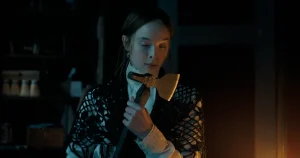






Ryan Murphy’s Monster anthology has become one of Netflix’s most talked-about true crime experiments, not only because of its chilling performances and cinematic ambition, but because it repeatedly forces viewers to ask how much of the story is real and how much is invented for our entertainment. The first season, which introduced Evan Peters as Jeffrey Dahmer, drew immediate backlash when it emerged that the families of Dahmer’s victims had never been consulted, raising uncomfortable questions about whether turning tragedy into prestige television can ever be done ethically. Season two pushed further into difficult territory with Erik and Lyle Menendez, who publicly objected to the show’s insinuation of an incestuous relationship between them, even as Murphy defended his creative choices by pointing out that the renewed attention had helped their ongoing fight for parole. By the time the third season turned to Ed Gein, the real-life murderer and grave robber whose story informed Psycho, The Texas Chainsaw Massacre, and The Silence of the Lambs, the series had established a pattern: it is less a documentary than a dark, imaginative meditation on how America consumes violence. With season four now streaming, the show turns its attention to Lizzie Borden, the famously acquitted woman accused of axing her father and stepmother in 1892—and once again, the line between historical record and dramatic speculation has become dangerously thin.
There is something almost hypnotic about how Monster humanizes the people at the center of its stories, and showrunner Ian Brennan spoke to that strange intimacy when he told reporters that working on these projects makes you “form an emotional opinion” about murderers, and that “growing to like these people” is an unexpected and strange part of the process. That honesty is refreshing, but it also highlights exactly the problem at the heart of the Lizzie Borden season. Lizzie is one of the most mysterious figures in American crime lore, a Sunday school teacher and daughter of a wealthy, disliked man, who somehow became the prime suspect in a brutal double murder and then walked free when the jury could not convict her. Because the historical record is so full of gaps, the show has enormous freedom to invent motives, relationships, and even entire subplots, and it uses that freedom liberally. The result is a season that feels emotionally rich, unsettling, and beautifully acted, but one that risks presenting pure fiction as if it were hidden truth. The challenge for any true crime drama is to honor the uncertainty of history rather than smooth it over with a neat, dramatic narrative, and Monster too often chooses the comfortable lie over the uncomfortable unknown.
One of the most significant inventions in the new season is Lizzie’s alleged romantic relationship with her maid, Bridget, portrayed as a new servant who becomes both Lizzy’s lover and her partner in murder. This storyline is not new—it was explored in Evan Hunter’s 1984 novel Lizzie and in the 2018 film Lizzie—but it remains pure speculation. There is no concrete historical evidence that the two women were lovers, and no account from anyone who knew them that would support the idea. Likewise, Monster introduces a scene in which Lizzie’s father, Andrew Borden, is having a sexual affair with Bridget, and even suggests that the affair results in a pregnancy. That too appears to be entirely fabricated for the sake of dramatic tension. The real Bridget Sullivan was a young Irish immigrant who worked for the Bordens and testified at Lizzie’s trial, but nothing in the court records or contemporary reports suggests she had romantic or sexual relationships within the household. By turning servant and mistress into lovers, the show creates a deeply personal motive for the murders, but it does so by reshaping real people into characters who serve the plot rather than remaining true to the murky, incomplete reality of their lives. It is easy to understand the temptation: sexuality, betrayal, and forbidden longing make for compelling television, and the historical silence surrounding these women invites projection. But there is an ethical difference between imagining what might have happened and presenting that imagination as likely fact, and Monster often blurs that boundary beyond recognition.
Perhaps the most indefensible inaccuracy in the season involves Bertha Manchester, a real woman who was killed with an axe just days before Lizzie’s trial began. The show’s storyline suggests that Lizzie and Bridget were responsible for Manchester’s death as well, but that is demonstrably false because Lizzie was in jail at the time, awaiting trial for the murders of her parents. A day laborer later took responsibility for Manchester’s death, and there is no credible evidence connecting Lizzie or Bridget to the crime. This is not a matter of interpretation or a fun conspiracy theory; it is a matter of fact, and by blurring the two cases, Monster does a disservice not only to Lizzie but to the memory of Manchester, a victim whose story deserves its own dignity rather than being folded into someone else’s myth. The willingness to sacrifice factual accuracy for narrative shock is especially troubling here because the true crime genre already struggles to remember that the people involved—whether accused or victim—were real human beings with families, reputations, and complicated inner lives. When a show like Monster lifts details from reality and then rearranges them simply to make its story darker and more thrilling, it sends a quiet but dangerous message: that the emotional experience of the audience matters more than the actual truth. That is a slippery slope, and one that erodes public trust in history just when we need it most.
The question of motive is where Monster does its most invasive work, because the real historical record offers no clear reason why Lizzie might have killed her father and stepmother. She was acquitted, and the evidence against her was largely circumstantial, leaving researchers to speculate about psychology, abuse, greed, and family dysfunction for more than a century. The show makes a definite judgment call: it presents Lizzie as guilty and constructs an elaborate backstory in which she was abused by her father and stepmother, turning her act into a kind of desperate revenge. In service of that theory, it shows her stepmother Abby Borden killing Lizzie’s pet doves, throwing boiling soup at a maid, and generally behaving with cruelty so exaggerated that it feels less like history and more like a fairy tale villain. No evidence supports this characterization of Abby, and many historians have pointed out that the real woman appears to have been more ordinary than monstrous. Others have suggested that if Lizzie did indeed commit the murders, her motivation was far more practical: her father had recently changed his will, and an inheritance was at stake. That sort of mundane, unflattering, and deeply human motive—money, jealousy, resentment over property—might be harder to dramatize, but it is closer to the messy reality of family conflict. Monster instead chooses a dramatic narrative of abuse and vengeance, which makes for better television but does real damage by creating false memories of real historical figures. When viewers recall the show later, they may remember Abby as an abuser and Lizzie as a wounded victim striking back, rather than a woman whose story remains unresolved and far more complex.
Finally, the season attempts to grandly connect Lizzie Borden to a lineage of female killers, specifically Aileen Wuornos and Countess Elizabeth Bathory, and in doing so it ventures completely into the realm of invention. There is no historical evidence linking Lizzie to these figures, and no indication that Wuornos was inspired by Borden in any meaningful way. The show even hints that Wuornos visited the Borden residence, but this is impossible because the house was not opened to the public until 1996, and Wuornos was arrested on murder charges in 1991, remaining in prison until her execution in 2002. Such factual errors are not tragic accidents; they are conscious choices made to deepen the fairy tale, to create a sense of dark feminine legacy that did not exist in reality. The comparison between Lizzie, an acquitted nineteenth-century woman accused of killing her parents, and Wuornos, a serial killer who was executed after a brutal and traumatic life, flattens the very real differences between their circumstances and eras. It reduces them to easy archetypes—the monstrous woman, the vengeful daughter, the hidden predator—rather than treating each as a separate, complicated human being with a story that deserves careful attention. If Monster is truly interested in “growing to like these people,” as Brennan said, it must also respect them enough to allow for contradiction, ambiguity, and the plain, unexciting truth that some things will never be known. The most human thing we can do with Lizzie Borden is admit that we do not have all the answers, and that filling every silence with sensationalism does not illuminate her mystery—it simply buries her again under another layer of fantasy.