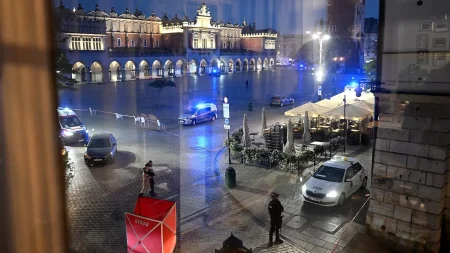




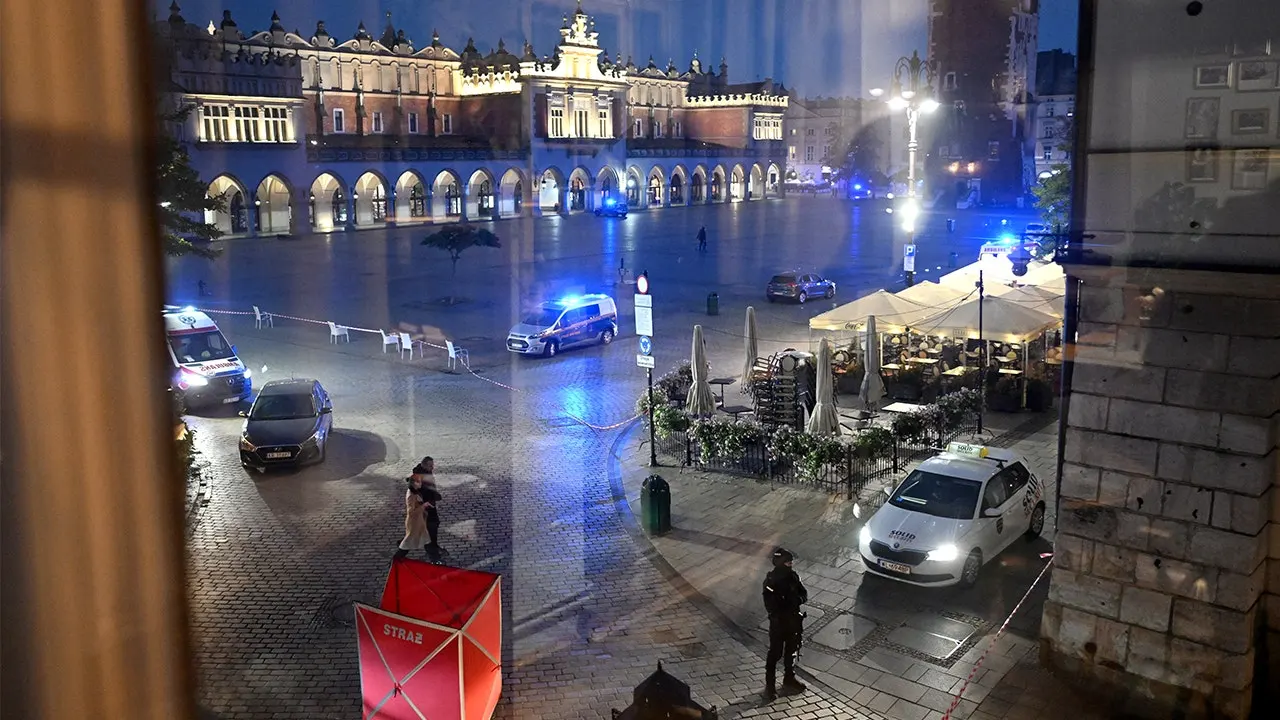
The news lands like a sudden storm over a city that has always known how to celebrate life. The gunman who turned a crowded square in Krakow into a scene of chaos and bloodshed has died, according to Polish authorities. He was twenty-four years old, critically wounded by police gunfire during the attack on Saturday, and after several operations in a hospital, he succumbed to his injuries on Monday. But his death does not bring closure. It only deepens the mystery and the grief left behind. Six people were killed that day—four women and two men—and fifteen others were wounded, their lives forever changed in a matter of minutes. The historic Main Square, usually filled with tourists, street musicians, and families enjoying the afternoon, became a place of screaming, running, and sirens. Now it is a place of candles and flowers, of strangers holding one another, of a city trying to understand how such darkness could arrive so suddenly in its most beloved public space.
Polish prosecutors have opened an investigation into the killings and attempted killings, including the attacks on police officers, and they have not ruled out terrorism as a possible motive. In fact, they are treating the case as a potential terrorist offense. The gunman is reported to have held far-right views, though investigators have yet to publicly establish what drove him to commit such an atrocity. This lack of clarity is perhaps the hardest part for the public to accept. People want reasons, explanations, a neat narrative that makes sense of the senseless. But the truth is often messier, buried in a young man’s mind, in his online world, in his family home, in the resentments and fantasies that may have been festering for years. The investigation will likely take months, and even then, the full picture may remain incomplete. What is already clear is that this was not a random moment of madness; it was an armed attack on unarmed civilians in broad daylight, carried out with what appears to be deliberate preparation and a chilling disregard for human life.
And then there is the other horror, the one that happened behind closed doors before the public attack ever began. Police discovered the bodies of the suspect’s mother, father, and sister at the family’s home in Ostrowiec Świętokrzyski, a town about ninety-three miles northeast of Krakow. The three are believed to have died from gunshot wounds, though authorities have not confirmed the exact circumstances of their deaths. It is impossible to hear this detail without feeling a heavy weight in the chest. A family of four, now reduced to a single name in a criminal investigation. Did they know what he was planning? Did they try to stop him? Were they the first victims, or were they caught in the aftermath of something even more tragic? The authorities have not yet answered these questions, and perhaps they never fully will. But the image of that home in a quiet Polish town, surrounded by police tape, is a stark reminder that violence often begins where we feel safest—and that the people who commit terrible acts are not always strangers living on the margins. Sometimes they are sons, brothers, neighbors, someone’s whole world, until one day they become something else entirely.
The attack itself was brazen in its cruelty. The gunman, dressed in military-style clothing and wearing a bulletproof vest, drove into Krakow’s historic Main Square on Saturday and opened fire without warning. There was no declared target, no negotiation, no apparent attempt to make a statement that could be understood. He simply arrived and began shooting. The victims include a British man and an Austrian woman, and five foreign nationals were among the wounded. This detail reminds us that the pain is not confined to one country. People from different nations, different backgrounds, different paths through life were thrown together in a single moment of terror. The Main Square is not just a location; it is a meeting point for the world, a UNESCO World Heritage site where history lives in every cobblestone. On any given day, you might hear a dozen languages, see children chasing pigeons, watch an elderly couple share an ice cream, or bump into a student taking a break from studying at the nearby Jagiellonian University. Now, for the families of the dead, that beautiful square will forever be crossed with grief. The city of Krakow, which has survived wars and occupation and centuries of change, must now carry this fresh wound in its collective memory.
In the midst of the horror, there were acts of courage that should not be forgotten. Two police officers were injured while stopping the gunman, and as of Sunday, both were still hospitalized but conscious. They ran toward the danger while everyone else was running away. They exchanged gunfire with a heavily armed man in a crowded public space, knowing that every second mattered, knowing that if they did not act, more people would die. Their injuries are physical reminders of the price of protection, but their survival is a small mercy in a tragedy filled with losses. First responders, too, rushed to the scene—paramedics, firefighters, civilians who performed first aid, tour guides who herded visitors into buildings, shopkeepers who opened their doors to the terrified. In the aftermath, the story of the shooting is not only a story of violence; it is also a story of community, of people refusing to let fear define them. Still, the psychological scars will remain. Survivors will relive the sound of gunfire for years to come. Witnesses will struggle with what they saw. The police officers, even after they heal, will carry the memory of that afternoon with them. And the city itself will have to learn how to be joyful again in a place where joy was violently interrupted.
This tragedy comes at a moment when Poland, like many countries, is wrestling with questions about extremism, public safety, and the fragility of everyday life. The shooting has also ignited fears of copycat violence, a concern that has become all too familiar in an era of highly publicized attacks and online radicalization. But in the days ahead, the focus must remain on those who lost their lives, those who were wounded, and those who loved them. The dead are not statistics; they are people with names, faces, dreams, and families who will never be the same. The wounded are not just medical cases; they are survivors facing long roads of recovery, both physical and emotional. And the members of the suspect’s family, now gone as well, are part of a tangled and tragic story that authorities are still trying to piece together. As investigators work and as Poland mourns, the world watches with a mix of sorrow and helplessness. There are no easy answers, no simple lessons, no words that can undo what happened. But there is still the choice to mourn together, to hold space for the victims, to refuse to let hatred have the final word. The gunman ended his own life indirectly through the violence he began, but he should not be remembered as the center of this story. The center belongs to the six people who will never come home, and to the fifteen who survived but will carry the weight of that day forever.