



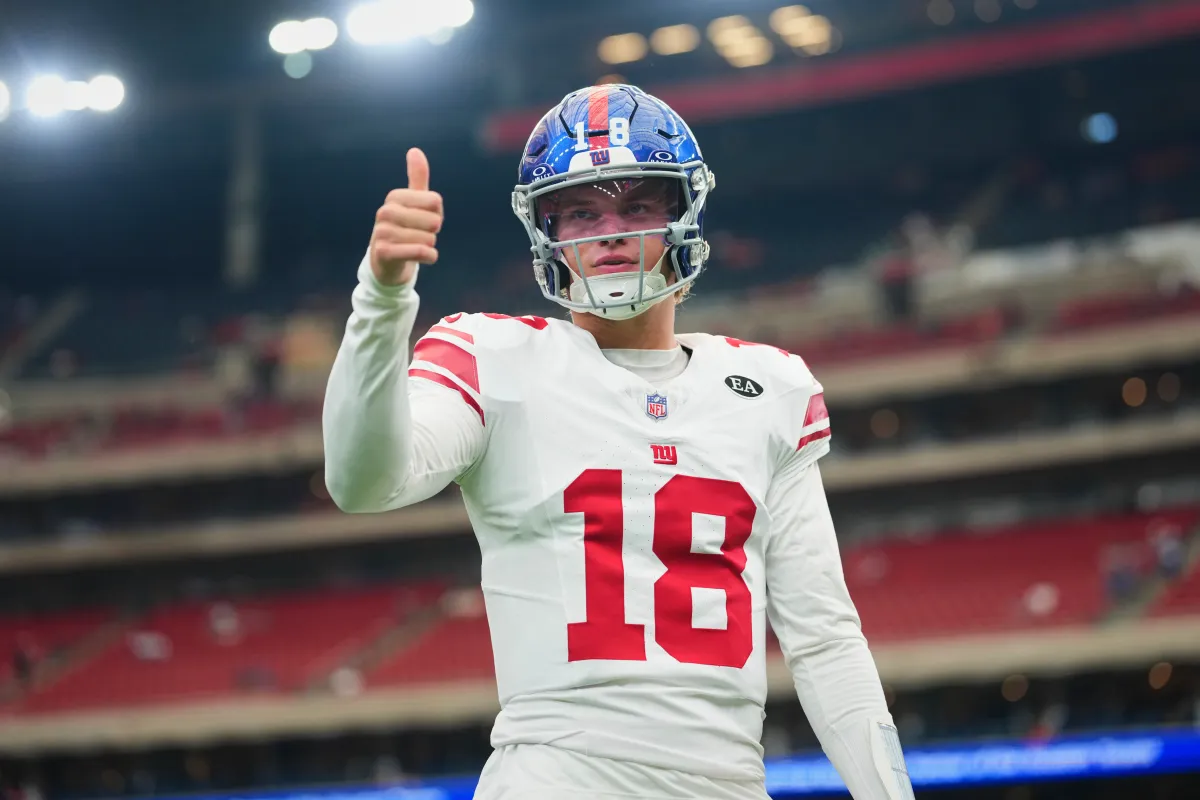
On a crisp autumn Sunday, with the roof of the stadium buzzing and the hometown crowd desperate for something to believe in, JJ McCarthy jogged onto the field as the starting quarterback of the New York Giants. It had been a long, winding road to get to that moment—through college glory, a first-round draft selection, a devastating injury, a surprising trade, and weeks of waiting behind a veteran who had already stumbled. But there he was, finally, under the bright lights, with the weight of a struggling franchise resting squarely on his shoulders. The game itself was a back-and-forth emotional roller coaster. The Houston Texans came in with their own playoff ambitions, and they pushed the Giants to the brink. But when the final whistle blew, the scoreboard read 27-21 in favor of the home team, and McCarthy had done something that had felt almost impossible just seven days earlier: he had given Giants fans genuine reasons to smile. There was a new energy in the building, a sense that maybe, just maybe, the offense had found its direction. It wasn’t a perfect performance by any means, but it was honest work—the kind of gritty, steady, efficient quarterbacking that wins games when the playbook, the clock, and the pressure all seem to be closing in.
Looking at the stat sheet, McCarthy’s first start looked like a solid, if unspectacular, introduction to life as the Giants’ QB1. He completed 20 of his 28 pass attempts for 252 yards, showing a nice balance of short, quick reads and the occasional downfield strike that kept the Texans’ defense honest. He didn’t throw a touchdown pass, but he also didn’t throw an interception, and that alone felt like a breath of fresh air for a team that had been tormented by turnovers in previous weeks. More importantly, he moved the chains. He converted third downs. He managed the pocket with a veteran’s calm, stepping up when pressure came off the edges and checking the ball down when nothing deep was available. There were moments when he looked like a rookie still learning the speed of the pro game—a hesitation here, a missed window there—but there were also moments when he looked like the franchise quarterback he was drafted to be. The Giants offense, which had sputtered and stalled for much of the season, suddenly had rhythm. The line blocked better, the receivers ran sharper routes, and the running game found lanes because McCarthy’s presence forced defenders to respect the pass. His teammates fed off his energy. On the sideline, players were talking, celebrating, engaging—not with the tight-jawed anxiety of a team bracing for bad news, but with the easy confidence of a group that finally believed the man under center could deliver.
After the game, McCarthy stood at the podium with his sweatshirt still damp from the celebration, a faint smile on his face. Reporters expected him to bask in his first career start, to talk about the touchdown pass that almost was, the deep ball he threaded between two defenders, or the way he scrambled out of the pocket to buy time on a critical third-and-long. Instead, he offered a blunt, almost dismissive assessment of his own individual performance. “Truly the only stat I care about is going 1-0,” he said. “I could care less how we get it done. At the end of the day, you want to perform well, you want to execute well. But at the end of the day, all that matters is getting that victory.” It was a quote that could sound cliché if it came from a cynical veteran, but from McCarthy it felt different—earnest, grounded, and oddly refreshing. Here was a young quarterback who had waited years to be the guy, who had every reason to soak up the spotlight, and instead he brushed aside his own numbers to point at the only thing that mattered to him: the team won. That mindset is exactly what the Giants have been missing. It is the kind of quiet leadership that doesn’t show up in box scores but transforms locker rooms. McCarthy didn’t need to tell anyone he was grateful for the opportunity; you could see it in the way he hugged his offensive linemen, the way he sought out the wide receivers after the game, and the way he spoke not as a individual star but as one part of a larger organism.
To fully understand the weight of McCarthy’s first start, you have to rewind the chaotic sequence of events that brought him to New York. Earlier this season, in a move that stunned both fan bases, the Giants acquired McCarthy in a blockbuster trade with the Minnesota Vikings. The trade was framed as a direct response to the season-ending knee injury suffered by Jaxson Dart, a promising young quarterback who had been expected to lead the offense into the future. Suddenly, the Giants were left scrambling, and general manager Joe Schoen pulled the trigger on a deal that brought McCarthy east. It was a bold gamble, a win-now move with one eye on the future, and it immediately raised expectations inside the locker room. McCarthy, though, didn’t get the starting job handed to him overnight. He had to wait behind veteran Jameis Winston, a seasoned gunslinger with a big arm and a history of untamed risk-taking. In last week’s loss to the New Orleans Saints, Winston threw his second interception of the afternoon, and the coaching staff had seen enough. The era of Winston was over almost as quickly as it began. McCarthy was promoted, and the game against the Texans became his audition—not just for the rest of the season, but for the long-term future of the franchise. He handled the moment with a maturity that belied his age, never trying to do too much, never forcing the ball into impossible windows, and never letting the pressure of the moment turn him into someone he isn’t.
Now, with the bye week approaching, the Giants have a chance to catch their breath, heal their wounds, and run a full week of practice with McCarthy firmly installed as the starting quarterback. The victory over the Texans creates a foundation, but the schedule doesn’t get any easier. In Week 9, the Giants will face the Philadelphia Eagles, a divisional rival that knows how to exploit young quarterbacks. The Eagles bring relentless pressure off the edge, a hostile environment on the road, and a defense that will force McCarthy to process information faster than he ever has before. But that is exactly the kind of challenge he seems to crave. The bye week will allow offensive coordinator Mike Kafka to tailor the playbook around McCarthy’s strengths—his athleticism, his quick release, his ability to throw accurately on the move. It will also give him time to build chemistry with his top receivers, to practice the timing routes that win games in November and December, and to study the Eagles’ schemes until he can see them in his sleep. The franchise has to feel better about its trajectory now than it did a week ago. The defense still has question marks, the offensive line still has injuries, and there is still a long, grueling road ahead. But there is something different in the air, a quiet optimism that has been missing for a long time. It starts with the quarterback position, and for the first time in years, the Giants have a young quarterback who seems worthy of the faith the organization has placed in him.
At the heart of McCarthy’s appeal is not just his arm or his legs or his football IQ—it’s his simplicity. In a league that often overcomplicates things with analytics, advanced metrics, and endless tape study, McCarthy seems to understand that football, at its core, is a game of human will. You block, you tackle, you throw, you catch, and if you do those things better than the other team, you win. That worldview is refreshing, and it has made him an easy player to root for. His journey from the University of Michigan, where he won a national championship and became one of the most celebrated quarterbacks in school history, to the NFL has been marked by both triumph and adversity. He was drafted in the first round by Minnesota, a franchise that believed in him enough to invest a high pick in him, but a knee injury derailed his rookie season before it could truly begin. He spent months in rehab, grinding through workouts, wondering whether his chance would ever come. When it did, it wasn’t in the uniform he had imagined. It was in New York, in the middle of a season nobody expected, playing for a team that had lost its quarterback, lost its confidence, and was quietly searching for a spark. McCarthy didn’t try to be a savior. He didn’t make bold predictions or shout slogans. He just went out there, played football the way he has always played it, and walked away with his first win as a starter. In a world of noise, he chose silence. In a sport of stats, he chose the scoreboard. And when asked about his performance, he looked straight into the camera and said, “All that matters is getting that victory.” For a team starving for substance, his words were more than just a soundbite—they were a promise.