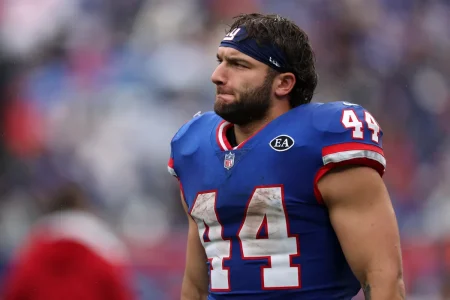



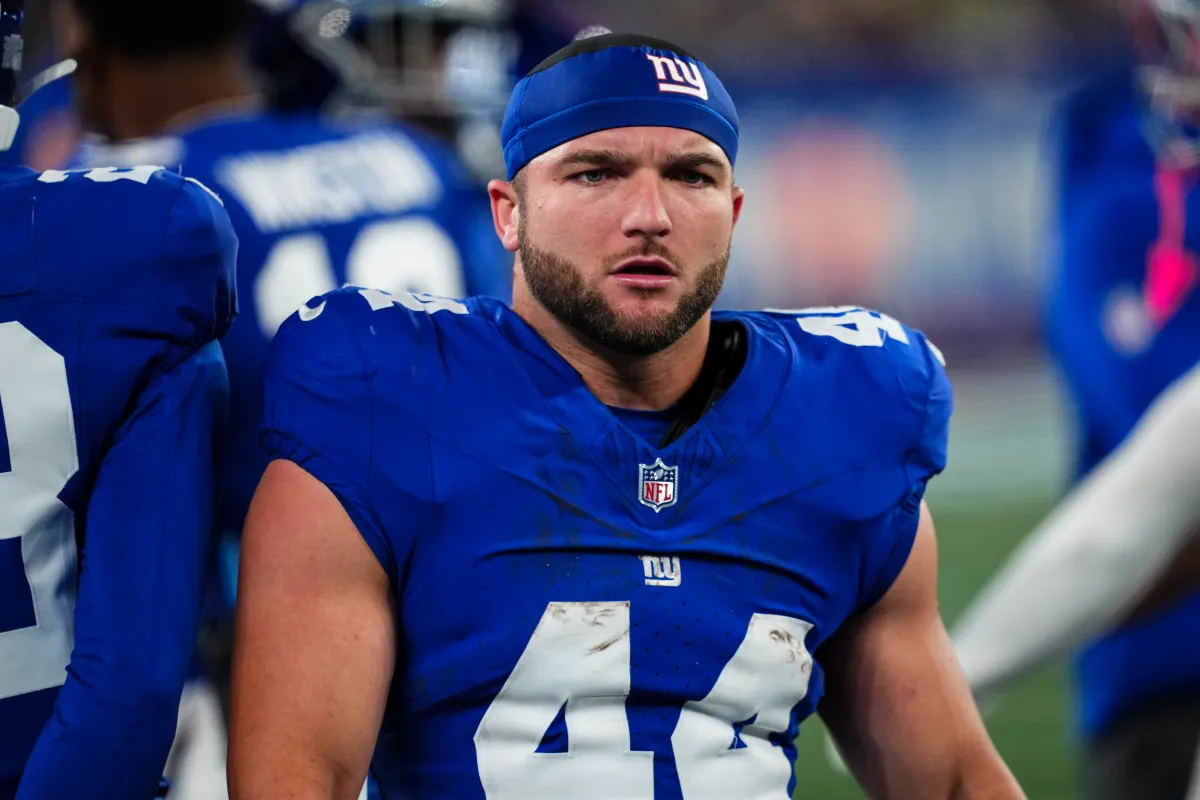
Cam Skattebo spent the better part of a week answering for a performance that looked nothing like him. One game after being held to zero carries—an almost humiliating stat for a running back who prides himself on violence, relentlessness, and finishing every run like it might be his last—he went out and did what he always believed he could do. In the New York Giants’ 27-21 overtime win over the Houston Texans on October 25, Skattebo carried the ball 17 times, gained 124 yards, and scored a touchdown. ESPN noted afterward that it was his first 100-yard rushing game as a professional, but the numbers only tell a fraction of the story. This wasn’t just a stat line; it was a statement. For weeks, the Giants’ ground game had been uneven, and Skattebo himself had been part of that inconsistency. There was a fumble in a frustrating tie against the Washington Commanders. There was a game against the New Orleans Saints in which he played only six snaps and never got a single carry. And then there was the decision by the team to move on from Najee Harris, a move that left the backfield with plenty of motivation but also plenty of uncertainty. Skattebo used all of that as fuel, and against Houston he ran like a man who had been waiting for the chance to prove that his patience wasn’t the same as surrender. Every cut, every collision, every extra-yard finish was a reminder that the Giants’ running back room had a pulse, and that Skattebo intended to be its heartbeat.
But the same game that celebrated his breakout also reminded him how complicated his style of play can be. At the tail end of a long run, Skattebo barreled into Texans safety M.J. Stewart, lowering his shoulder in the kind of punishing finish that has become his trademark. The officials saw something different. They threw a flag for unnecessary roughness, ruling that Skattebo had made contact with the crown of his helmet. It was a moment that could have been celebrated as football at its most physical, but instead it became a controversy. Skattebo was furious, and he didn’t try to hide it. He had to be physically held back by the Giants’ coach on the sideline, and the coach then turned to protest the flag himself. Whatever Skattebo said to the official in that heated moment, he kept private. But when it came to the league, he was anything but quiet. He made it clear that he was tired of being praised for his aggressive running style by the very same institution that was now punishing him for it. He pointed out that the NFL loves to post his highlights, loves to put his bruising runs on social media, loves to market the violence and the passion and the old-school mentality. But then, he said, the league wants to take something away from him for playing the exact same way. In his mind, the contradiction was impossible to ignore.
The frustration poured out in a quote that captured the moment perfectly. He said the NFL loves to post him when he does stuff like that, but then also wants to take stuff from him. He insisted that he was going to keep running the ball the way he wanted to run it, and if that meant he was going to keep getting flagged or fined, then, in his own words, he guessed he was going to play for free. It was a defiant, emotionally raw statement, the kind of thing a player says when he feels like the sport he loves is working against him. OutKick noted that the replay looked a lot like many of Skattebo’s earlier carries, which only added to his argument. If the exact same physical contact had happened on any other play, it might have been highlighted on television. But because it happened at the tail end of a run, against a safety who was in the way, it was treated as a violation. Skattebo acknowledged that a fine might be headed his way, and there was a resignation in his voice. He knew the league’s process by now. He knew that the money might come out of his check, that the flag might come out against his team, that all the joy of his breakout performance might get complicated by a ruling he thought was wrong. Still, he wasn’t going to change. That was the real message of the day. Skattebo would rather risk the penalty than run timid, and if that meant playing for free, so be it.
To understand why this mattered so much, you have to look at the weeks that led up to it. The Giants had been through a rough stretch, and Skattebo had been right in the middle of it. In the overtime period against the Washington Commanders, he put the ball on the turf. It was his fifth fumble in just 13 career games, and the turnover helped turn what should have been a win into a tie. It was the kind of mistake that sticks with a running back, especially one who takes so much pride in being reliable. A week later, he was essentially invisible, playing six snaps without a single carry against the Saints, a game the Giants lost. Whether that was a coaching decision or a matchup issue or something else, it clearly didn’t sit well with him. Then came the news that the team had released Najee Harris, and suddenly the backfield was in flux. There was opportunity, but there was also pressure. Skattebo responded the way he always said he would. Against Houston, he wasn’t just running; he was proving a point. He wanted to show the coach, he wanted to show the team, and he wanted to show everyone watching that the Giants had running backs who could carry the load. After the game, he said it was awesome to be able to show the coach and the team that they had running backs in the backfield who could do it. The words sounded simple, but the performance behind them was anything but. It was a reminder that football, at its core, is about players who refuse to be forgotten.
There was also a moment in the overtime period that summed up Skattebo’s entire afternoon. With the game on the line, he ripped off a career-long 42-yard run, the kind of explosive, sideline-to-sideline burst that makes defenders look slow. It was the biggest play of the day, and it set up Devin Singletary’s 30-yard walk-off touchdown that sent the Giants into the bye week with a much-needed win. But the run came at a cost. Skattebo’s hamstring acted up on the play, and he limped off the field afterward, a reminder that his style of running is brutal on his own body as much as it is on the defense. He gave the team everything he had, and then he had to watch the finish from the sideline, his legs aching but his spirit maybe stronger than it had been all season. The Giants improved to 4-2-1, and the bye week could not have come at a better time. They need the rest, not just because of the injury list but because the schedule is about to get even harder. After the bye, they head to Philadelphia to face the Eagles, and then they have another NFC East matchup just five days later. That kind of stretch will test the entire roster, but especially a running back who has already shown he is willing to run through walls. Skattebo will need his body to hold up, and he will need his emotions to settle just enough to stay on the field. The challenge is that the same fire that makes him special is the fire that sometimes gets him into trouble.
In the end, the story of Cam Skattebo against the Texans is bigger than the penalty, bigger than the 124 yards, even bigger than the overtime win. It is a story about identity. Skattebo is the kind of runner who believes that the game is supposed to be violent, that a defender’s job is to stop you, and your job is to make him wish he hadn’t tried. He is a throwback, the kind of player who would have been celebrated in an era before every collision was subject to review. But he plays in a league that has to balance entertainment with safety, and that creates a strange tension. The NFL wants the highlights, wants the fierce, angry running backs, wants the plays that get people talking. But it also wants to protect players, and it does so by throwing flags and imposing fines that often feel arbitrary to the people being punished. Skattebo represents the old school, and he isn’t afraid to say so. He isn’t going to apologize for running the ball the way he wants to run it. He understands that a fine may be coming, that the league may see it differently, but he refuses to let that change who he is. That is both his greatest strength and his greatest vulnerability. It is what makes his teammates love him and what makes opponents respect him. It is also what makes him a target. But after a game like this, it’s clear that the Giants need that fire. They need someone who carries the ball like he has a personal grudge against every defender on the field. They need someone who can take an entire backfield’s frustration and turn it into a performance that lifts the whole team. Cam Skattebo did that. He limped, he screamed, he got flagged, he got fined, he got celebrated. And at the end of the night, he got exactly what he wanted: a win, a statement, and a spot in the middle of the story that the NFL could not look away from.