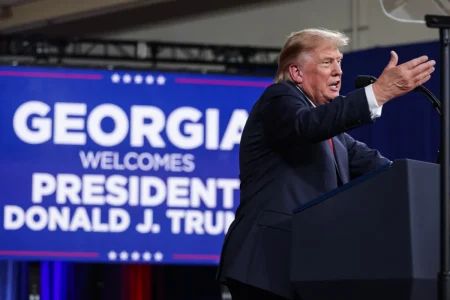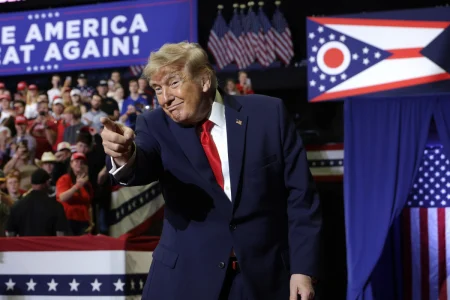



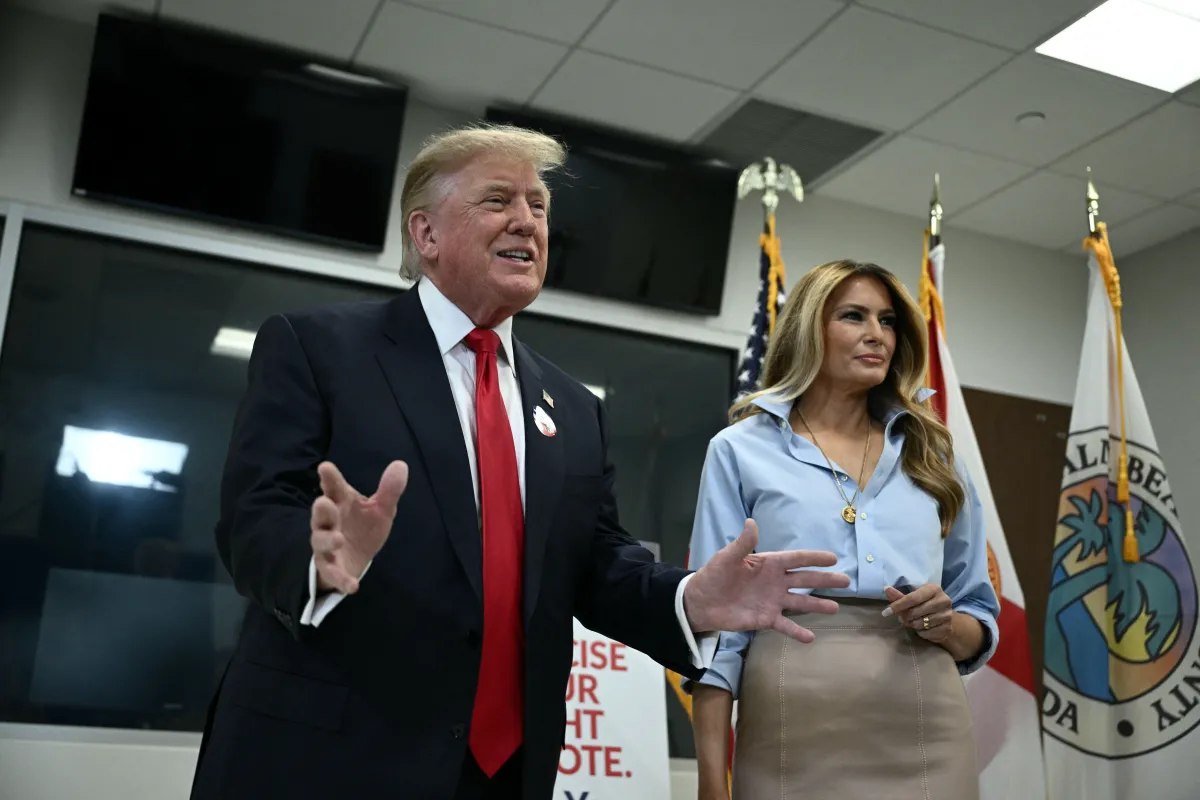
On a sun-drenched Saturday in late October, after casting his vote in Palm Beach, President Trump paused to speak with reporters in that familiar, freewheeling style that has defined so many of his public moments. The conversation could have been about any number of things, but it soon drifted toward military technology, Iran, and a family story the president clearly loves to tell. In the middle of a rambling explanation about American strikes on Iranian equipment, he brought up his uncle, Dr. John Trump, who he claimed had “invented radar.” You can almost picture the scene: the Florida sunshine, a cluster of microphones and cameras, the president leaning in with a “can you believe it?” as if delivering a little-known bit of family trivia. He said the military had knocked out all of the radar systems, and then added, with a note of pride, “Some of the things my uncle invented, the radar. My uncle invented radar, can you believe it? From MIT. Dr. John Trump. I mean, he’ll probably be angry at me, but I knocked out their radar. I knocked out all of the different things, and the only thing they have going for them right now is inflation.” It was vintage Trump: a tangent wrapped in a boast, mixing family heritage, patriotic bravado, and a jab at the economy, all in the span of just a few sentences. But the claim itself, while delivered with confidence, was less a historical fact than a piece of family folklore, one that would soon be gently corrected by the internet.
Almost as quickly as the clip hit social media, the fact-checkers went to work. A journalist named Aaron Rupar shared a shortened version of the president’s remarks on X, the platform formerly known as Twitter, and it didn’t take long for the community to weigh in. Beneath the video appeared a community note, one of those crowdsourced corrections that X now uses to add context to misleading posts. The note was approved by other platform users and read, with the quiet authority of a librarian correcting a student in class, “Donald Trump’s uncle did not invent radar. The ‘first practical radar system’ was patented by Sir Robert Watson-Watt, who built on the work of others such as Heinrich Hertz and Christian Huelsmeyer.” It was a polite but firm rebuttal, the kind of digital footnote that has become increasingly common in an age where misinformation can travel faster than the truth. The note didn’t attack the president, didn’t mock him; it simply stated the facts as historians understand them. And in doing so, it turned a casual remark into a teachable moment. Newsweek reached out to the White House press office for comment, but the story didn’t really need a response. The record was already clear. Radar wasn’t invented by one person, let alone by Dr. John Trump, no matter how proud his nephew might be of him. The correction was less a rebuke of the president and more a reminder that invention, especially of something as transformative as radar, is rarely a single-bulb lightbulb moment.
The truth is that radar, like so many great technologies, was the product of many hands and many minds working across decades and continents. It wasn’t a solitary genius who one day announced “I have invented radar.” It was a slow, cumulative process of discovery and refinement, with scientists building on the work of those who came before them. British radio engineer Sir Robert Watson-Watt, who is often credited as a key figure in the development of radar, was the first to admit this. In his 1958 memoir, “Three Steps to Victory,” he wrote with characteristic humility: “It has become habitual to call me ‘the father of radar.’ The genealogical tree is cluttered with legitimate grandparents, great-grandparents and great-great grandparents of radar.” That image of a family tree is a lovely and accurate one. The story begins with German physicist Heinrich Hertz, who proved the existence of electromagnetic waves in a series of experiments between 1886 and 1889. Those waves, invisible and silent, became the foundation upon which radar would later be built. Then came another German physicist, Christian Hulsmeyer, who in 1904 patented a device that could detect ships using radio waves. It was an early precursor to radar, a kind of primitive echo-location that hinted at what was possible, even if it didn’t yet have the range or reliability to change the world. The crucial breakthrough came in 1935, when Watson-Watt, working at the National Physical Laboratory in Teddington, England, produced a device that could consistently locate aircraft. That success led to the creation of Chain Home, a network of radar stations strung across the United Kingdom. When the Battle of Britain raged in 1940, these radar stations gave the Royal Air Force a critical advantage, allowing defenders to see incoming German bombers before they arrived. It was radar, in other words, that helped save Britain from invasion. And it was the combined contributions of scientists like Hertz, Hulsmeyer, and Watson-Watt, along with countless engineers and researchers, that made it possible.
So where does Dr. John Trump fit into this story? He didn’t invent radar, but he did play an important and genuinely impressive role in helping to bring it to the United States military. Dr. Trump, the younger brother of President Trump’s father Frederick, was an accomplished electrical engineer in his own right. He joined the faculty at MIT in 1936 as an assistant professor and became deeply involved in radar research, which was then one of the most urgent scientific priorities of the age. By 1942, he had been appointed secretary of the U.S. National Defense Research Committee’s Microwave Committee. That bureaucratic-sounding title placed him at the center of the nation’s radar development effort, with responsibility for overseeing radar research across the country. It wasn’t glamorous work, but it was essential. He helped guide, coordinate, and push forward the science that would eventually be used to track enemy aircraft, guide bombing missions, and protect American ships in the Pacific. Then, in February 1944, Dr. Trump went to work alongside Watson-Watt and other key British scientists while heading the British Branch of MIT’s Radiation Laboratory. The Rad Lab, as it was known, was one of the most consequential research centers of World War II, a place where some of the brightest minds of a generation gathered to refine radar into a battle-ready technology. Dr. Trump’s role there was not that of the lone inventor, but of a scientific statesman, someone who managed people, ideas, and resources across the Atlantic to make sure the Allies had the best possible equipment. That is no small thing. He was a builder of collaboration, a translator between cultures, and a steady hand in a time of chaos. His contributions were real, meaningful, and worthy of respect. They just weren’t the contributions of an inventor who conjured radar out of thin air.
This isn’t the first time President Trump has told a story about his uncle that doesn’t quite hold up under scrutiny, and the pattern is a fascinating one. In 2023, while speaking in Pennsylvania, the president claimed that his uncle had taught Ted Kaczynski, the man known as the Unabomber, during his time at MIT. He described his uncle as having found Kaczynski to be a “seriously good” student, a detail that added a little human interest to an otherwise dark story. But when MIT was asked about it, the response was blunt: “We have no enrollment record or information that Ted Kaczynski ever attended MIT.” In fact, Kaczynski attended Harvard as an undergraduate and earned his Ph.D. at the University of Michigan, then joined the faculty at Berkeley. He did not appear in MIT’s records. And there was another problem with the timeline. Dr. John Trump died in 1985, eleven years before Kaczynski was publicly identified and arrested in 1996. It’s possible, of course, that Dr. Trump had some interaction with Kaczynski that isn’t recorded in official documents, but the story as told by the president doesn’t align with the facts as they are known. What makes these claims interesting isn’t that a proud nephew would want to elevate the memory of his uncle. That’s a human thing to do. We all want to believe our family members were important, exceptional, perhaps even legendary. The problem is that the legend starts to crowd out the truth. Dr. John Trump doesn’t need to be the inventor of radar to be worth celebrating, and he doesn’t need to have taught the Unabomber to be an interesting figure. His real story, as an MIT professor, a wartime research leader, and a key link between American and British science, is already remarkable. It’s a story worth telling accurately.
There is something touching about the way President Trump consistently comes back to his uncle, reaching for these family anecdotes to add a personal gloss to whatever point he’s making. It suggests a genuine pride in his family’s heritage, a desire to connect his own story to something larger than himself. And there’s nothing wrong with being proud of a relative who served his country during the greatest conflict in human history. But the repetition of these inflated claims also points to a deeper human instinct, one that most of us can recognize in ourselves. We are drawn to simple stories of genius and invention, stories where one heroic figure changes the world with a flash of insight. Real history, though, is messier. It’s full of collaboration, incremental progress, dead ends, and rediscoveries. Radar wasn’t born in a single laboratory or a single moment; it emerged from the collective work of scientists across Germany, Britain, and the United States, building on each other’s discoveries in ways that make it impossible to assign a single inventor. Dr. John Trump was a real part of that magnificent effort, not as its creator, but as a dedicated organizer, researcher, and bridge-builder. That is a legacy of genuine substance. Perhaps the kind thing to say is that the president’s exaggeration is a form of love, clumsy but sincere. Yet the careful observer should always come back to the facts, not to diminish the man, but to honor him with honesty. History doesn’t need mythmaking to be awe-inspiring. The truth about radar, and about the people who developed it, is extraordinary enough. And if there is a lesson to be drawn from this whole small episode, it’s that we serve our families best when we tell their stories the way they actually happened, with all the imperfections, contributions, and quiet sacrifices that made them real.