


It hasn’t even been a full week into the 2026-27 NBA season, and yet the Oklahoma City Thunder have already been reminded of how fragile everything can be. On Sunday night, the Thunder hosted the Los Angeles Clippers at Paycom Center in what was shaping up to be another statement victory for a young team with championship ambitions. Oklahoma City was undefeated, the crowd was buzzing, and the energy in the building was electric. But in the final minutes of the fourth quarter, a moment of pure athletic ambition turned into a scene of collective dread. Jalen Williams, the dynamic forward affectionately known as “J-Dub,” drove to the rim with the kind of ferocity that has made him one of the most beloved players on the roster. He attempted a dunk, but as he came down, his body twisted awkwardly and his left ankle buckled beneath him. The arena went silent. Williams stayed on the floor, writhing in obvious pain, while his teammates and trainers rushed toward him. The game, which had been a showcase of Oklahoma City’s depth and resilience, suddenly took a backseat to something far more important than the scoreboard. The Thunder would eventually win the game 108-101, remaining undefeated, but the aftermath of that win was heavy with worry, uncertainty, and the kind of emotional weight that no statistic can measure.
As the medical staff huddled around Williams, the gravity of the moment became impossible to ignore. This was not the kind of injury that allows a player to shake it off and walk to the bench. Williams remained on the floor for several minutes, his face contorted in pain, while the entire arena watched in hushed concern. The trainers carefully examined his ankle, trying to determine the severity before doing anything else. Eventually, it became clear that Williams would not be walking off the court on his own. A stretcher was brought onto the hardwood, and the reality of the situation settled over the crowd like a cold shadow. Being carried off the court on a stretcher is one of the most sobering sights in sports, particularly for a team that has so much invested in a player’s health and future. But even in that agonizing moment, Williams did something that spoke volumes about his character. As he was being lifted onto the stretcher, he raised his hand and gave two thumbs up to the crowd. It was a small gesture, but it carried an enormous message: he was okay, he was fighting, and he intended to come back. The packed arena responded with a roar of support, chanting “J-Dub! J-Dub!” as he was wheeled off the court. It was the kind of scene that reminds you why sports can be so powerful—not because of the dunks or the victories, but because of the shared humanity between a player and the people who cheer for him.
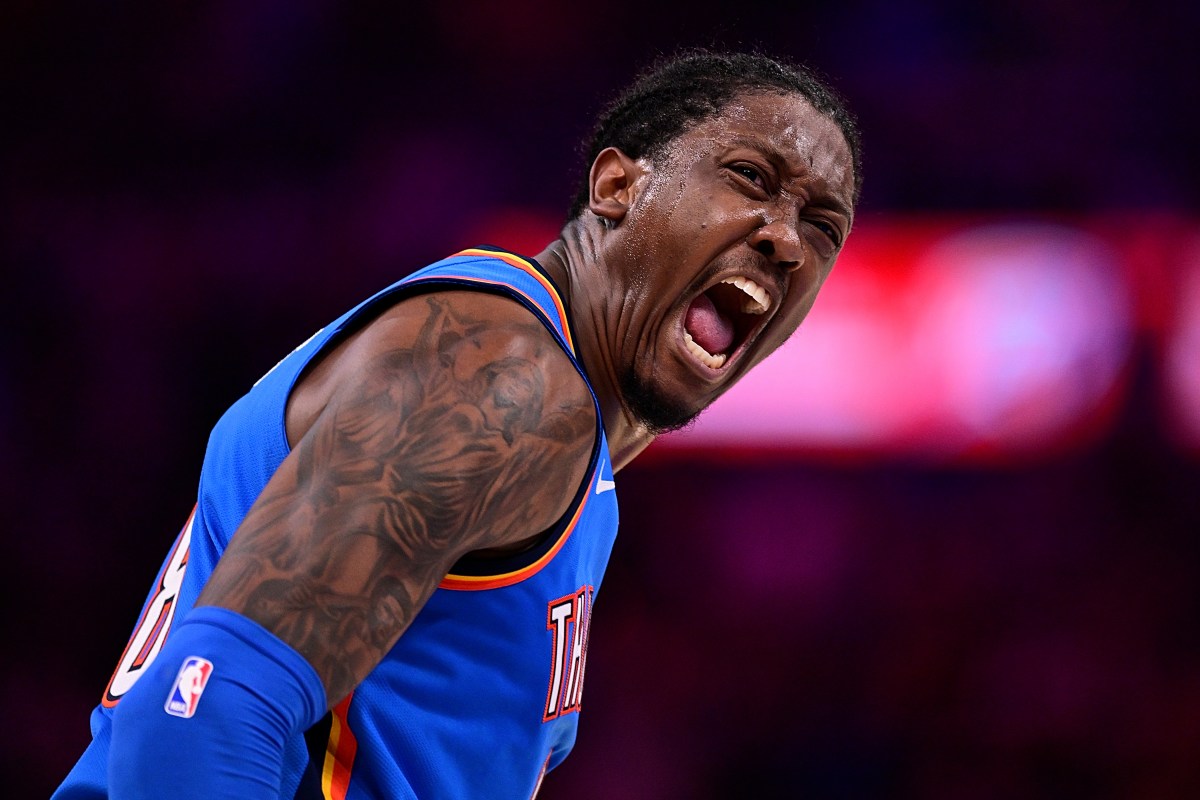
The emotional weight of the moment was perhaps nowhere deeper than on the Thunder bench, where Williams’s teammates watched with a mixture of fear and helplessness. Shai Gilgeous-Alexander, the team’s superstar and unquestioned leader, was visibly shaken. As the trainers worked on Williams, Gilgeous-Alexander stood nearby, his eyes red and glistening. Cameras caught him wiping away tears as Williams was placed on the stretcher, and the image of SGA’s raw emotion quickly became the defining visual of the night. For Gilgeous-Alexander, this was not just a teammate going down. It was a brother, a partner in the nightly battle, someone who had helped build the Thunder into one of the most exciting teams in the league. When interviewed by the Thunder broadcast after the game, Gilgeous-Alexander was still fighting back tears. His voice cracked as he tried to put his emotions into words. “I just feel bad for him. Nothing more than that,” he said. There was no mention of the win, no talk about the standings, no discussion of what the team needed to do differently. In that moment, all that mattered was Jalen Williams and the knowledge that his season—and perhaps his career—could be altered in an instant. When asked how the Thunder would respond to the injury, Gilgeous-Alexander offered a response that was equal parts vulnerability and resolve. “We don’t have no choice,” he said. “It’s what we signed up for. It’s obviously going to be tougher on a player like that. But, he’s not gone forever. He’s going to be back better than ever, we know it. We just gotta hold the fort down until he comes back.” Those words, spoken through the kind of pain that only someone who truly cares can express, captured the spirit of a team that has learned to lean on one another through every challenge.
To understand why this injury hit so hard, you have to understand what Jalen Williams means to the Oklahoma City Thunder. He is not just another talented player on a roster full of young stars. He is the heartbeat of a team that has risen from the ashes of a rebuild to become a legitimate contender. Drafted as a relatively unheralded prospect out of Santa Clara, Williams defied expectations from the moment he entered the league. He worked relentlessly on his game, turning himself into one of the most versatile and reliable players on the roster. He can score, pass, rebound, defend multiple positions, and make the right play when it matters most. But perhaps more importantly, Williams plays with a joy and intensity that endears him to fans and teammates alike. He is the kind of player who celebrates other people’s successes as passionately as he celebrates his own. He is the kind of teammate who will dive on the floor for a loose ball, sacrifice his body for a charge, or stay after practice to work on his shot. In a league filled with individual superstars and contract dramas, Williams represents something refreshing: a player who genuinely loves the game and the people he plays with. His nickname, “J-Dub,” has become a rallying cry in Oklahoma City, a symbol of the grit and togetherness that defines this era of Thunder basketball. And now, watching him laid out on the court with an injury that could keep him away for weeks, months, or even longer, felt like a cruel twist of fate for a player who has given everything to the game.
As of now, there have been no official updates regarding the severity of Williams’s injury. The Thunder organization, known for being cautious and player-first in its approach to medical matters, has understandably remained tight-lipped. But based on the way Williams reacted, the way he had to be helped onto a stretcher, and the way his teammates responded with such visible anguish, there is a very real possibility that he will miss significant time. The question on everyone’s mind is not whether he will play again—everyone alive in the building seemed certain that he would return—but rather how long the road back will be. Ankle injuries in basketball can be tricky. What looks like a simple sprain can linger for weeks. More serious injuries, like torn ligaments or fractures, can end a season in an instant. The Thunder are only three games into the season, and they entered Sunday night undefeated, full of hope and momentum. Losing a player of Williams’s caliber would be a massive blow to any team, let alone one with championship aspirations. He played 32 minutes against the Clippers, contributing eight points, five assists, two rebounds, and two steals before going down. Those numbers, while modest, do not tell the full story of his impact. His presence on the floor opens up opportunities for everyone else. His basketball IQ and defensive instincts make the entire unit better. Without him, the Thunder will have to find new ways to generate offense and maintain the defensive intensity that has become their trademark. But if there is one thing this team has proven over the years, it is that they know how to respond to adversity. They have been counted out before, doubted before, and forced to overcome injuries before. And while the road ahead may be difficult, Gilgeous-Alexander’s words echo a belief that has come to define this organization: they will hold the fort down until their brother returns.
In the grander scheme of things, Jalen Williams’s injury is a reminder of the fragility of every athlete’s career. We watch these players soar through the air, defy gravity, and make the impossible look routine. We forget that beneath the highlight reels and the championship banners, they are human beings making split-second decisions that can have lifelong consequences. One moment can change everything. One awkward landing can turn a season of promise into a season of rehabilitation and doubt. And yet, in that same moment, we also see the power of community. We see the fans chanting the name of a player they love, not because he scored thirty points or hit a game-winning shot, but because he represents something greater than basketball. We see his teammates standing together, tears in their eyes, refusing to let fear overshadow hope. We see a young man, lying on a stretcher, still finding the strength to offer a thumbs up to the people who care about him. That image will linger long after the specifics of the game fade away. It is a reminder that sports are not just about wins and losses. They are about connection, about love, about the bonds that form when people share a common purpose. For Jalen Williams, the road ahead will not be easy. There will be long days, painful rehab sessions, and moments of frustration. But if there is one thing his journey has already taught us, it is that he is not alone. He has a team that will fight for him, a city that will cheer for him, and a brotherhood that will never stop believing in him. And when he finally steps back onto the court, whenever that may be, the Thunder will be ready to welcome him home with open arms, another chapter in a story that reminds us all of the resilience of the human spirit.