


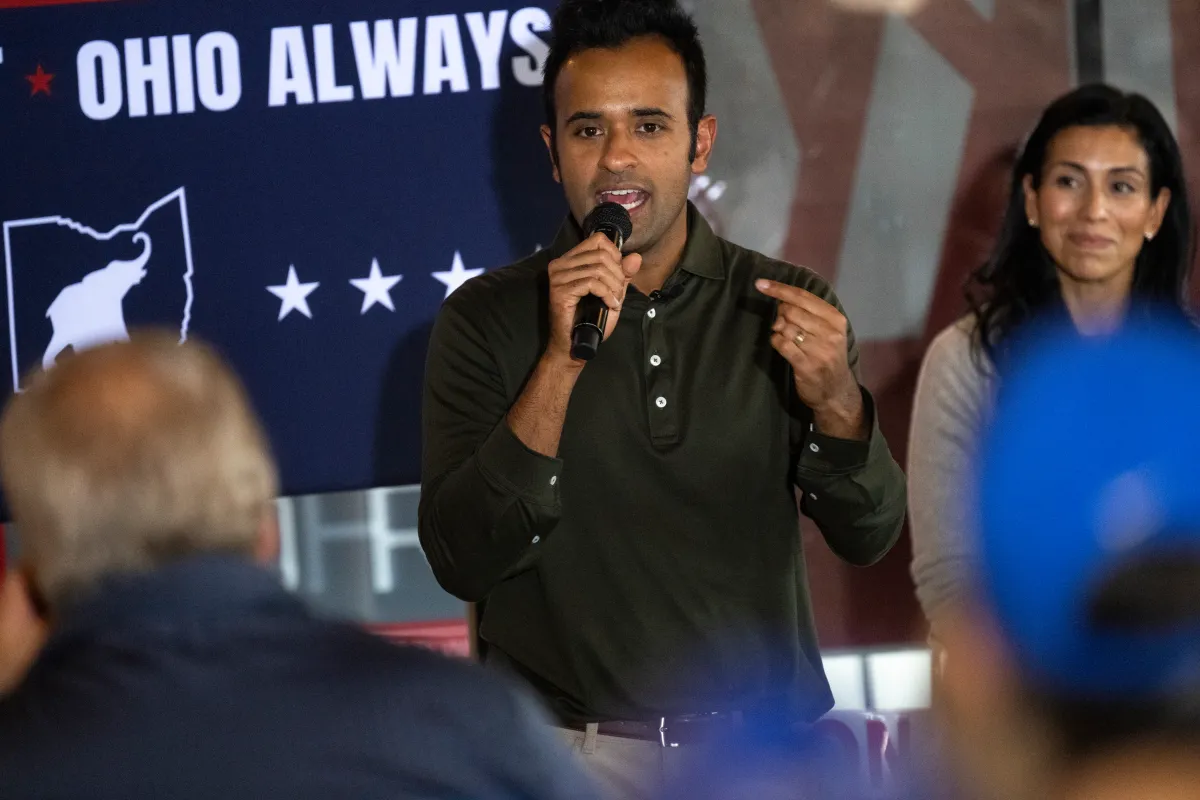
In the fiercely competitive final stretch of Ohio’s race for governor, an already bruising campaign has taken a wrenching, personal turn that has left even seasoned political observers stunned. Republican candidate Vivek Ramaswamy, known nationally for his provocative style and unapologetic culture-war rhetoric, is facing a wave of backlash after his campaign released an advertisement featuring the estranged mother of his Democratic opponent, Dr. Amy Acton. The ad, which uses the woman to call Acton “a liar,” was intended to damage Acton’s credibility, but instead it has triggered a cascade of cancellations, angry reviews, and heartbroken reactions across the state. Venues that had agreed to host Republican events featuring Ramaswamy are now pulling out, with small-business owners suddenly caught between party loyalty, community pressure, and their own discomfort with a campaign tactic that feels less like policy debate and more like family trauma weaponized for political gain. The entire episode has become a vivid illustration of how toxic American political culture has become, not just for candidates but for the ordinary people who run restaurants, breweries, and entertainment spots in places like Delaware, Newark, Zanesville, Monroe, and Strongsville. What was once a routine logistical decision — opening your doors to a political rally — now carries the weight of moral judgment, and many are deciding that the cost is simply too high.
The first high-profile cancellation came Friday when the Old Dog Ale House & Brewery in Delaware, Ohio, abruptly canceled a GOP event featuring Ramaswamy. The news was reported by USA Today’s Jessie Balmert, and it immediately signaled that the controversy was spilling out of the digital world and into Main Street America. The Ohio Republican Party said they had found a new location for that event, but the damage was already done. Then came Elliot’s Wood Fired Kitchen in Newark, a family-friendly restaurant known for its wood-fired pizzas and warm atmosphere. In the comments section of a recent Facebook post, the restaurant made its position unmistakably clear: it would not host the Ohio GOP’s planned event on Tuesday. The Ohio Republican Party’s bus tour website now simply lists that event’s location as “to be announced,” a phrase that speaks volumes about the chaos unfolding behind the scenes. For a small business, hosting a political event can seem like a neutral act of civic engagement, but in this hyper-polarized moment, neutrality is rarely allowed to stand. A restaurant that rents out a private room to a candidate can find itself tagged on social media, flooded with phone calls, and accused of endorsing every position that candidate has ever taken. Meanwhile, the candidate moves on to the next stop, seemingly unharmed, while the business owner is left to sort through the wreckage of a decision that probably seemed simple at the time.
The online backlash has not stopped with the venues that refused to participate. Several Ohio venues that did host GOP events over the weekend have been hit with a coordinated wave of one-star Google reviews, many of them sharing photos of Ramaswamy at the sites. Kick-N-Ax in Zanesville, an axe-throwing bar that would seem like an unlikely setting for a political rally, found itself at the center of the digital storm. Izzy’s in Monroe and The Local Bar Strongsville were also targeted, their ratings suddenly peppered with angry one-star reviews from people who likely had never visited and may not have even lived in the same state. Some reviewers went out of their way to include pictures of Ramaswamy at the venues, turning the review pages into a kind of public shaming gallery. For business owners, this is the nightmare scenario of the modern political moment: you are not judged by the quality of your service, the friendliness of your staff, or the taste of your food, but by which politicians walked through your door. No matter how many positive reviews a business has accumulated over the years, a single political controversy can bury it under an avalanche of outrage. And even though some of those one-star reviews will be removed or balanced out, the psychological toll is immediate and real. It forces small-business owners to ask themselves a painful question: Is participating in civic life worth risking the goodwill they have spent years building? The answer, increasingly, is no.
At the center of this firestorm is the advertisement itself, which has drawn rare bipartisan condemnation. The ad features Amy Acton’s estranged mother, who calls her own daughter “a liar.” It is a deeply personal attack, one that reaches not into Acton’s policy record but into the most private corners of her life. To understand why so many people have been horrified by this tactic, you have to understand Acton’s story, and it is a story that makes the attack feel not just unfair but cruel. Acton has spoken publicly about being sexually abused by her stepfather as a child. She was just twelve years old when she testified against him in court, a devastating ordeal for any child, let alone one who was trying to find the courage to tell the truth about a trusted adult. She has not seen her mother since that testimony, a separation that was not her choice but a consequence of events set in motion by the very people who should have protected her. According to Acton, her stepfather was charged with rape before he fled the state with her mother. The fact that Ramaswamy’s campaign found her mother, brought her before a camera, and put her in an ad attacking her own daughter is, for many observers, beyond the bounds of acceptable political combat. It is one thing to attack an opponent’s voting record, their policy positions, or even their character in the public square. It is quite another to resurrect a survivor’s childhood trauma and turn it into a political weapon.
The human dimension of this story is impossible to ignore. Imagine being Amy Acton, a physician and public health official who rose to prominence during the pandemic, only to have the most painful chapter of your childhood put on display for millions of voters. The memory of abuse is not a political talking point; it is a scar that never fully heals. To have your estranged mother, the person who was absent during the worst moments of your life, suddenly appear in a campaign advertisement calling you a liar, must feel like a betrayal that goes beyond anything politics should ever ask anyone to endure. And to know that your mother fled with the man who was charged with raping you, that she chose him over her own child, and then to see that same mother recruited by a major political campaign, is a wound that no amount of spin can justify. The reaction across the political spectrum suggests that many Americans, regardless of their party, recognize this as a step too far. People can disagree about taxes, healthcare, immigration, and education, but there is a baseline of humanity that should not be crossed. When we see a survivor being attacked through the very person who failed her as a child, something inside us rebels. It is not just a bad ad; it is a symptom of a culture that has lost its moral compass.
In the end, this episode is not really about a single candidate or a single advertisement. It is about what we have become as a political culture. We have increasingly come to treat elections as wars in which every human being is a weapon to be deployed, every personal story is a piece of ammunition, and every small business is a battlefield. The venues withdrawing from Ramaswamy events are not necessarily taking a stand on policy; they are making a human decision. They are saying, quietly and publicly, that there are lines we should not cross. The one-star reviews and the angry Facebook comments are just as troubling, because they show how quickly outrage can become a tool of intimidation. We are losing the ability to distinguish between a candidate and a hometown gathering place, between a political opponent and a human being with a history. This is a developing story, and there will no doubt be more twists to come. But regardless of how the race unfolds, something important has already been revealed. We can argue about budgets and borders and taxes until we are blue in the face, but we cannot argue away the simple fact that some things are sacred. A child’s pain, a survivor’s story, a small business owner’s livelihood — these are not just political talking points. They are the fabric of real life. And if we keep tearing at that fabric, eventually there will be nothing left to fight over but the ashes.