


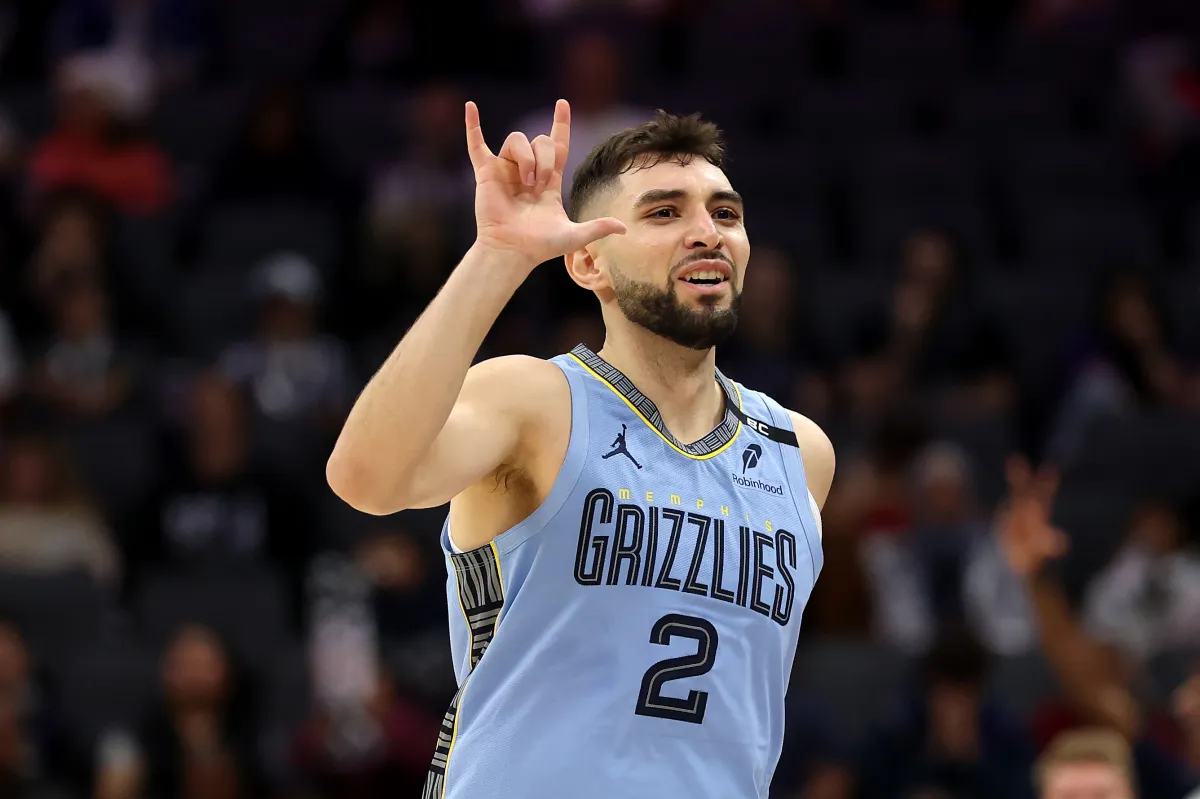
The NBA’s scoring leaderboard through the first week of a new season is supposed to read like a list of the usual suspects: Luka Dončić, Devin Booker, Zach LaVine, Tyrese Maxey. These are the names we’ve come to expect at the top, the superstars whose highlight packages define the league’s nightly drama and whose scoring titles feel almost preordained. So when the official numbers came out for the opening week of the 2026-27 campaign, there was a natural double take. Sitting above all of them, with an average of 34.7 points per game, was Ty Jerome. Not a misprint. Not a temporary blip from a hot-shooting role player. The Memphis Grizzlies point guard, a former first-round pick who had spent years bouncing around the league as a backup and fringe rotation piece, had transformed himself into the most prolific scorer in basketball. It was the kind of story that makes the NBA so endlessly compelling, a reminder that even in an era dominated by predictable narratives and superteam calculations, there is still room for a player to redefine himself, to grab hold of an opportunity and refuse to let go. And for Jerome, this was not just a lucky week or a favorable schedule. It was the culmination of years of subtle development, of waiting for the right system, of trusting his own shot even when others seemed unsure. What made it even more impressive was the context: these were not empty stats accumulated during blowout losses. Each of his scoring outbursts came in a Memphis victory, and together they helped propel the Grizzlies to an undefeated start.
The season opened with a statement that no one saw coming. Facing the Utah Jazz on the road, Jerome poured in 45 points, a stunning career-high and a personal exclamation point for a player who had entered the league nearly a decade earlier as a promising but unspectacular rookie. The performance was not simply about volume; it was about timing. He hit tough shots with defenders in his face, attacked switches, pulled up from deep with confidence, and somehow managed to get to the free-throw line at will. When the final buzzer sounded, the Grizzlies had a comfortable win, and Jerome had quietly introduced himself to a new stratosphere of offensive basketball. But the real test was always going to be whether he could do it again. The Golden State Warriors have a way of exposing overconfident play, of forcing the ball out of a scorer’s hands and turning individual brilliance into isolation stagnation. Jerome, however, adapted. He came back two nights later with 28 points, a slightly quieter but far more controlled performance, picking his spots and letting the game come to him. In that second win, he showed another dimension: the ability to score within an offense, to remain patient, to let the defense dictate when and how he attacked. Then came the Sacramento Kings, another stiff challenge, and Jerome responded with 31 points, capping a week of relentless production. Three games, three victories, and an average that would make any All-NBA guard blush. More than the numbers, it was the consistency that stood out. He wasn’t shooting hot and then vanishing. He was systematically dismantling opposing defenses with a repeatable process, an evolving blend of three-point shooting, mid-range creativity, and relentless off-ball movement.
The league took notice. When the NBA announced its first Eastern and Western Conference Players of the Week, the Western honor went to none other than Ty Jerome, a recognition that would have seemed absurd just a few months earlier. For a player whose career had been defined by what he could not quite do, this was a moment of validation. The journey to Memphis had been anything but direct. Jerome was selected 24th overall in the 2019 NBA Draft, a pick acquired by the Phoenix Suns in a draft-night trade, and he arrived in Arizona with the polished pedigree of a Virginia Cavaliers national champion. That Cavaliers background was telling: he had been a winner, someone who understood the importance of shareable basketball, but he had never been asked to be a primary scorer. In the NBA, his role was quickly defined as limited. He spent parts of his early career in Phoenix, then moved to Oklahoma City, where he saw minutes but rarely served as a focal point. A stint with Golden State followed, and then Cleveland, each stop offering flashes of promise but never the kind of sustained opportunity that would allow him to discover his full potential. It would have been easy to give up, to accept the label of a reliable backup who might one day earn a modest contract and a supporting role. Instead, Jerome kept sharpening his craft, kept building confidence in his own game, and waited for a situation that understood what he could become.
That situation arrived with the Grizzlies. In the 2025-26 season, Jerome played 15 games for Memphis and averaged a career-high 19.7 points per game, a breakout that hinted at what was to come. But even those numbers could not fully prepare anyone for the explosion that followed. Perhaps it was the familiarity of a second season in the same system, perhaps it was the trust of coaches and teammates, or perhaps it was a simple matter of timing and health. All those factors seemed to converge with the arrival of a new season. Jerome began playing with an aggressive freedom that had never been part of his reputation. He used screens with more intent, cut harder, and shot with the kind of confidence that borders on arrogance. What made him particularly dangerous was that he was not simply a one-dimensional shooter. He could operate in pick-and-rolls, make the right pass when defenses collapsed, and even hold his own defensively, enough that his scoring did not become an invitation for the opponent to attack him. The Grizzlies, a team with a young, athletic core, suddenly had another engine, someone who could change the rhythm of a game in the half-court and provide a calming presence in late-game situations. His teammates fed off his energy, and the fans in Memphis began to believe that this was not merely a hot stretch but a genuine transformation. There is something deeply human about watching a player finally find his moment. Ty Jerome had always had the talent; what he had lacked was the leash to let it run. Now, with the Grizzlies, he was being encouraged to shoot, to drive, to take risks, and he was responding with performances that made headlines and turned the league’s attention toward Memphis.
The challenge now is sustaining it. Maintaining momentum in professional sports is one of the hardest things to do, especially for a player who has spent years being undervalued. The Grizzlies will get an immediate test on Monday night, an early-season rematch against the same Utah Jazz team that Jerome scorched for 45 points in the opener. The Jazz will be waiting, with an adjusted game plan, extra attention on his every movement, and a determination to force someone else to beat them. How Jerome responds will tell us a great deal about whether this is a true breakthrough or simply a magnificent but fleeting moment. For the Grizzlies, the rematch is an opportunity to prove that their 3-0 start is no fluke, that the team has found a new identity and a new offensive hierarchy. For Jerome, it is an opportunity to show that he belongs among the league’s elite scorers, that his opening week was not an outlier but a proclamation. There is also the matter of fatigue, both physical and mental, as he will now face the pressure of increased defensive attention, longer stretches with the ball in his hands, and the expectation that he must replicate his numbers night after night. But if his past journey tells us anything, it is that Jerome does not shy away from difficulty. He has already overcome being traded, being waived, being sent to the end of benches, and being forgotten by the wider basketball public. Playing with a target on his back is a far more pleasant problem to have, and he seems ready for it.
In the end, Ty Jerome’s emergence is a beautiful reminder of why the NBA’s regular season can still surprise us. We spend so much of our time obsessing over rankings, mock drafts, trade rumors, and the same handful of super- stars that we forget the league is filled with players who are one opportunity away from rewriting their careers. Jerome was never supposed to be a leading scorer. He was supposed to be a role player, a system guard, a nice story for a few years before fading into basketball memory. Instead, he has turned his career inside out and proved that labels are often just cages. His name at the top of the scoring leaderboard is not just a statistical anomaly; it is a testament to persistence, to the incremental improvements that happen away from the spotlight, to the courage required to keep believing when everyone else has already written your story. And for the Grizzlies, who have a history of welcoming unconventional heroes, he is the perfect frontman for a season that is just beginning. There will be ups and downs, bad shooting nights and turnovers, games where the ball simply will not go in the basket. But for one glorious week, Ty Jerome was the best scorer in the world, not by reputation but by production, not through hype but through hard work. It is the kind of story that makes people fall in love with sports, and it is far from over. When Monday night’s rematch tips off at 9 p.m. ET, all eyes will be on the man who made the Grizzlies the talk of the league. The Jazz will come after him with everything they have, and Jerome will have to prove once again that his new reality is not just a dream. If the first week is any indication, he will not just survive the challenge. He will score his way through it, one impossible shot at a time, turning every doubt into fuel and every skeptic into a believer.