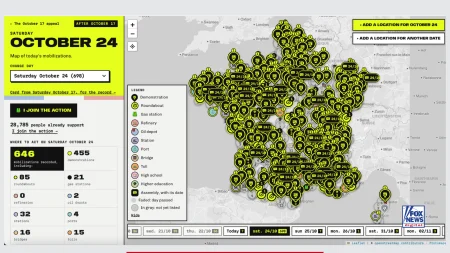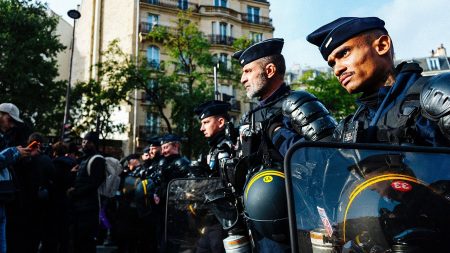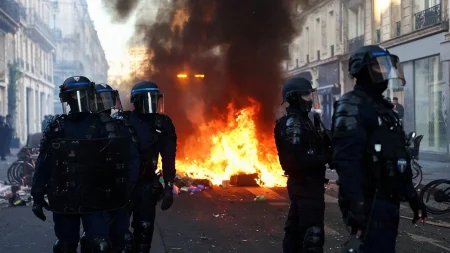


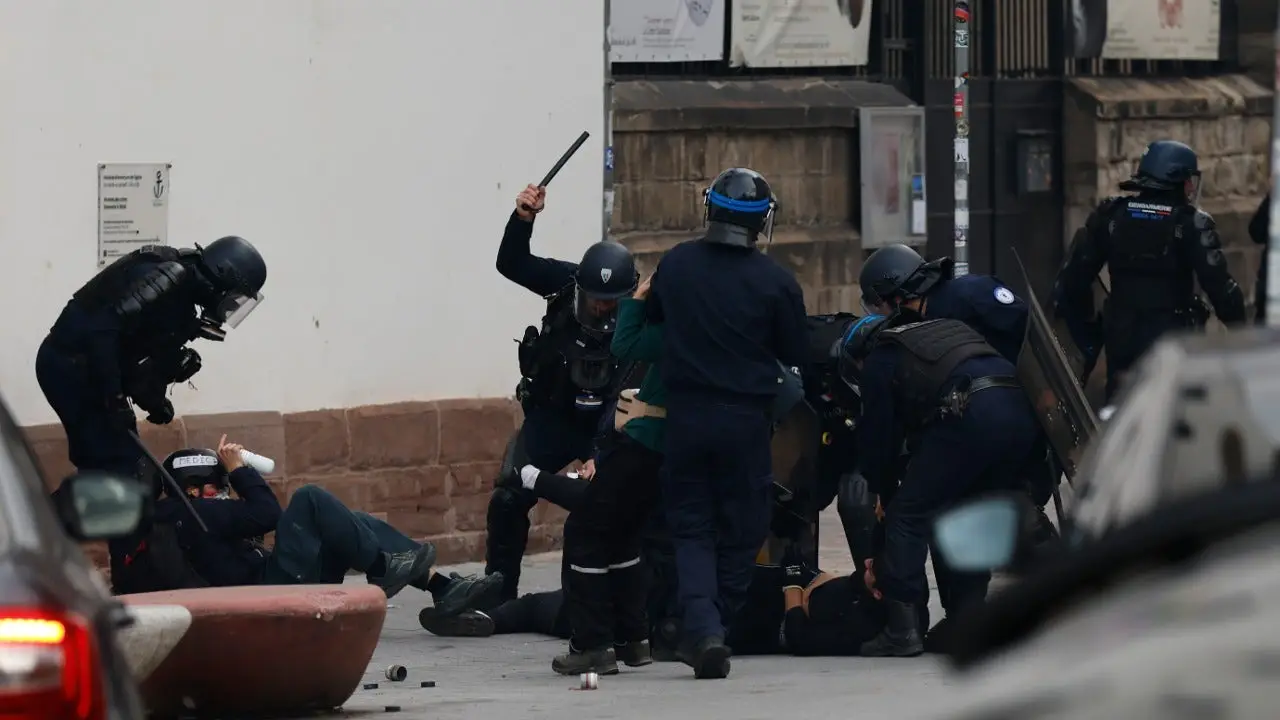
Saturday in France unfolded under a shadow of tension, as nationwide protests resumed and French authorities moved aggressively to keep the peace. Interior Minister Laurent Nuñez announced that 135 people had been arrested so far, with most of those arrests coming after police conducted preemptive searches of demonstrators. According to Reuters, the individuals taken into custody were found carrying objects that could easily become weapons—fireworks, ball bearings, and other items that had no place in a peaceful demonstration. The strategy was clear: stop troublemakers before they could start trouble. For many protesters, however, the heavy-handed approach felt like a violation of the very rights they were marching to defend. There is a delicate line between ensuring safety and infringing on civil liberties, and on this sweltering weekend, France found itself wrestling with that line on every street corner. The scenes were both familiar and unsettling—crowds chanting, banners waving, and ordinary citizens walking side by side with people whose intentions were far less certain. Police officers, many outfitted in riot gear, stood in long lines, their faces hidden behind helmets, scanning the crowds for signs of escalation. The mood was not one of celebration but of wary determination. Parents pushed strollers among demonstrators, elderly men and women held handmade signs, and students with backpacks stood shoulder to shoulder with union members. Yet, everyone knew that the day could turn at any moment. The arrests, Nuñez explained, were necessary to protect the majority of peaceful marchers from a minority bent on chaos. But for those watching from their windows, the sight of so many police vehicles and officers in body armor only reinforced the feeling that something had gone deeply wrong between the people and their government.
Paris, the grand stage of French history, looked like a city bracing for siege. Tens of thousands of people filled the streets, their voices rising in unison, but the atmosphere was far from festive. Police conducted more than 3,000 checks in the capital and made 65 arrests, according to the BBC. The Paris Police Department issued a blunt statement: “Violent individuals have no place in the marches. The objective is clear: to prevent troublemakers from joining the procession, and to ensure the safety of the demonstrators.” Those words were meant as reassurance, but the visual evidence suggested otherwise. Shopkeepers across central Paris had boarded up their storefronts with heavy plywood, turning elegant boulevards into gray, barricaded corridors. Museums that ordinarily welcomed millions of visitors each year locked their doors and placed signs advising of closures. More than twenty metro stations suspended service, leaving both regular commuters and confused tourists to find alternative routes through a city that seemed to be holding its breath. The sense of normal life being suspended was palpable. Bakers, who had risen before dawn to prepare their croissants and baguettes, stood behind closed shutters, peering nervously through narrow gaps. Cafés that usually spilled onto the sidewalks were empty, their chairs stacked on tables behind glass doors. Even the pigeons that normally strutted through the central squares seemed to sense that something was off. For many Parisians, it was a strange and painful déjà vu—a memory of past protests and riots that had scarred the city, followed by the slow, difficult work of reconstruction and reconciliation. Tourists, many of whom had arrived expecting romance and beauty, found themselves navigating a landscape of police barricades and metal detectors. Some took photographs, others looked frightened, and a few simply sat on curb edges, waiting for the streets to open up again. The city was not completely shut down, but it felt like a place holding its breath, waiting to see whether the anger would remain peaceful or explode into the kind of violence that had made headlines around the world.
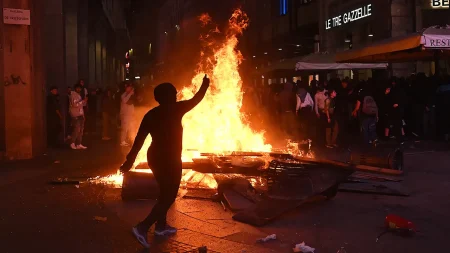
Beyond the capital, the story was even more volatile. In cities like Clermont-Ferrand, Grenoble, Lille, and Nice, police resorted to firing tear gas to break up unruly crowds that refused to disperse. The sharp, acrid clouds drifted through narrow streets, sending coughing demonstrators running for open air. In Nice, authorities used a water cannon to push back a group of protesters who had ignored repeated orders to retreat, sending powerful jets of water crashing into the crowd. In Marseille and Lyon, the situation escalated into direct clashes between police officers and hooded youths, the sounds of shouts and shattering glass echoing through residential neighborhoods. For the people who live in these cities, the unrest turned ordinary afternoons into moments of fear. Mothers rushed children indoors, shopkeepers pulled down metal shutters, and elderly residents watched in disbelief as young people in masks faced off against lines of police. The hooded figures were not a unified movement; they were a mix of angry teenagers, opportunists, and radicals who seemed more interested in destruction than in dialogue. But their presence turned every protest into a test of nerves. Emergency services worked overtime, and hospitals braced for possible injuries. Local officials pleaded for calm, but their words were often drowned out by the sound of sirens. For many ordinary French citizens, the clashes were heartbreaking because they overshadowed the legitimate grievances that had first brought people into the streets. The peaceful teachers, students, and workers who wanted to voice their concerns found themselves sharing space with what the government called agitators—and it was the agitators who dominated the news cycle. Yet, to simply blame a few bad apples would be to ignore the deeper anger that simmered beneath the surface. The chaos in Marseille and Lyon was not a random act of violence; it was the explosive result of long-festering frustrations over inequality, unemployment, and a sense that the government did not care about the struggles of everyday people. In those streets, the distinction between protester and rioter blurred, and the voices of reason were drowned out by the sound of breaking windows and the hiss of tear gas canisters.
The government’s response was massive and unapologetic. Around 70,000 police officers were deployed across the country to clamp down on agitators and prevent a repeat of the unrest seen during recent demonstrations. The memories of those days were still raw: cars torched in the middle of the night, the City Hall building in Limoges set ablaze, and looters rushing into broken storefronts to steal whatever they could carry. Last weekend alone, more than 2,700 people were arrested during protests that degenerated into riots and stealing sprees. Shopkeepers who had spent years building their businesses watched in horror as their livelihoods were destroyed in minutes. Firefighters battled flames while dodging projectiles thrown by masked individuals. Police officers, many of whom were exhausted and frustrated, felt they were caught between a burning city and a public that blamed them for the violence. The deployment of 70,000 officers was meant to be a show of strength, but it also reflected a deep anxiety within the government: this was not a routine demonstration but a national crisis. In the days leading up to Saturday, officials had worked around the clock to coordinate a security plan that would allow peaceful protest while preventing the chaos that had previously shredded the fabric of order. They set up special mobile units, authorized water cannons, and gave commanders the authority to make arrests without waiting for violence to erupt. Human rights groups criticized the preemptive arrests as disproportionate, but many residents in affected areas welcomed the police presence. “At least they’re trying to protect us,” one shopkeeper reportedly said as he hammered nails into a wooden board across his window. The sheer scale of the operation was difficult to miss: columns of police vans rumbling through cobblestone streets, officers standing shoulder to shoulder at major intersections, helicopters buzzing overhead like mechanical wasps. But the force, however impressive, was only a symptom of the problem. It treated the fire but did not extinguish the underlying anger. And as the sun set on Saturday, many wondered whether the massive police presence had brought safety or simply postponed the reckoning.
At the heart of this unrest were not the hooded youths or the looters, but students and their very concrete frustrations. The protests began weeks earlier, led by high school and university students who were fed up with a public education system that was failing them. They spoke of teacher shortages that left entire classes without instructors, while others were forced to study in overcrowded classrooms where there were not enough desks or books. They described dilapidated buildings with leaky roofs, broken heating systems, and walls covered in mold. For these young people, the classrooms were not just uncomfortable—they were symbols of a society that had written them off. A student in Clermont-Ferrand told reporters that her history class had been cancelled for three weeks because no substitute teacher could be found. Another in Lyon described how his university library had been closed for months due to structural problems, leaving him with nowhere to study. These were not abstract political grievances; they were daily humiliations that made young people feel invisible. They marched not with sophisticated ideological slogans but with simple, heartfelt demands: we want teachers, we want space, we want a childhood that does not feel like a struggle. The movement grew quickly because so many students recognized their own experience in these stories. High schoolers walked out of classes, university students organized sit-ins, and teachers themselves joined the rolling strikes, adding their own voices to the chorus. The government responded with promises of funding and reforms, but for the students, the promises rang hollow. Years of budget cuts and neglect had created a generation that felt abandoned. Their anger was not directed at any single person but at a system that seemed to value numbers and statistics more than human beings. As the student movement gained momentum, it caught the attention of larger forces. Labor unions, seeing an opportunity to channel this energy, stepped in to support the demonstrations, broadening the cause far beyond the walls of the classroom.
When the major labor unions joined the protests, the student movement transformed into a nationwide expression of discontent. The demands expanded to include opposition to government austerity policies, concerns over wages and pensions, and the rising cost of living that was squeezing households across France. Nurses who had worked through the pandemic and were still earning poverty wages marched alongside railway workers, teachers, and retirees. Grandmothers who had spent their entire lives contributing to the social system now worried that they could not afford to heat their homes or buy fresh food. Young workers, burdened by precarious contracts and soaring rents, saw their futures slipping away. The protests became a rare moment of solidarity between generations, each group understanding that the other’s pain was connected. The labor unions brought organization, resources, and a sense of discipline that the student movement had lacked. They set up carefully planned routes, marshals to keep the peace, and a platform of demands that resonated far beyond campus quads. But they also inherited the problem of the radicals, the black-bloc extremists who viewed every protest as a chance to confront the police. The marchers, peaceful and vocal, tried to distance themselves from the violence, but the images of flames and tear gas continued to shape public perception. Government officials pointed fingers at the hard left, accusing revolutionary groups of infiltrating and hijacking the demonstrations. Some moderate union leaders feared that the violence was undermining their cause, while others argued that the anger would have exploded regardless of who was leading. On the ground, the mood was one of urgency. People did not want to riot; they wanted to be heard. They wanted the government to acknowledge that their concerns were real and that the policies of restraint and cutback had damaged their daily lives. But with every escalation of force, every water cannon, every arrest, the distance between the state and the people grew wider. As night fell over France, the streets emptied, police remained on guard, and the city lights reflected off boarded windows and broken glass. The demonstrations had spoken, but whether anyone in power was listening remained an open question—one that the people of France, weary and hopeful in equal measure, would continue to ask in the days to come.