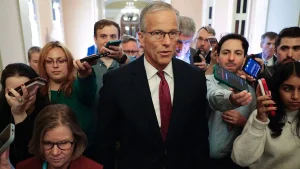


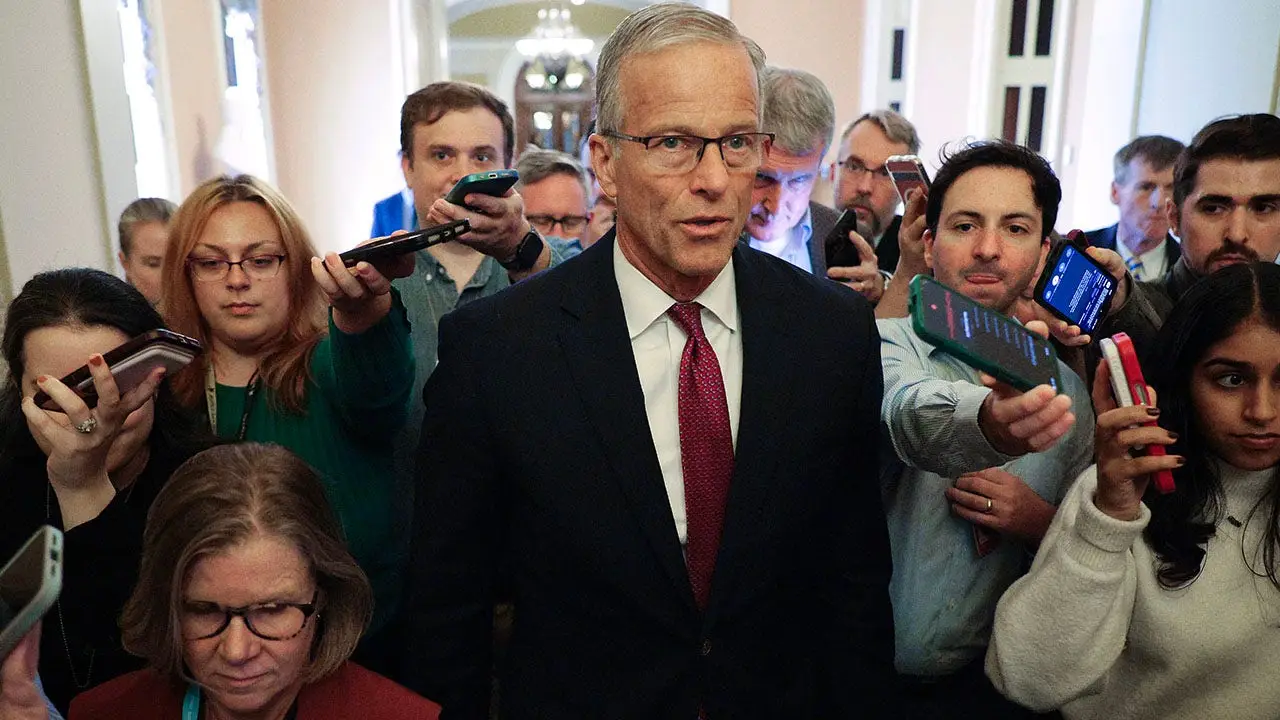
FREMONT, Neb. — The closing days of a campaign are usually full of nervous second-guessing, but Senate Majority Leader John Thune is determined to project calm. The South Dakota Republican has been on a cross-country sprint to support vulnerable GOP senators, making stops in states where the political weather has turned ugly and trying to reassure voters that the party’s narrow Senate majority is not as fragile as it looks. Thune, who holds the gavel in a Senate divided 53 to 47 in favor of Republicans, knows that defending a majority can be like trying to hold sand in your hand. Every race matters, and even a single loss could change the legislative agenda for the next two years. His latest appearance came in Fremont, Nebraska, next to Republican Sen. Pete Ricketts, who is not considered one of the party’s main worries. But the visit was less about Ricketts than about the message it sent: Republicans are not going to concede any ground. In an interview with Fox News Digital, Thune admitted that this has been a difficult cycle, with headwinds blowing against the GOP and several races that were once comfortably red suddenly looking competitive. Yet he framed those races as “jump balls”—close contests where any outcome is possible—and made clear he believes the public polling is not telling the whole story. “I think the polling right now, like it has been in past elections, under-reflects the Republican vote,” Thune said. That is his core argument: the polls are systematically missing Republican voters, and when they show up on Election Day, the map will look much better than the forecast. Thune repeated that the party is “not giving up on any of them,” a phrase he has been using on the trail to keep candidates and donors from losing hope. With just days to go, his job is part strategist, part cheerleader, and he seems to be enjoying the fight.
Thune’s optimism, though, is being tested by a political environment that has shifted under the GOP’s feet. Republicans are currently defending six Senate races that independent handicappers consider toss-ups, and in some places the picture has gotten noticeably murkier. Kansas, for instance, was supposed to be a safe Republican hold, but Sen. Roger Marshall is now locked in one of the more unexpected nail-biters of the cycle. Mississippi and South Carolina, two states that Republicans have historically dominated, have also drifted closer to the Democratic column in recent polling, giving Democrats reason to dream about expanding the map into deep-red territory. Thune acknowledges all of this, but he insists that public surveys are not the whole story. He believes that Republican voters are consistently under-sampled in the polls, and that the same dynamic that has surprised political observers in previous elections will show up again this time. That is why he keeps telling candidates and local party leaders that they cannot afford to be depressed by the numbers. Instead, he says, they should focus on the mechanics of getting out the vote, especially among “low propensity” voters who supported former President Donald Trump in the past but may not vote in midterms unless they are personally contacted and reminded. In Thune’s view, a strong ground game can overcome a bad poll. He has been traveling to state after state, meeting with county chairs, shaking hands at local events, and delivering the same message: the race is not over until the last vote is counted. The energy he says he sees on the ground does not match the gloomy forecasts, and he is betting that the disconnect will show up on Election Day.
One of the clearest signs of the GOP’s anxiety, however, is not in the polling but in the money. Campaign cash is always a tell in the final weeks of an election, and where the biggest Republican groups are choosing to spend—or not spend—paints a revealing picture. The Senate Leadership Fund, a super PAC closely aligned with Thune, recently moved millions of dollars out of Georgia and into Kansas, a shift that surprised many political operatives. Georgia had been seen as a top pickup opportunity for Republicans, with Rep. Mike Collins challenging Democratic Sen. Jon Ossoff, a first-term incumbent who has become a major fundraising powerhouse. But Ossoff has consistently led Collins in the polls, and his campaign has been drowning the airwaves in ads. Rather than continue pouring money into what looked like a losing cause, the Senate Leadership Fund decided to redirect resources to Kansas, where Marshall suddenly found himself fighting for his political life. The move was a practical decision, but it was also an admission that the GOP’s original math had changed. Republicans had hoped to go on offense against Ossoff, but they are now spending more time trying to protect seats that should never have been in danger. That is not the sign of a party that feels entirely secure. Thune, though, spins the funding shift as part of a larger strategy. He says the party is being nimble, moving money where it is needed most, and refusing to waste resources on races that are no longer competitive. Whether that sounds like clear-eyed realism or a quiet retreat depends on who is talking.
Nowhere is the tension more visible than in North Carolina, a state that Republicans once considered a reliable part of their Senate majority. When incumbent Sen. Thom Tillis decided to retire, the GOP turned to Michael Whatley, a former co-chair of the Republican National Committee and a close ally of Donald Trump. But Whatley has found himself in a brutal fight against Roy Cooper, the former Democratic governor of North Carolina, who has name recognition, a moderate image, and a strong fundraising operation. Recent polls have shown Cooper with a lead, and the outside money that once flowed toward Whatley has begun to dry up. The Senate Leadership Fund pulled back nearly all of its North Carolina spending earlier this month, a move that political observers read as a sign that national Republicans no longer believe the race is winnable. Even Trump, who held a rally for Whatley on Tuesday, admitted that he is worried. “I think he’s a great man, and I am worried about him,” Trump told reporters. “I hope he wins. He was a great leader for the whole Republican Party when I won, and he’d be a great senator.” That kind of public doubt from the party’s most popular figure is not exactly what a struggling candidate wants in the final days. Thune, however, continues to sound confident about the GOP’s chances, even in North Carolina. He argues that the polls have been consistently wrong about Republican support, and that Whatley’s ties to Trump and the base will help him pull off an upset. But the funding decisions and Trump’s own comments suggest that the party’s Establishment is bracing for the possibility of another loss.
Meanwhile, Democrats are feeling a surge of optimism that they haven’t experienced in years. They believe a blue wave is building, and they are pointing to three forces that could carry them back into the Senate majority: anger over the economy, frustration with conservative social policies, and a string of strong candidates in unlikely places. The Democratic Senatorial Campaign Committee has expanded its target list to include states that were not even on the map a few months ago. In Mississippi, where Republican Sen. Cindy Hyde-Smith is seeking reelection, Democratic challengers have been raising serious money and running competitive campaigns. In South Carolina, where Republican Sen. Lindsey Graham has long been a fixture, Democrats believe the race has become closer than it has been in decades. And in states like Iowa and Missouri, where Republicans have usually had comfortable margins, the numbers have tightened enough that both parties are paying attention. Republicans have tried to counter by pouring hundreds of millions of dollars into Senate races, and outside GOP groups have maintained a significant spending advantage. But Thune and his allies know that money alone cannot save every incumbent. Voters are angry, the national mood is volatile, and the usual rules of political gravity seem to be shifting by the day. Thune’s response to all this is to keep reminding Republicans that the fundamentals still favor them: the electoral map is better for the GOP, the conservative base is motivated, and Democratic candidates are being forced to defend a president and a party that many voters blame for inflation and cultural chaos. It is a familiar argument, and Thune is making it with all the energy he can muster.
In the end, Thune’s faith comes down to one word: turnout. He believes that Republicans can hold the Senate if they get their voters to the polls, especially the kind of lower-propensity voters who came out for Trump in past elections but sometimes stay home during midterms. In every state he visits, Thune says, the focus is on identifying those voters, contacting them repeatedly, and making sure they have a plan to vote. “Turnout’s going to be a big part of whether or not we’re successful or not,” he said. “And in every state I’ve been in, that is a clear-eyed focus of our candidates.” He also believes that Republicans need to win over a meaningful slice of the middle—independents and moderates who might be wary of the GOP’s most extreme voices but are equally uncomfortable with the direction of the Democratic Party. That is a delicate balancing act. Trump’s presence on the trail can energize the base, but it can also alienate swing voters. Thune seems aware of this, and he has been careful to frame the election as a choice between two very different visions, not just a referendum on the current president. As he wrapped up his visit to Nebraska, he sounded almost defiant in his prediction. “I think that we’re gonna outperform the polls for sure come Election Day,” he said. Whether that is a genuine assessment of the race or just the brave face of a leader trying to hold his party together, it will be put to the test soon enough. For now, Thune is doing what leaders do in the final days of a campaign: pretending to know what the outcome will be, and hoping the voters prove him right.