


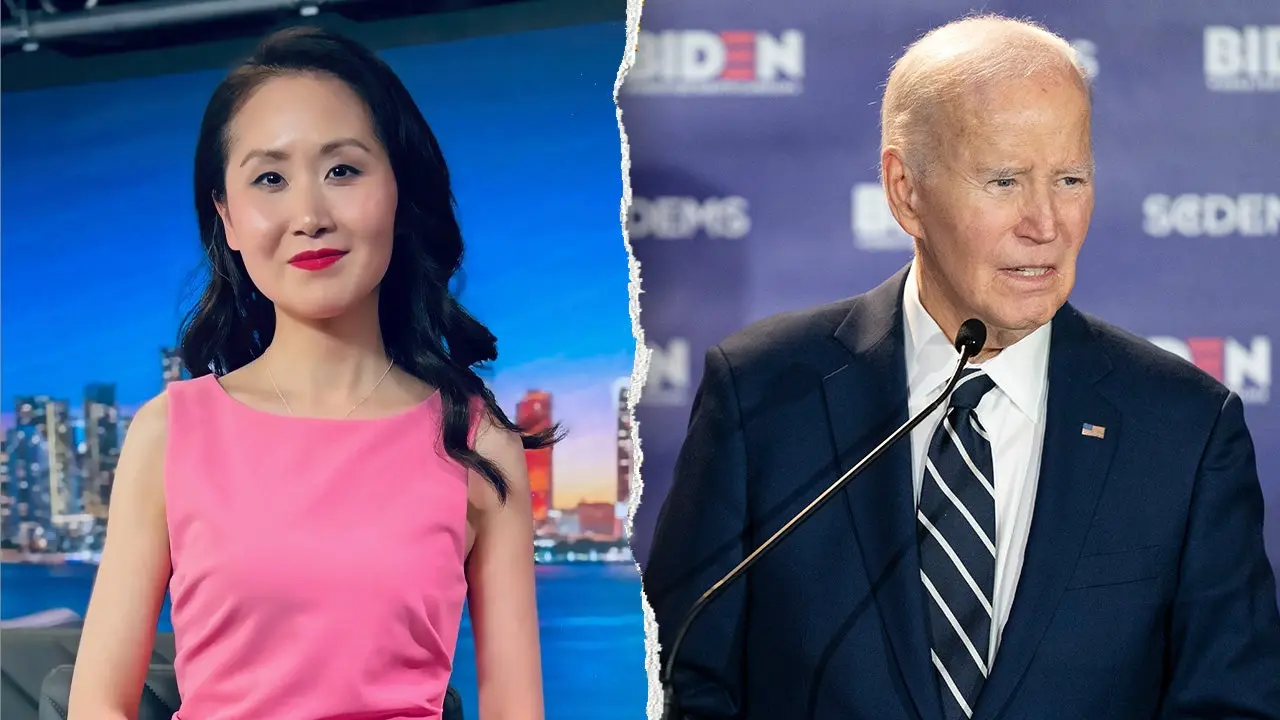
There are moments in politics when the people closest to the fire see the smoke long before the flames become visible to everyone else. Lindy Li was one of those people. A former Democratic fundraiser who once moved comfortably inside the party’s most powerful circles, Li now describes herself as a conservative, but her journey away from the Democratic Party was not born out of ideological spite. It was born out of frustration, disappointment, and a deep sense that the people in charge were refusing to see what was right in front of them. During the 2024 campaign, Li says she warned party leaders about then-President Joe Biden’s cognitive decline. She was ignored. Her warnings were brushed aside, perhaps inconvenient, perhaps uncomfortable, but in her view, entirely accurate. And now, watching the Democratic Party in 2026, she sees the consequences of that willful blindness. The party is not just struggling; it is being hollowed out. And into that hollow space, she says, has stepped the Democratic Socialists of America. Li does not mince words when she talks about the DSA. “They’re a metastasizing cancer,” she told Fox News Digital. It is a striking image, and she means it in the most serious way possible. But she is also careful to explain that the DSA did not create the current crisis on their own. They simply walked into a vacuum. “Power abhors a vacuum,” she said. “They’re simply filling a vacuum. There’s no one there.” In her view, the Democratic establishment has left the building, and the socialists have moved in. For anyone who has watched the party over the last decade, her words carry a painful ring of truth.
The mechanics of how the DSA gained such influence are not mysterious to Li. She lived it. In 2018, when she was running for Congress in Pennsylvania’s 5th Congressional District, she encountered what she describes as a kind of political extortion dressed up as civic engagement. The DSA handed her a questionnaire. It was not a suggestion. It was not a voluntary opportunity to share her views. It was, in her telling, a demand: everyone in this congressional race must fill out this questionnaire. Li says she felt she had no choice but to comply, and she did not expect the answers to come back and haunt her. But they did. The answers were attached to her name, preserved forever, even making their way onto her Wikipedia page. She laughs about it now, but there is a bitter edge to the humor. “So now on my Wikipedia page it has me as some tree-hugging, marijuana-supporting whatever,” she said. “I said none of that. They just grabbed it from the questionnaire.” The anecdote is a window into how the DSA operates. They do not need to win every election in order to win the broader war. They simply need to get candidates on the record, force them to adopt positions, and then hold those words over their heads later. Li describes the people behind these efforts as “over-educated bums,” a sharp insult that reflects her disdain for what she sees as an ideological movement more interested in purity than practical governance. But whatever one thinks of her language, the strategy has worked. Candidates across the country have been pushed further and further left, often against their own instincts, simply because the DSA has been organized, relentless, and unafraid to play the long game.
The results of that long game are now visible in the 2026 election cycle, where DSA-backed candidates have enjoyed a string of victories that have stunned many political observers. Li, however, is not stunned. She saw this coming years ago. The establishment Democratic Party, in her view, has offered no real resistance, no compelling alternative, and no reason for voters to feel inspired. She points to the contrast between this moment and previous election cycles. In 2006, at this same point in the cycle, the Democratic Party had clear, dynamic figures ready to take the stage. Barack Obama had already delivered his famous speech at the 2004 Democratic National Convention, the one about how there is no blue America and no red America, only the United States of America. Everyone knew he was going to be a major player. Hillary Clinton was also a household name, a formidable force with a powerful machine behind her. The party had a bench. It had energy. It had ideas. What does it have now? Li asks. Who is the candidate? We do not know. There is no single figure who has captured the imagination of the party, no one who seems ready to carry the mantle, no one who can stand on a stage and make Americans believe that the Democratic Party has a vision for the future. And that, Li argues, is precisely the problem. The vacuum is not just at the top; it is everywhere. Into that vacuum step the socialists, with their questionnaires, their organized cadres, and their willingness to show up. They are not necessarily winning because Americans suddenly embrace socialism. They are winning because no one else is fighting for the space.
If there is a single figure who embodies the failure of the Democratic establishment, Li believes it is Ken Martin, the chair of the Democratic National Committee. She does not even try to hide her contempt. She calls him a “milquetoast man” who nobody remembers. It is a brutal assessment, but it is also a strategic one. Li argues that the Democratic Party needs a leader who is unforgettable, dynamic, vigorous, someone who can launch a compelling argument to the American people. Instead, she says, the party has chosen someone who fades into the background, someone who cannot compete with the energy and aggression of the DSA. And the problems are not just about personality. The party is, in Li’s words, broke. The DNC has accumulated massive debt, and in a move that would have been unthinkable just a few years ago, it used its own headquarters as collateral to secure a loan. Public records confirmed that the DNC took out a $15 million loan, with the building as security, and the arrangement allowed the group to withdraw an additional $5 million if needed. On top of that, campaign finance records showed the DNC was carrying almost $18.5 million in debt as of June 30. It is a staggering financial situation. “Ken Martin is a joke,” Li said, and the financial picture only reinforces her argument. How can a party that cannot pay its bills, that has to put its own headquarters on the line, compete against a movement that is motivated, organized, and absolutely certain of its own mission? The Democratic establishment is not just losing the ideological battle; it is losing the institutional one as well. And Li believes the party’s own leaders have no one to blame but themselves.
Li’s story is not just about the present. It is about a decade of ignored warnings. She says she was raising alarms about the DSA long before it became a mainstream concern. In 2020, she appeared in a Fox News documentary that warned against the DSA, and she says the message was clear then, just as it is now. “I kid you not,” she said, “these people have been poisonous for a very long time.” She saw them as an internal threat, a force that was eating the Democratic Party from the inside out. And now she is preparing to tell the broader story in her own words. Her upcoming book, titled “Unburdened,” promises to expose the Democratic leaders who covered up Biden’s cognitive decline and, presumably, to reveal the deeper dysfunction that allowed the party to drift so far from its own voters. The title itself is telling. Li has spent years carrying the weight of what she witnessed, the warnings that were dismissed, the truths that were inconvenient, the party that she once loved and believed in turning into something she no longer recognizes. She now considers herself a conservative, but her critique of the Democratic Party is not simply the gloating of an opponent. It is the lament of someone who saw the cracks forming long before the wall came down. She sounds like a former insider who has watched a once-great institution surrender itself to extremists, not because the extremists were so powerful, but because the moderates were so weak. That is a harder story to tell, but it is the one Li is telling.
In the end, Li’s warning is not just about the Democratic Party. It is about what happens when a major political institution loses its sense of purpose. The DSA is not, in her view, the root cause of the problem. The root cause is the vacuum. The root cause is the failure of leadership. The root cause is a party that spent so much time protecting itself from internal threats that it never noticed the external takeover happening right under its nose. Li’s language is harsh, and some will dismiss her as a bitter ex-insider or a partisan turncoat. But the facts she points to are difficult to dispute. The Democratic Party is in debt. It lacks a clear leader. It has no obvious presidential candidate. It is losing primary after primary to candidates who are further left than the voters themselves. And into that void steps an organization with a clear agenda, a disciplined strategy, and a willingness to do the unglamorous work of showing up, handing out questionnaires, and making candidates commit. Whether the DSA is a cancer or just a symptom, Li’s message is essentially the same: the Democratic Party has abandoned the battlefield, and someone else is now claiming the ground. Her book, her interviews, and her public statements all carry the same urgency. She wants Americans to understand what is happening before it is too late. But for now, she sounds less like someone who expects the party to wake up and more like someone who has already watched it die. The only question left is who will inherit the remains.