

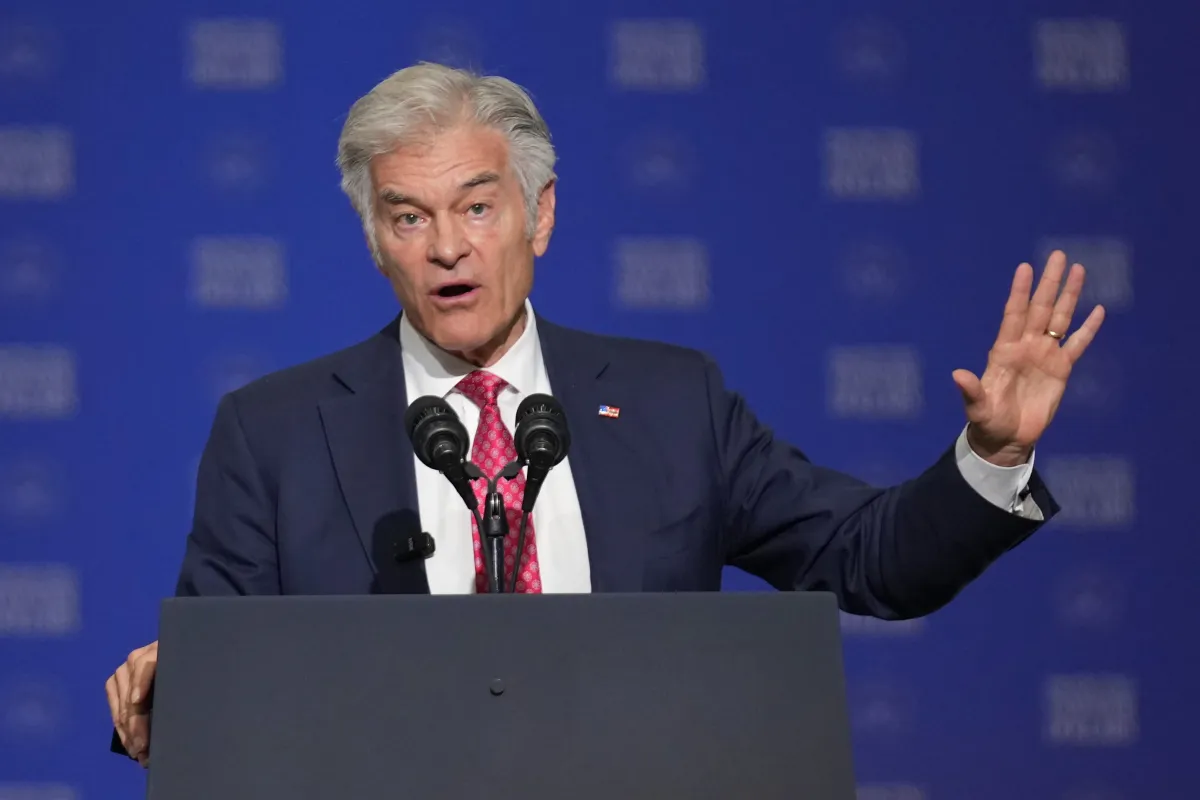
In a striking moment of candor that broke the mold of a tightly controlled government narrative, Dr. Mehmet Oz, the administrator of the Centers for Medicare and Medicaid Services, stepped into the national spotlight on Sunday to draw a very public, very firm line between political rhetoric and medical reality. Appearing on CBS News’ Face the Nation, he directly confronted the administration’s own messaging regarding the combined measles, mumps, and rubella (MMR) vaccine, bluntly stating that it is “not a lethal vaccine.” The comment was not made in a vacuum; it was a direct rebuttal to President Donald Trump’s extraordinary assertion, made just days earlier during a White House executive order signing ceremony, that the long-standing combination shot “could be quite lethal.” Host Margaret Brennan, pressing the issue with pointed persistence, forced Oz to clarify a statement that had sent shockwaves through the medical community and left millions of parents confused and anxious. As he faced the camera, Oz acknowledged the gravity of the moment, attempting to balance his loyalty to the administration’s broader vaccination overhaul with the undeniable, decades-old scientific consensus that the MMR vaccine is one of the safest and most effective interventions in modern medicine. His clarification managed to soothe the immediate fears of many viewers, but it also exposed a deep fracture in the administration’s public health strategy—one where the highest-ranking health officials are now forced to publicly disavow the commander-in-chief’s most dangerous exaggerations. Oz’s firm denial, while necessary, serves as a stark reminder of the collateral damage caused when political ideology collides with the precision of public health data, leaving everyday families to untangle the mixed signals.
The controversy traces back to a sweeping executive order signed by President Trump earlier in the month, which aimed to radically overhaul the federal government’s approach to childhood immunization. During that ceremony, the president voiced a long-disproven theory that the combined MMR shot—which has been administered safely to children for over forty years—carries hidden dangers when given as a single injection. He proposed that the components be separated into three distinct shots, administered at different times, arguing that the individual vaccines are “not at all lethal, but just very effective” when given alone. The president offered no scientific evidence to substantiate these claims, and notably, the official order goes far beyond just the MMR vaccine. It directs the Department of Health and Human Services (HHS) to reconsider the entire childhood vaccine schedule, placing various immunizations, including RSV monoclonal antibodies and hepatitis vaccines, into a “high-risk” category, thereby narrowing routine access. It also encourages states to space out all pediatric immunizations “to the maximum extent feasible.” While the president and his allies frame this as a matter of parental choice and safety, the immediate practical reality renders the directive almost impossible to follow. The manufacturer, Merck, which produces the sole MMR vaccine in the United States, has stated unequivocally that separate single-antigen shots are not a product it can provide anytime soon, indicating it would take at least another decade to develop, license, and distribute them. This leaves the executive order as a symbolic, yet dangerous, gesture—a policy mandate that exists on paper with no corresponding supply chain, while simultaneously undermining trust in the very vaccine that is currently available to protect children from a deadly, resurgent virus.
In his attempt to rationalize the president’s stance during the interview, Dr. Oz looked abroad for historical context, specifically to Japan, where a combination MMR vaccine was indeed suspended back in 1993. Oz noted that other countries offer the measles vaccine separately, which is true, but his explanation glossed over a complex and cautionary history that ultimately reveals the danger of abandoning the combined shot. The Japanese ban was not triggered by vague fears of lethality, but by a specific and tragic manufacturing issue: a particular strain of the mumps component caused some vaccinated children to develop aseptic meningitis, a severe inflammation of the protective membranes covering the brain and spinal cord. While the risk was real, the Japanese government did not simply abandon vaccination; instead, they pivoted to offering a separate measles and rubella (MR) vaccine, with a separately optional mumps shot. However, this fragmentation created a significant immunity gap that lingers to this day. Health officials only began administering a measles booster shot to Japanese children in 2006, meaning older generations who had received only a single dose—or who skipped the optional mumps shot—remain more vulnerable to infection and complications than younger cohorts. By citing Japan, Oz inadvertently highlighted the clinical superiority of the combined MMR vaccine that the U.S. currently uses. Rather than validating Trump’s proposal, the Japanese example demonstrates how logistical complexity and fragmented immunization schedules leave populations exposed for years, undermining the collective protection that the 95% vaccination threshold provides. Oz’s attempt to bridge his boss’s fantasy with reality was, at best, a clumsy mitigation—it acknowledged a historical anomaly without ever endorsing the notion that the American MMR vaccine carries any equivalent risk, but it failed to fully dispel the confusion his own president had generated.
The stakes of this political muddle are not academic; they are playing out in pediatric wards and school registrars across the country, where the United States is currently experiencing its most severe measles outbreak in more than three decades. According to the latest data from the Centers for Disease Control and Prevention (CDC) highlighted over the weekend, there have been 2,777 confirmed measles cases nationwide as of August 20, with 36 separate outbreaks occurring this year—accounting for a staggering 94 percent of all reported infections. Measles is not just a benign childhood rash; it is a highly contagious, airborne virus that can cause pneumonia, brain swelling (encephalitis), and permanent hearing loss, and it can kill. The surge in cases is a direct consequence of eroding immunization rates. The CDC data reveals that only about 92 percent of American kindergarteners received the MMR vaccine in the past school year, a figure that falls critically short of the estimated 95 percent threshold required to establish herd immunity—the communal barrier that protects infants who are too young to be vaccinated, as well as those with compromised immune systems. When vaccination rates dip below that 95% mark, the virus finds cracks in the armor, jumping from an unvaccinated child to a vulnerable adult or baby in a matter of minutes. Public health officials are watching these numbers with alarm, knowing that every week of vaccine hesitancy, fueled by unfounded claims from the highest office in the land, extends the life of the outbreak. Dr. Oz’s pushback is a welcome professional correction, but the damage of the president’s statements may already be influencing family decisions, adding a further layer of urgency to a crisis that is entirely preventable with a proven vaccine.
The medical establishment, along with a growing chorus of Republican and Democratic lawmakers, has reacted with unmistakable alarm to the executive order and the accompanying rhetoric. Senator Bill Cassidy, a Louisiana Republican and practicing physician, did not mince words, stating that the president “does not have the expertise to make these changes.” Cassidy warned that separating the MMR vaccine would not only increase the number of required doctor’s visits—each one exposing a child to potential contract with the measles virus—but would also substantially increase vaccine hesitancy by creating an unnecessary fear of the combined shot. Major public health organizations, such as the Partnership to Fight Infectious Disease, echoed this sentiment, issuing stark warnings that rewriting vaccine guidance during the largest measles resurgence in decades “will only leave more American children vulnerable to preventable illness.” The scientific consensus is unequivocal: the combined MMR vaccine is clinically superior because it delivers immediate, simultaneous protection against all three diseases. Splitting them into separate shots would leave children susceptible to measles and mumps for weeks or months while they wait for the following injection, creating a dangerously prolonged window of vulnerability. Furthermore, the president has continued to insinuate that separating the vaccines might impact autism rates, despite decades of comprehensive studies involving millions of children that have found zero credible link between the MMR vaccine and autism spectrum disorder. The executive order is essentially a policy dictated by anecdote and pseudoscience, rather than the rigorous clinical trials that underpin modern immunization. By challenging this order, health officials like Oz, Cassidy, and countless pediatricians are fighting to maintain the integrity of a system that has saved countless lives, while trying to protect children from a disease that was declared eliminated in the United States in 2000 but has now made a vicious comeback.
For American parents trying to navigate the conflicting headlines, the reality on the ground remains stark and confusing. Despite the executive order, the CDC’s official vaccine schedule has not changed at all; it still recommends the combined MMR shot at 12 to 15 months and again at 4 to 6 years. When a parent takes their child to a pediatrician today, they will still receive the same combined vaccine that has been produced by Merck for decades—because that is the only product available on the American market. There are no single-antigen measles, mumps, or rubella vaccines sitting on shelves waiting to be administered. The executive order is a directive without a physical product to support it, and state health departments across the country are uniformly advising families to continue following the established CDC immunization schedule, citing the ongoing national outbreak and the high effectiveness of the combined shot. The disconnect between the symbolic policy and the operational reality is deeply unsettling for many families, who are left to trust their doctors over their politicians. Dr. Oz’s weekend clarification offers a glimmer of sanity, signaling that even within the administration, professional conscience can override partisan pressures. Yet, the lingering question remains: will the president’s false claims about “lethal” vaccines linger in the minds of hesitant parents, causing them to delay or forgo life-saving immunizations? In a nation facing its worst measles crisis in over thirty years, every day of delay is a gamble with a child’s health. The human cost of this political saga will be measured not in legislative victories, but in the number of preventable hospitalizations, missed school days, and tragic deaths. As the dispute rages on in Washington, the quiet, urgent advice from almost every doctor in America remains the same—get the MMR vaccine, trust the science, and protect your community. The truth, as always, is far more reassuring than the rhetoric.