


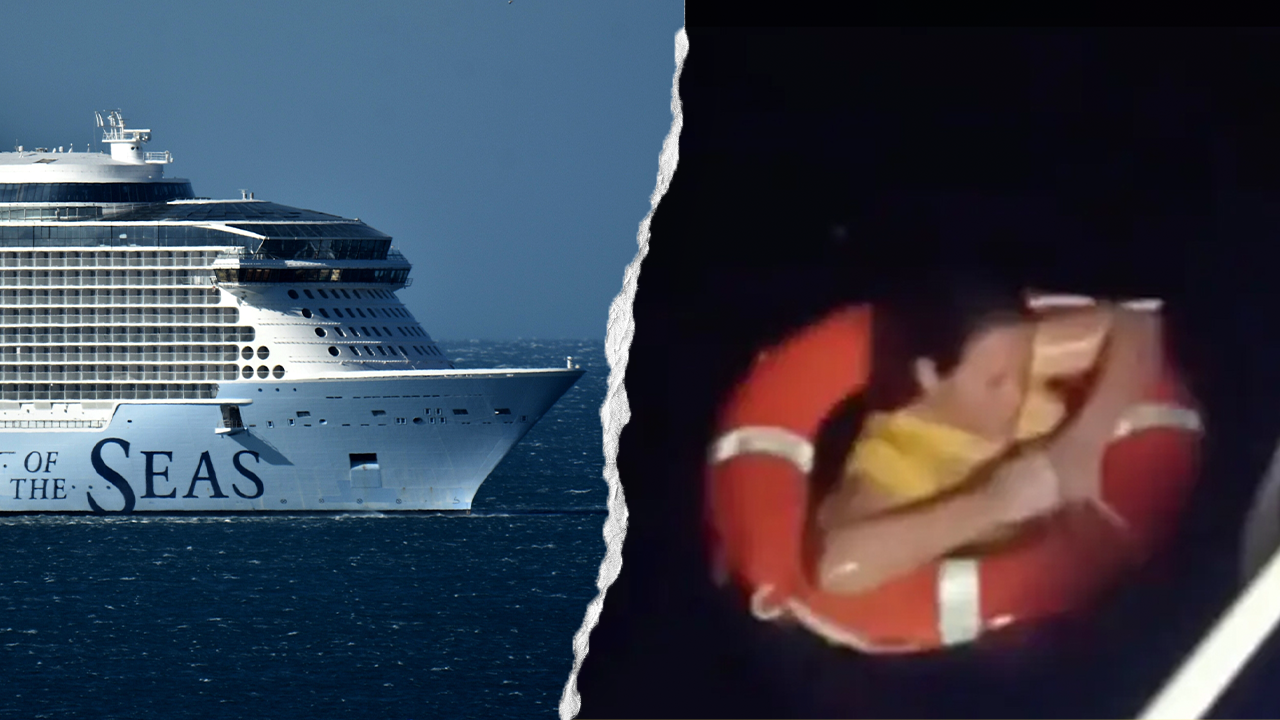
The sea is a vast, indifferent expanse, and for twenty hours, a 44-year-old woman from El Salvador existed in its cold, dark embrace, suspended between life and oblivion. She had gone overboard from the Royal Caribbean cruise ship Odyssey of the Seas as it sailed through the Ionian Sea near the Greek island of Zakynthos on Saturday. When the Hellenic Coast Guard finally pulled her from the water, she was clinging to a bright orange lifebuoy, a small beacon of hope against an endless horizon. The story, reported by the Greek Ministry of Foreign Affairs and confirmed to USA Today, is one of improbable survival, but also one of profound human desperation. How does a person end up alone in the ocean, watching the lights of a massive ship disappear into the night? The answer, according to the woman herself, was not an accident, nor a violent crime, but a strange and heartbreaking choice: she said she jumped because she “wanted to disembark.” In that single phrase lies a universe of untold pain, confusion, and a desperate need for escape that nearly cost her everything.
The rescue itself was a remarkable chain of events that unfolded against the backdrop of a dark, unforgiving sea. After the woman went overboard, a search operation was launched, with authorities scouring the waters between the cruise ship’s route and the island of Zakynthos. The hours ticked by, and the chances of finding her alive grew slimmer with each passing wave. Then, a cargo ship, the MSC Rossella III, which had been assisting in the search, spotted something almost impossible: a figure inside a glowing orange lifebuoy, bobbing in the inky blackness. The crew immediately alerted Greek authorities, and a Coast Guard vessel rushed to the location. When they arrived, they threw ropes to the exhausted woman and pulled her to safety. The physical toll of twenty hours in the water is almost unimaginable. Hypothermia, dehydration, and sheer muscle fatigue would have ravaged her body. Yet she held on. The human will to survive, even when the mind has chosen to leap into the void, is a powerful and mysterious force. Her rescue was not just a technical operation; it was a testament to the coordination of strangers—cargo ship crew, coast guard officers, and search coordinators—who refused to give up on a lone soul lost at sea.
After being pulled from the water, the woman was transported to the port of Katakolo, where she was immediately taken to a local hospital. According to the Hellenic Coast Guard, a prosecutor ordered a psychiatric evaluation, a clear indication that authorities recognized the incident was not simply a mishap but a cry for help. The woman reportedly told officials that she jumped from the cruise ship because she “wanted to disembark.” This is a chilling and poignant admission. It suggests a level of desperation so acute that the open ocean felt like a better alternative than staying aboard. Perhaps she felt trapped, overwhelmed, or lost in a way that had nothing to do with geography. For many people, the idea of being on a cruise—a floating city of endless food, entertainment, and ocean views—is a dream. But for someone in the throes of a mental health crisis, the same environment can feel like a gilded cage. The psychiatric evaluation ordered by the prosecutor is a necessary step, but it also raises larger questions about how we care for people who are struggling, both on land and at sea. What leads a person to such a drastic act? Was there a moment of regret as the ship sailed away? Did she pray, cry, or simply hold onto the lifebuoy in a state of shock? These are the human questions that linger long after the rescue boats have returned to port.
This incident is not isolated in the annals of cruise ship lore. Just last year, a man jumped off Royal Caribbean’s Rhapsody of the Seas in San Juan, Puerto Rico, for a strikingly different reason. Jey Gonzalez-Diaz, a passenger, leapt from the ship in an attempt to evade nearly $17,000 in gambling debt. Unlike the Salvadoran woman, his motivation was financial, not psychological—though one could argue that the desperation was equally intense. Gonzalez-Diaz survived the jump and was promptly detained by U.S. Customs and Border Protection officers. His story became a bizarre footnote in cruise ship history, a reminder that the open sea can sometimes feel like an escape route from problems that follow us wherever we go. But the two incidents together paint a troubling picture of human fragility. Whether it is a debt that feels insurmountable or a mental state that feels inescapable, the ocean can become a stage for our most desperate acts. In both cases, the individuals survived, but their futures remain uncertain. The woman now faces a psychiatric evaluation and likely a long road to recovery; the man faced legal consequences and the lingering shame of a very public fall. These stories are not just sensational headlines; they are windows into the complicated lives of people who board ships carrying more than just luggage.
For the cruise industry, overboard incidents are a recurring nightmare. While statistically rare, they capture the public’s imagination and highlight the inherent dangers of life at sea. The Odyssey of the Seas, one of Royal Caribbean’s modern mega-ships, is equipped with advanced man-overboard detection systems, but no technology can fully prevent a determined person from jumping. Cruise lines have implemented railings, cameras, and emergency protocols, but they cannot monitor every passenger’s emotional state. The industry often emphasizes safety, but the human element remains unpredictable. In this case, Royal Caribbean faced the challenge of continuing a voyage while a passenger was missing, coordinating with coast guards, and dealing with the emotional fallout for other guests and crew. When someone goes overboard, the ship becomes a scene of somber reflection. Passengers are often confined to their cabins or informed of the situation, and the festive atmosphere gives way to a grim reality. The crew, trained for emergencies, must balance their duties with the psychological weight of knowing that someone on their watch is lost at sea. The fact that this woman survived is a rare happy ending, but it does not erase the trauma experienced by everyone involved—the crew who noticed her absence, the passengers who heard the alarms, and the rescuers who found her in the dark.
Ultimately, this story is a profound reminder of the dual nature of the human spirit: our capacity for despair and our capacity for endurance. The woman who jumped from the Odyssey of the Seas did not want to die in the ocean; she wanted to leave the ship, to escape a situation that had become unbearable. In her mind, the jump was a way out. But in the water, alone with the stars and the waves, she found a reason to hold on. She clung to that lifebuoy for twenty hours, refusing to let go, even as her body weakened and hope faded. There is something deeply human about that contradiction—the same impulse that drives us to leap also drives us to survive the fall. As we process this news, we should extend compassion to her, not judgment. We do not know her story, her struggles, or the demons she was facing. But we do know that she is alive, and that is a miracle. Her rescue is a reminder that even in our darkest moments, help can arrive from unexpected places: a cargo ship on the horizon, a coast guard rope thrown into the night, or a stranger who refuses to look away. In a world that often feels divided, this small, fierce fight for one woman’s life in the Ionian Sea speaks to the best of what we can be—connected, vigilant, and merciful. She wanted to disembark, and in the end, she did, but not in the way she imagined. She came ashore not to escape her life, but to be given a second chance at living it.