


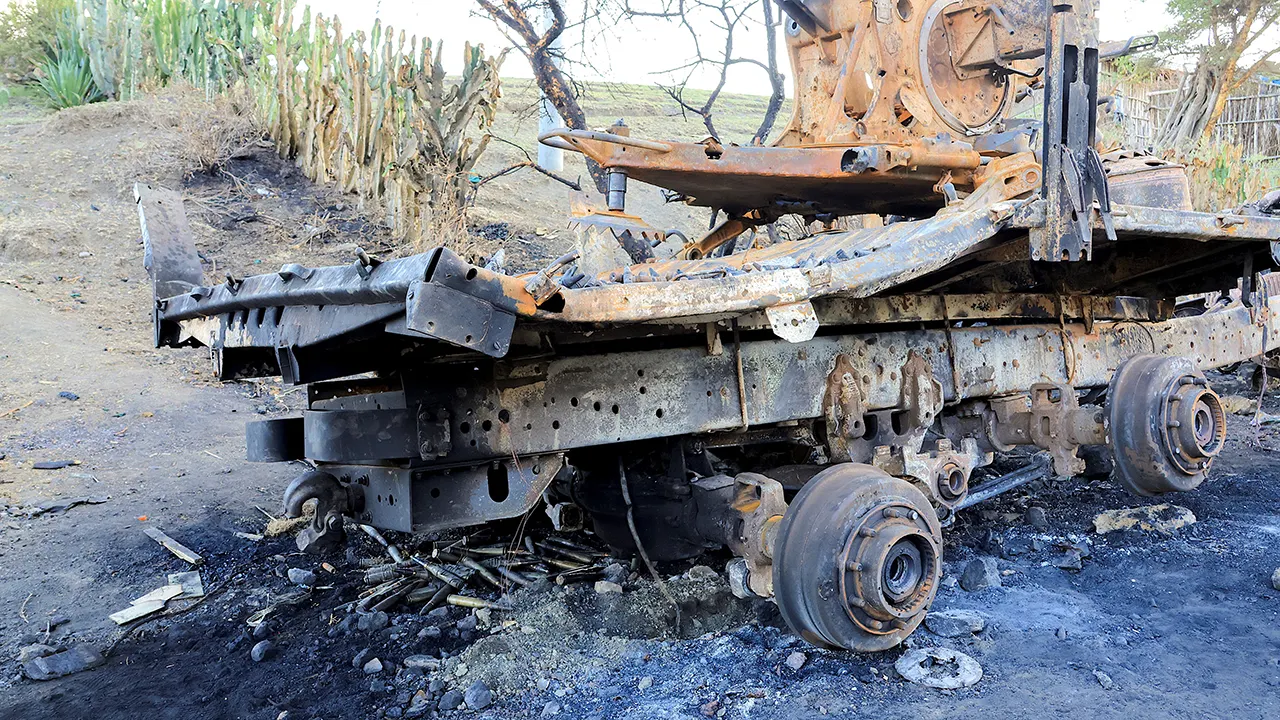
The Horn of Africa, a region already scarred by decades of war, famine, and political turbulence, now finds itself teetering on the edge of a precipice that could ignite a catastrophic new conflict. In early October, the quiet of Ethiopia’s capital, Addis Ababa, was shattered by explosions. Though the source was initially unclear, the U.S. Embassy, a beacon of American presence in this ancient city, quickly moved to caution its citizens. The embassy’s website spoke of “possible long-range attacks directed at Ethiopian military installations,” a chilling euphemism for what many feared were drone strikes. For ordinary Ethiopians, the news hit like a physical blow. They had grown accustomed to the fragility of peace, but the idea that their capital—home to the headquarters of the African Union, a symbol of pan-African unity—could be targeted from the sky felt like a nightmarish escalation. The embassy also warned of a more insidious threat: disinformation. Social media, already a welter of rumors and half-truths, was described as a breeding ground for false and misleading reports about the security situation. This only deepened the anxiety. In a country where access to reliable information can be a matter of life and death, the fog of war was becoming dangerously thick.
Behind these explosions lies a complex and bitter saga that stretches back decades, involving territorial disputes, ethnic rivalries, and the volatile legacy of colonialism. The immediate spark, however, was the breakdown of a shaky four-year ceasefire between Ethiopia’s federal government and the northern Tigray region. That truce, signed in the aftermath of a brutal conflict that left hundreds of thousands dead, was always fragile. In early October, Ethiopian troops pushed out rebel groups who had occupied Mekelle, the Tigrayan capital, effectively reigniting the war. But this time, the conflict has taken on a broader, more dangerous dimension. A coalition of rebel groups, calling itself the Ethiopian Peoples’ Forces Alliance for Survival, has emerged, uniting various armed factions that oppose the central government. This coalition claimed responsibility for the Addis Ababa attacks, boasting that they possessed drones. For analysts like Dr. Jalale Getachew Birru, a regional expert at the U.S.-based Armed Conflict Location and Event Data research group, this is a terrifying new phase. “Should the Alliance for Survival possess drone capabilities,” he told Fox News Digital, “it could fundamentally alter the dynamics of the conflict, refocusing strategic control on aerial dominance.” No longer would this be a war of ground troops and tribal militias; it would become a modern, asymmetric battle where the skies themselves are the prize. The fear is that such capability, if real, might not be homegrown. Blen Mamo, executive director of the Ethiopian Horn Review think-tank, pointed out that these attacks “exceed the capabilities of Ethiopia’s domestic insurgent groups, confirming Ethiopia’s allegation of foreign state involvement.” In a region where proxy wars are the norm, the threat of outside powers pulling strings is a specter that haunts every diplomatic attempt at peace.
The most significant point of contention driving this escalating crisis is Ethiopia’s desperate need for access to the sea. When Eritrea won its independence in 1993, Ethiopia became landlocked, cut off from the Red Sea and the global trade routes that pass through it. This geographical stranglehold has long been a source of national frustration. On October 5th, as he was sworn in for a new five-year term, Prime Minister Abiy Ahmed made his intentions clear. Sea access, he declared, was “of vital importance to Ethiopia’s civilization.” He pledged that “based on the principle of give and take, we will work diligently to ensure that Ethiopia has an outlet to the sea.” Such rhetoric, while aspirational, resonates deeply with a population that remembers a time when Ethiopian ships sailed freely. But it terrifies neighboring countries, especially Eritrea, which sees this as a direct threat to its existence. Eritrea’s leader, Isaias Afwerki, has historically been wary of Ethiopia’s ambitions, and the two nations have fought a bitter border war in the past. The recent reports of Eritrean troops entering Ethiopia—several videos apparently show convoys of trucks filled with uniformed soldiers passing through the city of Adigrat—are the most tangible sign yet that this new war is not just a domestic affair. Though unverified, these visuals have been enough to prompt immediate escalation. Ethiopia appears to have launched drone attacks in response, pushing the Eritreans back over the border. But the cycle of attack and retaliation is a dance of death that could easily spiral out of control, dragging in the entire Horn of Africa.
Adding fuel to the fire is the Grand Ethiopian Renaissance Dam (GERD), a colossal hydroelectric project built by Ethiopia on the Blue Nile. This dam, which Egypt and Sudan view as an existential threat to their water supply, has been a point of intense diplomatic friction for over a decade. Now, in a significant shift, Egypt has formally taken a position against Ethiopia, forming a coalition with Sudan, Eritrea, and Somalia. This coalition, announced earlier this month, represents a powerful bloc of nations with varying interests but a shared mistrust of Addis Ababa’s ambitions. For Egypt, the GERD is not just about water; it’s about regional hegemony. Cairo sees the dam as a weapon that Ethiopia can use to control the Nile’s flow, and thus the very lifeblood of the Egyptian people. Sudan, similarly worried about its own access to water, has been caught in the crossfire. Even Somalia, though more distant from the Nile, has its own grievances with Ethiopia, which has been accused of interfering in its internal affairs. The formation of this coalition is a stark warning to Ethiopia that its actions have consequences, and that it faces isolation if it continues on its current path. For the people of the Horn, this geopolitical chess game translates into food insecurity, disrupted livelihoods, and the ever-present threat of violence. The dam, once a symbol of Ethiopian progress and unity, has become a lightning rod for regional conflict, and its shadow looms over every diplomatic overture.
In the face of these swirling crises, the United States has attempted to play the role of peacemaker, though with limited success. The State Department has been actively engaged, with Undersecretary Allison Hooker meeting with Eritrean Foreign Minister Osman Saleh and speaking with Ethiopian Foreign Minister Gedion Timotheos. Assistant Secretary for African Affairs Frank Garcia also met with Minister Saleh. The message from Washington has been consistent and clear: both countries must respect sovereignty and territorial integrity, exercise maximum restraint, and return to dialogue. In a public statement, State Department spokesman Thomas “Tommy” Piggott emphasized the stakes: “The Horn of Africa cannot sustain another military conflict and humanitarian crisis.” He urged both sides to honor the 2018 peace framework and the agreement to resolve differences through peaceful means. But words, however well-intentioned, often fall flat in the face of deeply entrenched enmity. Former CIA analyst and National Security Council Africa Director Cameron Hudson believes the Trump administration needs to do much more than issue statements. “Regional leaders will say privately that they don’t want a regional war,” he told Fox News Digital, “But with so many armed actors and so much meddling going on in each other’s countries, a regional conflagration becomes increasingly likely. It is this kind of miscalculation that the Trump administration needs to be working now to guard against.” Hudson’s plea reflects a growing frustration among experts that the U.S. is not doing enough to prevent what could be one of the deadliest conflicts of the century. The diplomats are talking, but the guns are still firing, and the gap between rhetoric and reality is widening.
The consequences of a full-scale regional war in the Horn of Africa would be felt far beyond its borders. The Bab el Mandab Strait, a narrow passage between the Red Sea and the Gulf of Aden, is one of the world’s most vital shipping lanes. Any increase in violence across the Red Sea, especially with the Houthi attacks on shipping already causing havoc, could quickly disrupt global trade and energy supplies. “Local disputes can quickly become regional and international disputes with global consequences very quickly in this corner of the world,” Cameron Hudson warned. “Closure of the Bab el Mandab Strait, owing to unchecked tensions and violence across the Red Sea, will quickly be felt in the U.S.” Moreover, a war between Ethiopia and Eritrea would likely draw in Egypt, Sudan, and Somalia, creating a chaotic proxy conflict that could destabilize the entire continent. The humanitarian toll would be unimaginable—millions displaced, famine looming, and a generation lost to violence. Yet, despite these grim warnings, there is still a glimmer of hope. The people of the Horn, weary of decades of bloodshed, are not unanimously clamoring for war. Many ordinary citizens, both Ethiopian and Eritrean, share deep familial ties and a longing for peace. The question is whether their leaders, trapped in cycles of suspicion and ambition, will have the wisdom to step back from the brink. The U.S. and other international actors must increase their engagement, not just through diplomacy but through tangible incentives for peace. As Hudson put it, “The risk of regional conflict remains high,” but it is not inevitable. If the world acts quickly and decisively, it may yet prevent this knife’s edge from turning into a plunge into chaos. For the sake of millions, it must.