


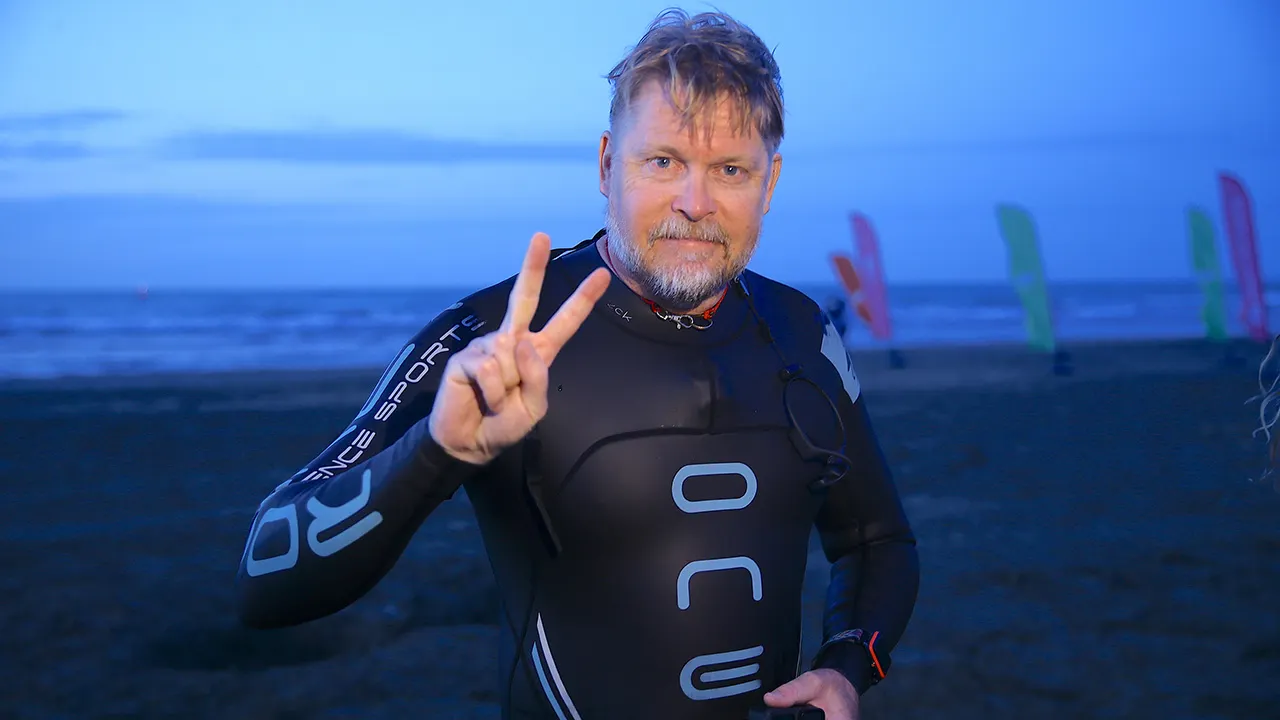
Karl Bushby has finally done what once seemed impossible: he has walked, crawled, sailed, and swum back to his native United Kingdom. On October 5, the 56-year-old adventurer announced he had completed the final stretch across the English Channel, swimming from France to the white cliffs of Dover. When he emerged from the cold, salty water and found a place to rest, the reality of what he had accomplished began to sink in. “I’m staring at the Union Jack flying outside this hotel,” he said. “I’ve seen many flags over the days, but that one is special.” It was a quiet, unassuming moment for a man who had spent nearly three decades in motion, crossing deserts, mountains, frozen seas, and hostile border posts. To celebrate, he ordered the meal he had been dreaming of for years: authentic British fish and chips. He shared a photo on social media, his joy almost palpable through the screen, not because the food was fancy, but because it tasted like home. Yet Bushby is quick to remind everyone that the journey is not over. He has roughly 240 miles left to walk, and he hopes to reach the finish line by the end of the month: his mother’s house in Hull. There, a woman in her eighties has been waiting for her son to come home from a walk that turned into a lifetime’s quest. The last leg will be walked at his own pace, one slow, aching step at a time, with the knowledge that at the end of it lies a kitchen table, a familiar voice, and the quiet closure of a promise made to himself when he was still a young man.
The origin of this extraordinary pilgrimage is as strange as it is inspiring. In the 1990s, Bushby received a birthday card from his father that told the story of two soldiers arguing about an impossible feat: walking from London to New York by crossing the Bering Strait, the icy gap between Alaska and Russia. To most people, the story would have been a curious piece of trivia, a reminder that some dreams are too big to ever be realized. But Bushby did not see it that way. He unfolded a map, looked at the enormous sweep of oceans and continents, and drew a single line from one point to another. In that moment, he said, he knew he had found his life’s mission. On November 1, 1998, the former British paratrooper set out from Punta Arenas, Chile, with only a few hundred dollars in his pocket and no real plan beyond walking north. He was young, lean, and full of the kind of reckless confidence that only exists in your twenties and thirties. He later described those early years in South America with a mixture of nostalgia and disbelief. “South America, you were young, it was all new, it was the boys adventure dream,” he said. He survived on the kindness of strangers, slept under tarps and roofs, and learned that the world was far more generous than he had ever been taught. He walked through deserts, over mountain passes, and across bustling cities, slowly becoming a citizen of the road rather than a tourist passing through.
Of course, no journey of such magnitude comes without hardship. Bushby expected the entire trek to take around 12 years, but life, geography, and geopolitics had other plans. He walked north through Central America, Mexico, and the United States, eventually reaching Alaska, where he had to wait for the Bering Strait to freeze over so he could cross on foot into Russia. The wait was long and uncertain, and when he finally attempted to continue, he hit a wall: in April 2012, Russian authorities denied his visa, bringing his expedition to a sudden halt. Rather than giving up or quietly returning home, Bushby did something remarkable. He began walking in the opposite direction, on a protest route to the Russian Embassy in Washington, D.C., determined to make his case in person. It was a bizarre, stubborn, and utterly human response to a bureaucratic obstacle. And it worked. The ban was overturned, and he was allowed to resume his journey. From Russia, he entered Mongolia and China, swam the Caspian Sea from Kazakhstan to Azerbaijan, and then pressed on into Europe, where new obstacles waited. The 2008 financial crash had already disrupted his funding. The COVID-19 pandemic shut down borders and forced long pauses. Political tensions, detention, close calls, and the simple, grinding physical toll of walking tens of thousands of miles all conspired to slow him down. There were moments when his body screamed for rest and his mind whispered that enough was enough. But Bushby kept moving, not because he was superhuman, but because he had learned a truth that many of us forget: you are far more capable than you think you are. “The world always looks bigger and scarier than it actually is,” he said. “People always underestimate themselves.” His career as an adventurer has been one long proof of that statement.
What kept him going, he says, were not the maps or the milestones, but the people. In every country, in every language, in every town where he stopped to ask for water or shelter, a stranger appeared with something he needed. A meal, a place to sleep, a story, or simply a smile that reminded him he was not alone. “The world is an incredible place, and it’s the people, the strangers that I have met along the way, that have kept me upright and moving forward,” Bushby explained. He has been hosted by families in remote villages, helped by workers in industrial towns, and guided by shepherds on desolate mountain trails. He has learned to trust in a shared humanity that transcends passports and politics. This is the quieter, deeper legacy of his 28-year trek. It was never merely about claiming a record or proving a point. It was about discovering that the world is filled with ordinary people who will open their doors to a tired stranger if you give them the chance. Bushby’s faith in humanity has been rewarded thousands of times over. In an age when the news often focuses on division and fear, his journey stands as a slow-moving, waterproof, stubborn testament to the idea that kindness is the most reliable currency on Earth. He did not walk 30,000 miles to conquer continents; he walked them to discover that the borders we draw on maps are far less meaningful than the bonds we build with one another.
The numbers themselves are staggering. Bushby has covered more than 30,000 miles across 29 countries. He has crossed three continents, survived the frozen Bering Strait, and swum across a major inland sea. He has been detained by authorities, threatened by weather, and forced to take sudden detours, yet he is still here, still walking, with only 240 miles remaining. Perhaps the most honest part of his story is the way he talks about the end. He is not sprinting across the finish line. He is walking slowly, deliberately, with the awareness that his joints are no longer what they used to be. “We went at a reasonable pace, we did what we needed to do and it has worked,” he said. “I know it’s time to stop, I know that much because I feel that in the knees and ankles.” There is no bitterness in that statement, only the quiet acceptance of a man who has pushed his body to its limits and respected its signals. He has lived out of a backpack for nearly three decades, seen the most remote corners of the planet, and endured challenges that would have broken most people. And now, at the end, the thing he wants most is not adventure but home. He wants to stand in his mother’s kitchen, hug her, and tell her that the boy who drew a line on a map all those years ago has finally arrived. He wants to open his eyes in Hull, a city he left as a younger man, and know that the circle has closed.
Bushby’s story is more than a travel tale; it is a meditation on purpose, endurance, and the meaning of home. In an era of fleeting attention and instant gratification, he offers the opposite: a decades-long commitment to a single, enormous goal, carried out at walking speed. He did not rely on sponsorships or helicopters or rescue teams. He got up every morning and moved forward, often without knowing exactly what the next day would bring. His journey was interrupted by wars, crises, and global pandemics, yet he refused to let any of them erase the line he had drawn on the map. He has proved that patience is a form of courage, and that the most profound discoveries happen not at the destination but along the way. The world, he says, is not as scary as it looks; it is full of beauty and kindness, if only we are willing to walk through it. As he approaches his mother’s home, he carries with him the memories of thousands of strangers, the weight of three decades, and the quiet satisfaction of a promise kept. He will have walked the equivalent of more than once around the Earth, not to escape his life, but to return to it with a heart full of wonder. The Union Jack in Dover meant something special to him, not because of patriotism, but because it marked the beginning of the last mile home. And when he finally knocks on his mother’s door, the impossible will be complete: a boy who once looked at a map would become a man who walked the whole way back, and the whole world in between.