

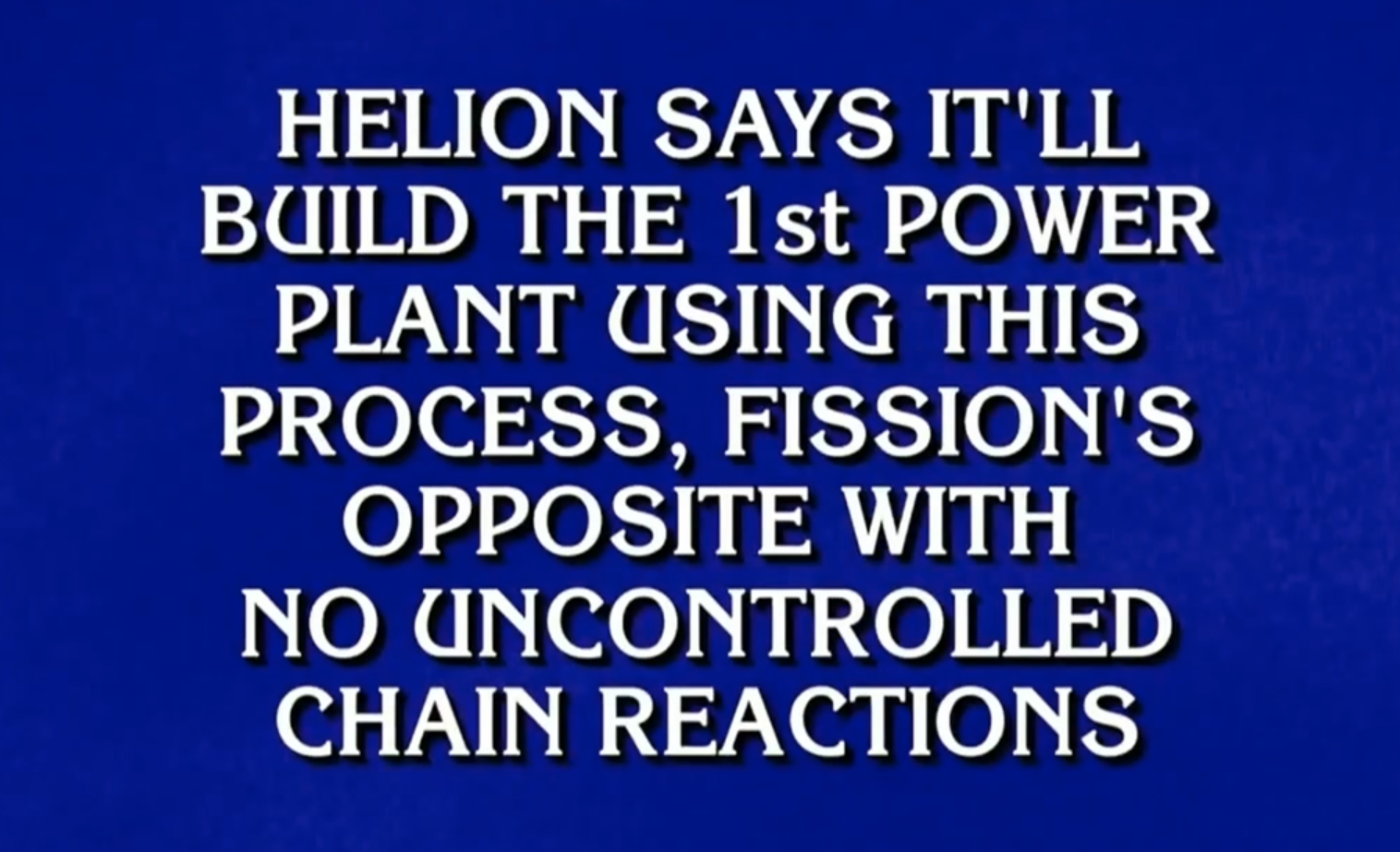
On a Tuesday evening in October, while millions of Americans settled into their living rooms for the familiar comfort of a trivia showdown, something quietly extraordinary happened. The iconic blue board of “Jeopardy!” flashed a clue that wasn’t about ancient history, classic movies, or state capitals, but about a company on a mission to harness the very power of the sun. The $800 clue under the category “Y Combinator” read: “Helion says it’ll build the 1st power plant using this process, fission’s opposite with no uncontrolled chain reactions.” For most viewers, it was just another question, a fleeting moment of brain-teasing before the next commercial break. But for the team at Helion Energy, tucked away in Everett, Washington, it was a surreal validation of years of tireless work, late nights, and audacious dreaming. When Greg Monson, a three-day champion from Portland, buzzed in and answered “What is fusion?” correctly, it wasn’t just a point on the scoreboard. It was a signal that a distant, complex scientific frontier had officially entered the mainstream lexicon—and that Helion, a company many had never heard of, had become a name worth knowing.
To understand why that Jeopardy! moment meant so much, you have to appreciate the sheer difficulty of what Helion is trying to do. Fusion is the process that powers the sun and the stars, where light atoms are smashed together at unimaginable temperatures and pressures to release vast amounts of energy. On Earth, we’ve been trying to replicate that for decades, but it’s proving to be one of humanity’s greatest scientific and engineering challenges. Unlike fission, which splits heavy atoms and leaves long-lived radioactive waste and the risk of uncontrolled chain reactions, fusion is inherently safer. It produces no greenhouse gases, no long-lived nuclear waste, and the fuel is abundant—isotopes of hydrogen found in seawater and lithium. The dream is clean, safe, nearly limitless power. But achieving a commercially viable fusion reaction on Earth has remained frustratingly out of reach. The temperatures required are hotter than the core of the sun, the magnetic fields needed to contain the superheated plasma are mind-bogglingly strong, and the engineering hurdles are staggering. For decades, fusion has been perpetually “twenty years away,” a running joke among scientists. Yet Helion is betting that the future is closer than we think, and they’re not just theorizing—they’re building a power plant.
Helion’s journey from a scrappy startup to a Jeopardy! answer is a classic Silicon Valley tale with a fusion twist. Founded by David Kirtley and a small team of true believers, Helion went through Y Combinator’s Summer 2014 batch, the famed accelerator that has also nurtured Airbnb, Reddit, and Coinbase. Back then, they were a handful of physicists with a radical idea: instead of using the massive tokamak designs favored by government research labs, they would use a pulsed approach, slamming plasma together in a way that’s more like a high-speed collision than a sustained burn. They call it a “pulsed, non-ignition” design, using a combination of a deuterium-helium-3 fuel cycle and a direct energy recovery system that could convert fusion energy directly into electricity, skipping the steam turbine step that loses efficiency. It’s an audacious plan, and while they’ve faced their fair share of skeptics, they’ve also amassed serious momentum. In June, they announced a jaw-dropping $465 million in new funding, bringing their total raised to over $1.5 billion and a valuation soaring to ten times that—around $10 billion. They’ve grown from those early YC days to more than 800 employees, recently expanded into a new 15,000-square-foot office in downtown Seattle, and now sit comfortably at the No. 2 spot on the GeekWire 200, which ranks the top Pacific Northwest startups. For a company that is still some years away from delivering its first commercial reactor, that kind of faith from investors and the tech community speaks volumes.
But the Jeopardy! moment was about more than money or rankings. It was about the human side of the mission. When CEO David Kirtley shared the clip on LinkedIn, his words were simple yet heartfelt: “Surreal to see Helion featured on Jeopardy! last night. And in great company with Y Combinator!” He added, “Clean, safe, reliable power is getting a little more mainstream.” That feeling of “surreal” perfectly captures the emotional journey of a founder who has spent over a decade banging on the doors of a scientific impossibility. For Kirtley, who started working on fusion as a graduate student, seeing his life’s work reduced to a trivia question must have been equal parts hilarious and gratifying. The fact that the clue was in a category about Y Combinator, rather than nuclear physics, made it even more meaningful. It placed Helion in the company of Airbnb, The Athletic, Coinbase, and Twitch—modern tech disruptors that have changed how we live, work, and play. Fusion energy, with its promise of solving climate change and global energy poverty, is arguably the most ambitious startup vision of them all, a goal that makes a millions-of-rooms platform or a cryptocurrency exchange look almost mundane by comparison.
The Jeopardy! spotlight also offers a glimpse into the broader fusion landscape, where Helion is not alone but stands out for its unconventional approach. Other companies, like Commonwealth Fusion Systems, TAE Technologies, and General Fusion, are chasing the same goal with different technologies. Government-backed projects like ITER in France have spent billions and still face decades of delays. Yet there is a palpable sense of a renaissance in fusion research. In late 2022, the National Ignition Facility at Lawrence Livermore National Laboratory achieved the first net energy gain from a fusion reaction in a lab setting, a proof-of-concept that captivated the world. Helion has its own milestones: they have demonstrated the ability to heat plasmas to the required temperatures, and they are working on a prototype called Polaris, which they aim to use to show net electricity generation by the end of the decade. For the 800 employees crammed into their Seattle and Everett offices, the Jeopardy! appearance was a validation that the outside world is starting to take notice. It’s one thing to get a massive funding round or a glowing write-up in a tech publication; it’s another to be a question that people answer on their couches, to be part of the cultural ether. It’s the kind of recognition that makes the long hours and seemingly insurmountable obstacles feel worth it.
As the final credits rolled on that Tuesday’s Jeopardy! episode, the moment passed for most viewers, but for Helion, it was a thread in a much larger tapestry of progress. It’s easy to romanticize the idea of clean energy, but the reality is that fusion is a marathon, not a sprint, and Helion still has a long way to go. They face scientific challenges, engineering red tape, and the simple fact that nothing about this has ever been done before. But moments like the Jeopardy! clue are gentle reminders that the vision is not as crazy as it once seemed. When a game show—a cultural institution that celebrates knowledge and facts—includes your company in its canon, it signals that the concept of fusion has moved from science fiction to a future that feels tangible. For Kirtley and his team, it’s not just about being a trivia answer; it’s about making sure that one day, everyone knows what fusion is because it’s powering their homes, their cars, and their cities. They are on a quest to change the world, and if along the way they get a little pop-culture glory, so be it. After all, what is more human than dreaming of a brighter, cleaner future and hoping that one day, the whole world will know your name?