


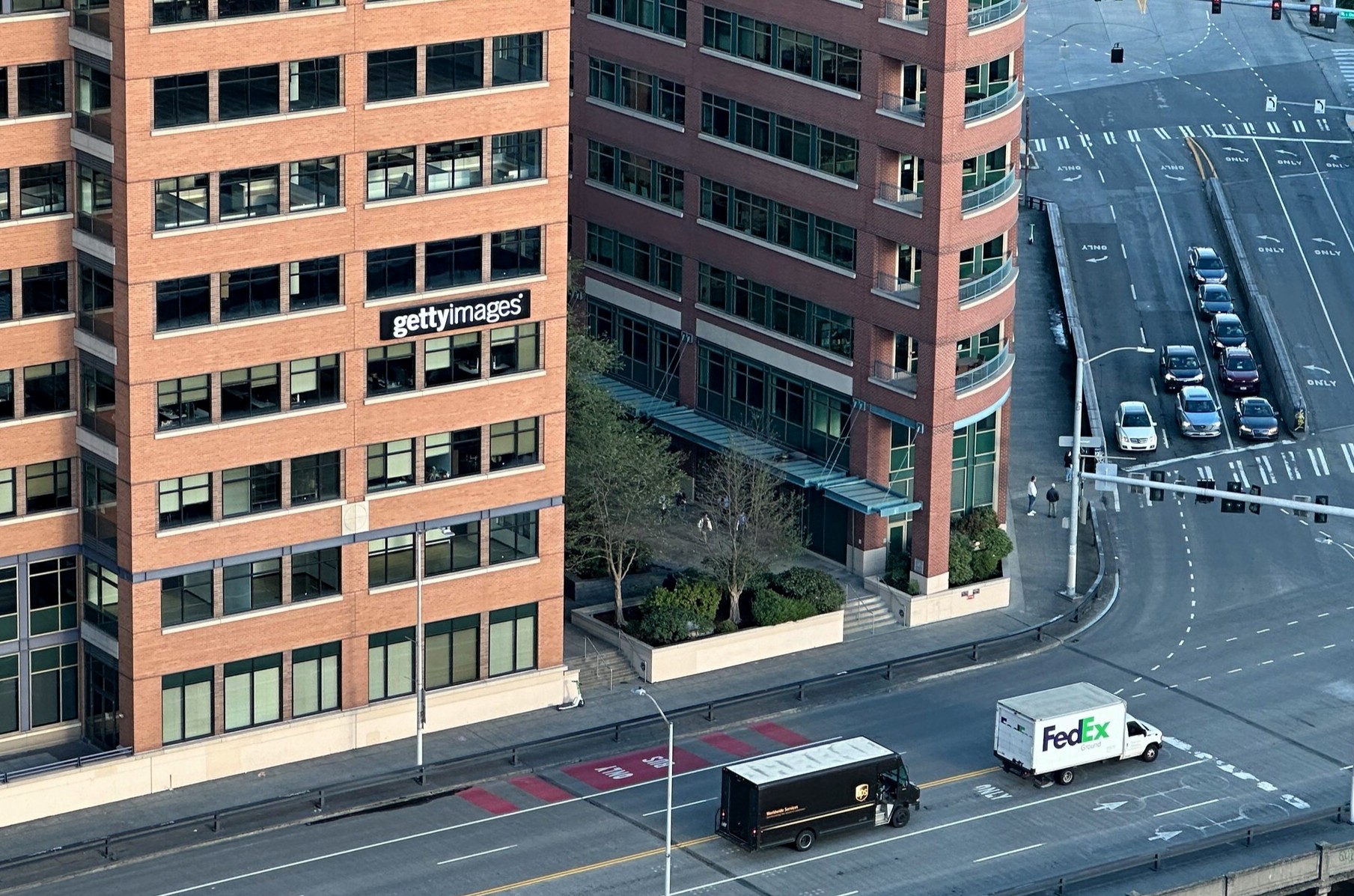
For the roughly 300 people who walk through the doors of Getty Images’ offices in Seattle’s Union Station complex each morning—past the historic train station, past the stadiums, into a building that has housed this company for years—the past few years have felt like a long, uncertain ride. They work for a company whose name is everywhere: on the credits of news photographs, on the walls of museums, on the screens of sports fans and magazine editors. Getty Images is the kind of brand that people trust to capture history in the making, from wars to World Cups to red carpets. But behind that iconic reputation, the company has been quietly fighting for its financial life. On Monday, employees finally learned what the next chapter would look like. Getty Images will keep its headquarters in Seattle and avoid layoffs as it moves into a prearranged Chapter 11 bankruptcy, a process designed to cut its enormous debt and take the company private. A spokesperson confirmed the plans to GeekWire, saying there is “no expected impact on employees.” In a city that has seen wave after wave of tech-industry layoffs, that simple promise matters. The company employs about 300 people in Seattle out of nearly 1,650 worldwide—a close-knit enough group that everyone knows someone whose job could be on the line. For many, the news was not a celebration but a relief, a chance to finally exhale. No one is popping champagne, but there is a sense that the worst may finally be over. Getty has been through crises before, and it has always found a way to keep going. The company’s leaders have promised to keep the mission alive. For a company that has been part of Seattle’s digital-media identity since the dot-com era, staying put feels like more than a business decision. It’s a small, reassuring sign of continuity in an industry that rarely offers any.
But how did a company with such a powerful brand end up in bankruptcy? The answer is a familiar and painful one: debt. Getty Images’ underlying operations were actually profitable last year. The company generated $981 million in revenue and $84 million in operating income. That sounds like a healthy business. Yet after interest payments and other costs, Getty posted a net loss of $206 million. The problem is not the photography; it’s the balance sheet. Getty has been weighed down for years by nearly $1.5 billion in debt, much of it dating back to 2008, when the company was owned by private equity firms. Those firms loaded Getty with leverage, and even after the company returned to public markets in 2022 through a SPAC merger that valued it at $4.8 billion, the debt did not go away. Every year, millions of dollars that could have gone toward technology, photographers, or employee raises were instead used to service that debt. For the people inside the company, the disconnect was hard to swallow. They could see that their work was good, that customers still wanted Getty’s images, that the brand still had enormous power. But no amount of good work could outrun the math of interest payments and legacy obligations. It was like running a race while carrying a backpack full of rocks. Employees watched as competitors invested in new platforms and artificial intelligence tools, while Getty had to divert resources to interest payments. It was frustrating to know the company could be thriving if not for decisions made years earlier by people who no longer even ran the company. The SPAC deal, in hindsight, was not a solution but a delay. It gave Getty a moment of public-market legitimacy, but it did not fix the fundamental mismatch between the company’s operating strength and its financial obligations. Now, the bankruptcy is intended to change that arithmetic. By shedding debt and starting fresh, Getty hopes to finally put the financial engineering behind it and focus on what it does best: telling stories through images.
The most dramatic blow came in the form of a merger that was supposed to save Getty Images from itself. In January 2025, the company announced a $3.7 billion deal to combine with rival Shutterstock. It was supposed to be a lifeline. The idea was to create a dominant visual-content company, one with enough scale to weather the storms of a changing industry. For months, employees at both companies worked toward that future. Integration teams planned, investors cheered, and Getty’s leadership insisted the deal would unlock new opportunities. But regulators in the United Kingdom had other ideas. They said the merger could only go through if Shutterstock sold its editorial business—a condition that Getty believed would gut the value of the deal. This summer, Getty walked away. The collapse was not just embarrassing; it was expensive. Getty spent more than $100 million on fees and financing costs related to the merger. For a company already drowning in debt, that was a devastating setback. The failed deal deepened the financial crisis and made a bankruptcy filing almost inevitable. On a human level, it was exhausting. Imagine spending months planning for a future that never arrives, then being told to go back to business as usual while the bills pile up. That is what Getty’s employees lived through. They kept doing their jobs—shooting, editing, licensing, supporting customers—while the company’s fate was being decided in boardrooms and courtrooms thousands of miles away. The merger’s collapse also sent a message to the broader market: Getty was not as strong as it seemed. Suppliers grew nervous, partners asked questions, and employees braced for the worst.
Even if Getty had merged with Shutterstock, it would still have faced a fundamental problem: the world of stock photography is changing faster than anyone expected. Getty’s creative business—the part that sells images to designers, marketers, and publishers—saw revenue fall 2.6% in the second quarter. The decline is not hard to explain. Artificial intelligence can now generate realistic images in seconds, and some customers have begun to wonder why they should pay for a professional photograph when an algorithm can produce something “good enough.” Smartphone photography has also flooded the world with billions of free images, making visual content feel abundant and cheap. For Getty, which built its business on the idea that professional photographers should be paid for their work, this is an existential challenge. It is also a deeply human one. The photographers who shoot for Getty—often freelancers who risk their safety to document wars, protests, sports, and wildlife—are being asked to compete with machines that never sleep and never demand credit. The company has tried to adapt, experimenting with AI-related content and new business models, but the pressure is not going away. For the employees in Seattle, this is not just a corporate concern. It is a question about the value of human creativity. In a culture that increasingly accepts machine-made images, what is a photographer worth? Getty’s ability to answer that question will determine whether it thrives or merely survives.
Now, with the failed merger behind it and a bankruptcy plan in place, Getty is attempting to reset. Under the restructuring announced Monday, members of the Getty family and affiliates of Koch Equity Development—the investment arm of Koch Inc.—will invest up to $533 million and own the company together. Koch has been a minority investor in Getty since 2018 and owned 27.5% of the company’s shares as of April. Bondholders, meanwhile, have agreed to retire $270 million in unsecured debt, and most secured lenders have agreed to reduce interest payments and push back repayment deadlines. The deal is designed to give Getty the breathing room it needs to invest in the future. But it comes at a cost: public shareholders are expected to be wiped out. The stock, once a symbol of the company’s public-market ambitions, had fallen to 12 cents, and the New York Stock Exchange suspended trading on Sept. 29. Getty plans to file for Chapter 11 in the coming weeks and hopes to emerge by the end of the year. CEO Craig Peters described the deal as an opportunity to “accelerate investment into the business and better position Getty Images for long-term success.” For the rank-and-file employees, the message is one of continuity: the headquarters stays, the jobs stay, and the mission stays. But even a prearranged bankruptcy is a sobering event. It forces everyone to imagine a worst-case scenario, even as they hope for the best. The next few months will be tense, as legal proceedings unfold and the company transitions from public to private ownership. The promise of no layoffs helps, but it cannot erase the emotional toll of watching a storied company come so close to the edge.
Getty Images is not just another company that happened to land in Seattle; its history is woven into the city’s identity. The company was co-founded in London in 1995 by Mark Getty and Jonathan Klein, but it found its American home here in the late 1990s. In 1998, Getty acquired Seattle-based PhotoDisc, a pioneer in digital stock photography, and the following year it moved its headquarters to Seattle. That move placed Getty at the center of the dot-com boom, when the city was becoming a global hub for digital media and technology. Over the years, Getty’s roots deepened. In 2016, it became the distributor of images from Corbis, its longtime Seattle-based rival, after Microsoft co-founder Bill Gates sold Corbis to China’s Visual China Group. Today, the company’s offices sit in the Union Station complex near Lumen Field, a location that feels both historic and modern. The next chapter will be written in bankruptcy court, but the goal is clear: to emerge leaner, with less debt, and with new investment from owners who believe in the company’s long-term value. Whether that will be enough remains an open question. The industry is still disrupted. The competition is still fierce. But there is something worth fighting for. Getty has spent three decades preserving moments that might otherwise have been lost—a goal that feels especially meaningful in an age of AI-generated content. For Seattle, the decision to keep the headquarters in the city is a sign of stability. For the employees, it is a chance to keep doing work they believe in. And for the rest of us, it is a reminder that even in a world of algorithms and smartphone cameras, professional photography still has a place—as long as there are people willing to look through the lens.