


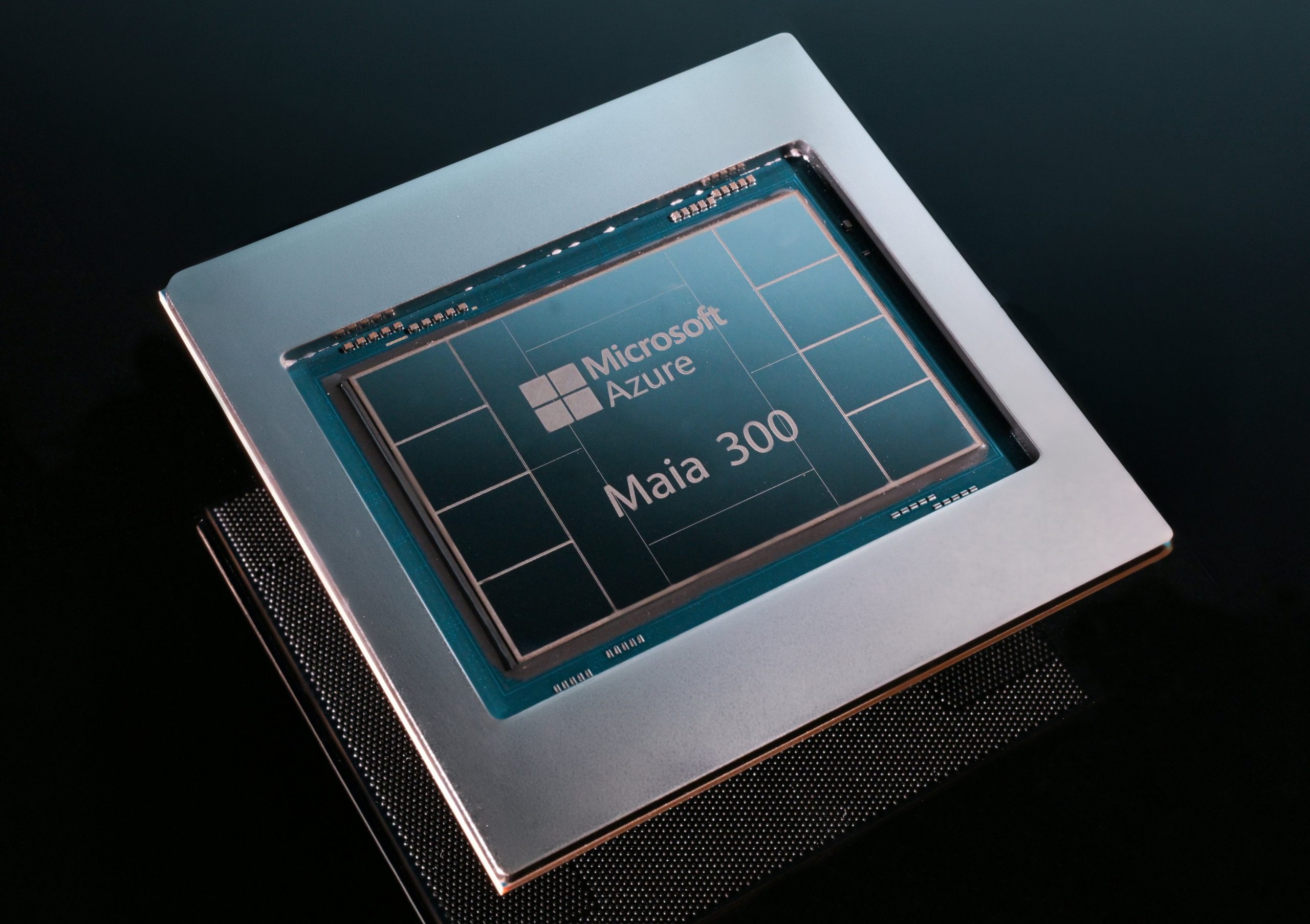
For a long time, running artificial intelligence at scale meant relying on Nvidia. The company’s chips are everywhere, and Microsoft, like most big tech firms, spent enormous sums buying GPUs to power its AI products. That arrangement made Nvidia one of the most valuable companies in the world, but it also left its customers with massive bills and limited flexibility. Microsoft has wanted a different path for years, and this week it made clear that the search for an alternative is now a central part of its strategy. The company announced Maia 300, the third generation of its custom AI chip, and said it plans to begin large-scale deployments in 2027. More striking, Azure chief Scott Guthrie said Maia will become the primary AI inference system for Microsoft’s products and services. That is not just another hardware announcement; it is a declaration of independence from the GPU industry’s dominant player. Inference, for anyone who hasn’t spent time inside the AI world, is the part of machine learning that happens after a model has been trained. When a user asks a chatbot for advice, when a document is summarized, when an AI agent works through a multi-step task, that is inference. It is the moment when the model applies what it has learned, and it is also where the daily cost of running AI services accumulates. Microsoft’s decision to put Maia at the center of that work is therefore a huge bet on its own engineering. Satya Nadella called it “our biggest bet yet on our own silicon,” and he wasn’t exaggerating. Microsoft still plans to buy huge numbers of Nvidia chips for training and other workloads. But over time, the company wants to control the chips that handle the constant, high-volume work of serving AI to users around the world. The potential savings are enormous, and so is the message: Microsoft is no longer willing to be dependent on anyone for the core infrastructure of its AI future.
The technical claims behind Maia 300 are the kind that make cloud architects sit up and notice. Microsoft says the chip will deliver about 40% more AI output for the same amount of power as leading GPU-based systems. In plain language, that means a server running Maia can complete about the same amount of AI work as a GPU server while using less electricity, or more work with the same electricity. That matters twice over: electricity is one of the largest costs in running a data center, and in many parts of the world it is also the hardest thing to find. Power supply has become one of the biggest constraints on AI expansion, and some cloud providers have had to turn away workloads because they simply could not get enough energy to run more servers. A chip that gets more work done per watt helps solve that problem. Microsoft also says a full rack of Maia 300 chips can produce up to seven times as much AI output as the current generation, a remarkable jump that points to improvements in both the chip itself and the systems around it. The design appears aimed at the kinds of tasks that are growing fastest in the AI industry: agents that can knock out multistep jobs, and models that can hold long conversations or reason across lengthy documents. Those tasks are memory-intensive and demand high levels of sustained throughput, not just raw speed. By building a chip specifically for those workloads, Microsoft is hoping to avoid the inefficiencies of using a general-purpose GPU for everything. The chips are being manufactured by TSMC, the same foundry that makes many of the world’s most advanced chips, so Microsoft is not trying to reinvent the semiconductor manufacturing process. What Microsoft wants is the design. It wants to decide exactly how the chip handles AI models, how it connects to memory, how it scales across racks, and how it fits into Microsoft’s cloud. That kind of control, the company believes, will translate into better performance, lower cost, and a more reliable supply chain. It also gives Microsoft the ability to iterate quickly, responding to changes in AI models without waiting for an external supplier to catch up.
For all the talk of competition, it would be a mistake to describe Microsoft and Nvidia as enemies. The two companies are still deeply intertwined, and their relationship is more complicated than a simple rivalry. Nadella and Nvidia CEO Jensen Huang shared a stage last week to launch a line of Windows PCs built around Nvidia chips, a reminder that Microsoft still needs Nvidia for much of the computing industry. Nvidia also remains a major supplier for Microsoft’s data centers, and Microsoft has said it will be among the first cloud providers to use Nvidia’s next-generation Vera Rubin systems. At the same time, Microsoft has also indicated that it will deploy systems based on AMD’s Helios chips. This is not a sudden divorce. It is a deliberate strategy to diversify. Microsoft wants to have multiple sources of advanced chips, and it wants to make sure that no single supplier can dictate terms. If Nvidia’s prices rise, Microsoft can lean more heavily on its own Maia chips or on AMD’s offerings. If Maia works well, Microsoft can use it for the majority of AI inference, saving billions of dollars and freeing up GPUs for the most demanding training workloads. But Microsoft also continues to benefit from Nvidia’s powerful chips and its mature software ecosystem. In practice, this means Microsoft will run a hybrid fleet. Some workloads will go to Nvidia, some to AMD, some to Microsoft’s own silicon, and the mix will shift over time based on cost, performance, availability, and the needs of each specific task. This is a much more nuanced position than the simple story of a tech giant breaking away from Nvidia. It is more accurate to say that Microsoft wants to be in the driver’s seat, with Nvidia as one of several suppliers rather than the only one. The fact that Nadella and Huang continue to appear together onstage is a testament to the strength of the existing partnership. But the fact that Microsoft is investing so heavily in Maia shows that the partnership is no longer exclusive, and that Microsoft’s ambitions are bigger than any single vendor.
Microsoft is not alone in this quest for in-house chips. The broader tech industry has been moving in the same direction for years, and each of the major players has its own version of the story. Google has been designing custom tensor-processing units for well over a decade, and it has begun selling access to those chips directly to some customers. Amazon has developed its Trainium family of chips and has managed to attract serious AI companies, including Anthropic, which has agreed to use Amazon’s hardware for a significant portion of its computing needs. Meta has rolled out its own AI chips for internal data center workloads. And OpenAI, which Microsoft has invested in and partnered with for years, unveiled its first custom chip in June, designed in collaboration with Broadcom. There are common themes behind all of these efforts. The first is cost. Nvidia’s top-tier GPUs are extremely expensive, and demand has consistently outpaced supply, creating shortages and long lead times. For companies that plan to run AI at massive scale, the economics of buying GPUs from a single supplier are difficult to sustain. The second theme is control. Custom silicon allows a company to optimize every part of the system, from the way memory is laid out to the way software is compiled. It also lets companies shield themselves from the risks of depending on a single supplier. The third theme is perhaps less obvious but no less important: AI is evolving quickly, and the optimal hardware for future workloads may not look like today’s GPUs. Companies that design their own chips can experiment with new architectures and adapt to changing models. They can build hardware for specific use cases, such as inference, instead of trying to serve every possible use case with a generic chip. Of course, this strategy is not easy to execute. Designing a modern chip takes years, requires enormous engineering talent, and carries no guarantee of success. A chip that performs brilliantly in a simulation can fail when it has to work with real-world software, real-world models, and real-world data centers. Microsoft has already experienced these challenges, and they help explain why the company is still playing catch-up in a race where Google had a head start and Amazon has been aggressive in courting AI customers.
Despite the bold promises, Microsoft’s custom silicon effort is still relatively young. Unlike Google’s TPUs or Amazon’s Trainium chips, Maia is not available as a standalone product for outside customers to rent. It is not competing directly in the market for cloud AI accelerators. Instead, Maia is being used to power Microsoft’s own services and the models behind them. That is a narrower focus, but it is also a practical advantage: Microsoft can start with its own workload and refine the chip until it performs well before turning it into a broader offering. The current generation, Maia 200, is already proving that the concept can work. Microsoft says it powers Microsoft 365 Copilot and runs models from both OpenAI and Microsoft. It is now being deployed in data centers across the United States, Europe, and Australia, and GitHub Copilot and Microsoft Foundry are expected to move onto it by the end of the year. These are real deployments, not just announcements. But the scale is still modest compared with the vast number of Nvidia chips in Microsoft’s data centers. The Information reported in August that Maia 200 was running in just two U.S. data centers as of this summer, which shows how slowly the transition is unfolding. Microsoft has also faced delays along the way. Its first Maia chip was announced in 2023, and the second generation did not arrive until January, after slipping from its original schedule. Industry analysts at Evercore ISI estimate that Maia will account for only about 10% of Microsoft’s spending on AI chips by early 2027. That 10% is not trivial, but it is a powerful reminder of how difficult it is to displace a market leader. Nvidia’s success is not just about hardware. It is about software libraries like CUDA, a vast ecosystem of developer tools, and years of integration into machine learning frameworks. A new chip needs more than good specs; it needs a community, a stack, and a reason for people to switch. Microsoft, to its credit, understands this. It is leveraging its control over its own services to create a beachhead for Maia, and it will gradually expand from there. But the path is long, and the company has no time to celebrate.
The next major milestone comes in November, when Microsoft plans to share more details about Maia at its Ignite conference in San Francisco. By then, the company will likely have more specifics on performance, deployment timelines, and perhaps pricing or availability outside Microsoft’s own products. The bigger story, though, is not about any single chip announcement. It is about the changing shape of the AI industry. For years, the conventional wisdom was that Nvidia had an unassailable lead. The company built the best chips, the best software ecosystem, and the most trusted brand, and it seemed as though every AI company had to stand in line for its products. Custom silicon was seen as a long-shot project for companies with more money than sense. But the reality is that the industry is already diversifying. Microsoft, Google, Amazon, Meta, and OpenAI all believe that the future will involve a mix of chips, and they are all investing billions to make that future happen. The winner may not be any single architecture; it may be the cloud providers that can offer the best combination of cost, performance, and flexibility. For Microsoft, the promise of Maia is compelling. If the chip delivers on its efficiency claims, Microsoft can lower the cost of AI services, expand into regions with limited power, and offer the kind of high-performance inference that customers increasingly expect. It can also reduce the amount of money it pays to Nvidia, which directly improves its bottom line. But there are also risks. Custom chips can have bugs, software integration can be painful, and the pace of change in AI is so fast that a chip optimized for today’s models may look outdated in two or three years. Microsoft has made clear that it sees this as a long-term bet, and that Maia will coexist with Nvidia rather than replace it overnight. Still, the direction is unmistakable. The era of a single chip dominating all of AI is fading. Microsoft, along with its rivals, is building a world where AI hardware is as diverse and specialized as the tasks it powers. Whether Maia 300 ultimately becomes the workhorse of Microsoft’s AI empire or a more modest chapter in the company’s semiconductor history, it has already changed the conversation. That is not a small thing.