


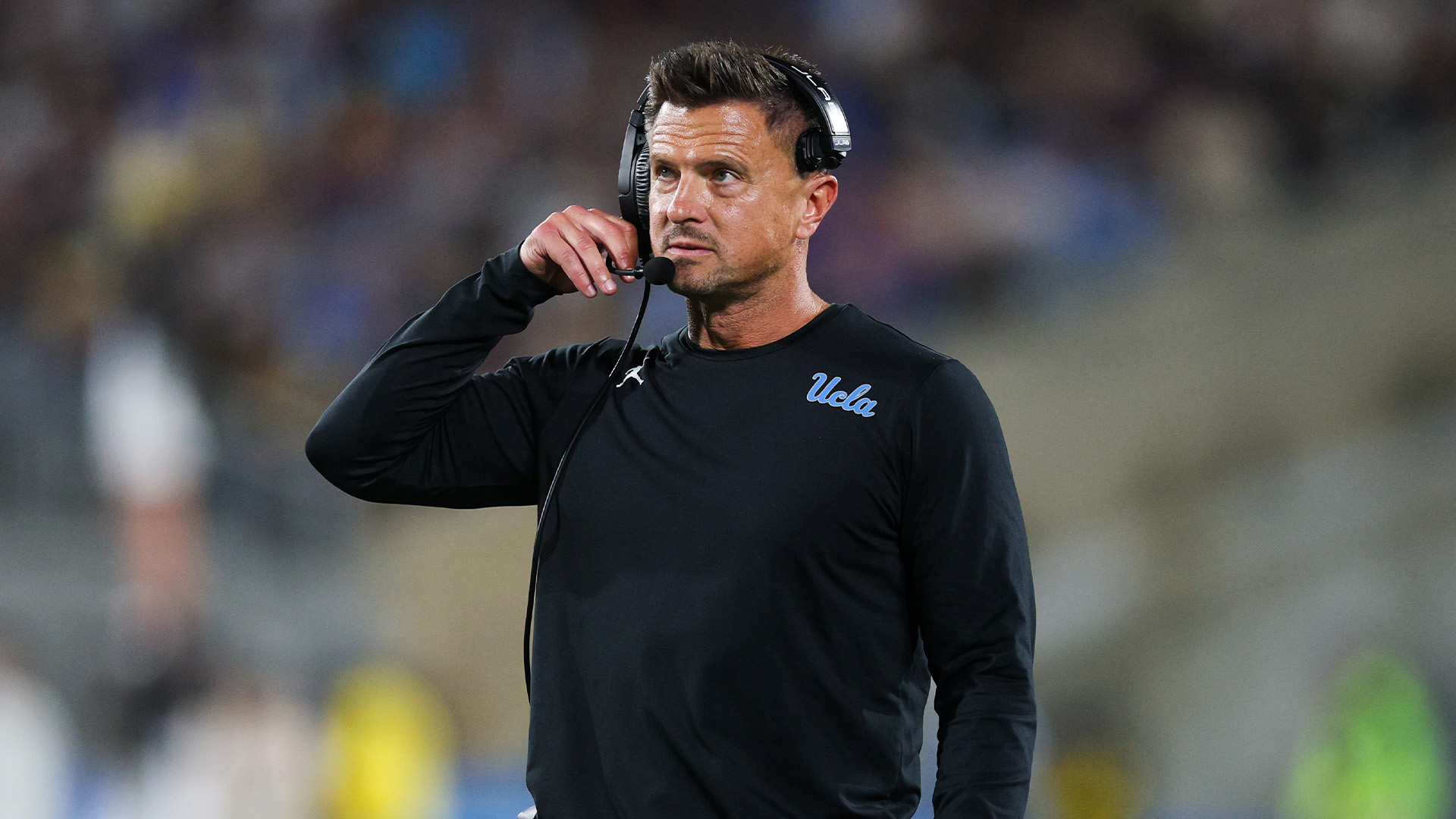
There is a particular joy in watching someone take a fixer-upper and turn it into a home, and Bob Chesney is doing exactly that at UCLA. The No. 12 Bruins have climbed to their highest ranking in four years, reaching the midpoint of the season as one of only nine unbeaten teams in the Football Bowl Subdivision. They share a perfect 3-0 record in Big Ten play with No. 4 Ohio State and No. 5 Indiana, a sentence that would have sounded absurd in August. This is the same program picked to finish 13th in the 18-team Big Ten, the same team that went a combined 8-16 overall and 6-12 in conference games over the previous two seasons under Deshaun Foster and Tim Skipper. The turnaround has been so striking that Chesney was voted the Big Ten’s top coach at midseason, and UCLA was named the conference’s most surprising team, in an Associated Press poll of writers who cover the league. None of this was supposed to happen so quickly. Rebuilding a broken football program usually takes years of patience and pain. But Chesney, with his sleeves perpetually rolled up and a roster stitched together from wherever he could find talent, has managed to make the Bruins relevant again before the calendar even turned to November. For a fan base that has spent years watching other teams celebrate while UCLA stumbled through coaching changes and injuries, this sudden surge feels less like progress and more like a fever dream. Players are flying to the ball, blockers are opening holes, and a once-hesitant campus is starting to buzz again. You can hear it in the stands, read it in the student section, and see it in the way the Bruins carry themselves. Chesney has done more than change a record; he has changed the atmosphere around a program that desperately needed a reason to believe. There is a long way to go, but for the first time in years, UCLA enters every game expecting to win, not hoping to survive. The fixer-upper is not just looking better; it is starting to shine.
Chesney did not walk into a stable situation; he walked into a construction zone. He arrived last December after two impressive years at James Madison, where he went 21-6 and led the Dukes to a spot in last season’s College Football Playoff. That success made him a hot name, but UCLA was a different kind of challenge. There was the predictable roster churn that follows every coaching change, players entering the portal, commitments wavering, and uncertainty everywhere. Chesney caught a break when starting quarterback Nico Iamaleava, now injured, decided to stay, giving the Bruins a foundational piece. Still, the roster’s overhaul was enormous: a Big Ten-high 46 transfers joined the program, including 11 from James Madison, along with 17 freshmen. Donor money for name, image and likeness spending poured in and helped, but the athletic department remained a financial wreck. Then, five days before the Bruins’ opener, chancellor Julio Frenk fired athletic director Martin Jarmond, the very man who had hired Chesney. Imagine the instability: a new coach trying to install a culture while the administrator who brought him to campus gets dismissed in the same week as the season opener. Most teams would have crumbled under the chaos. Chesney, instead, found a way to keep his players locked in, treating the noise as something outside the building. He told his team to focus on what they could control, and somehow they have done exactly that. The result is a 5-0 start that has made UCLA the talk of a conference that expected nothing from the Bruins. Behind the scenes, Chesney leaned on the relationships he built with the James Madison transfers, who already knew his system and his standards. They became the bridge between the old roster and the new one, helping the freshmen and other transfers learn what it means to practice with purpose and play with discipline. It has not been perfect, but it has been enough. And for a coach who has spent his career proving people wrong, this is just another chapter in a story that refuses to follow the expected script.
The numbers behind UCLA’s start tell a story that is almost hard to believe. Chesney is the first football coach in UCLA history to begin his debut season with five consecutive victories. The Bruins lead the Big Ten with 253 rushing yards per game, a ground game that has become a battering ram against teams with bigger names and deeper recruiting classes. Wayne Knight, one of the James Madison transfers, leads the conference with 109.6 rushing yards per game, and his bruising style has made him a cult hero in Westwood. Two wins stand out as evidence that this is no fluke. The 54-3 thrashing of Maryland two weeks ago was the program’s most lopsided victory in a Big Ten game and its most dominant conference road win since 1955. Then came last week’s 17-15 nail-biter at Oregon, a game that ended with the Bruins celebrating their first road victory over the Ducks since 2004. Those are the kind of milestones that used to belong to other programs, not a team that was supposed to be rebuilding. But statistics only capture part of the transformation. Watch the Bruins on the sideline and you see players who genuinely believe they are going to win, even when the game is tight. Watch them in the fourth quarter and you see legs that keep churning, blocks that keep getting sustained, and a defense that refuses to break. Chesney has instilled a toughness that cannot be measured in yards or rankings. It is the kind of quiet confidence that comes from doing the work when nobody is watching, and it has made UCLA one of the most dangerous teams in the country. The schedule still has landmines, and the season is only halfway home. But for a program that has spent years searching for an identity, the Bruins have found one. They run the ball, they stop the run, and they believe in each other. That simple formula has turned a projected also-ran into a team that now controls its own destiny in the Big Ten race.
As the Big Ten pauses at midseason, the individual honors reflect the unpredictability of this strange season. Northwestern quarterback Aidan Chiles earned the title of most surprising player, a label that fits a career defined by second chances. Chiles spent one year at Oregon State, then two at Michigan State, where he was benched after eight games last season. Now at Northwestern, he has led the Wildcats to a 4-1 start while completing 71.4 percent of his passes for an average of 234.4 yards per game. He has thrown nine touchdowns and no interceptions, a stat line that would have seemed impossible given his recent struggles. His story is a reminder that players are not finished products, and that a change of scenery can sometimes unlock the talent that was there all along. On the other side of the ball, Ohio State wide receiver Jeremiah Smith was the unanimous choice for top offensive player, and it is easy to see why. Smith has put together a season that looks destined to be one of the best in Buckeyes history. His 48 catches, 916 receiving yards and 11 touchdowns rank second in the country, and he has gone over 150 yards in four of six games, including two games over 200. Watching Smith play is like watching a painter work with colors that do not exist for anyone else; he makes impossible catches look routine and turns short throws into long touchdowns. Indiana quarterback Josh Hoover, meanwhile, was named the top first-year transfer. Hoover is the third in a line of one-year quarterbacks brought in by coach Curt Cignetti, and he has thrown 17 touchdown passes without an interception for the Hoosiers, who have been one of the season’s biggest surprises. This is the same quarterback who threw 33 interceptions over 35 games during his previous three seasons at TCU. The contrast is staggering, and it underscores how much a fresh start, a supportive system and a little trust can change a player’s trajectory. These stories are why college football keeps its hold on us. They remind us that redemption is real, that a bad past does not have to define a player, and that belief can turn potential into production. At midseason, these three quarterbacks and receivers are not just filling stat sheets; they are writing chapters in a season that no one predicted.
The defensive awards are just as compelling. Indiana edge Tobi Osunsanmi earned top defensive player honors after transferring from Kansas State, where he missed the second half of last season because of injury. Now healthy, he has been a nightmare for opposing offensive linemen. Osunsanmi leads the Big Ten with 9.5 tackles for loss and is tied for first with five sacks, alongside teammate Stephen Daley and Oregon’s Matyo Uiagalelei. His return from injury is not just a personal victory; it has helped transform Indiana’s defense into a unit capable of changing games. Meanwhile, Southern California defensive end Luke Wafle was chosen as the top first-year freshman, and he has lived up to every star attached to his name. A five-star recruit and the No. 1 prospect in the nation according to On3 and Rivals, Wafle has 27 tackles, six for loss and two sacks. Pro Football Focus grades him among the Trojans’ highest-rated defenders, and he has missed just two tackles on 264 snaps. For a teenager to command that kind of respect in a conference filled with older, stronger players is remarkable. Wafle plays with a motor that never stops, and his maturity on the field suggests a bright future. These are the kinds of performances that often get lost in the noise of playoff races and coaching searches, but they are what make college football so endlessly entertaining. Every week, a player nobody expected becomes a star. Every week, a comeback story reminds us that careers do not follow straight lines. The Big Ten’s midseason awards are a snapshot, but they celebrate players who have already given fans countless reasons to cheer. They also serve as a reminder that the conference is deeper than the usual blue bloods. From Northwestern to Indiana to USC, the league is full of players who show up every Saturday and leave everything on the field. Whether they are chasing championships or simply trying to prove they belong, these defensive standouts embody the grit that defines this sport.
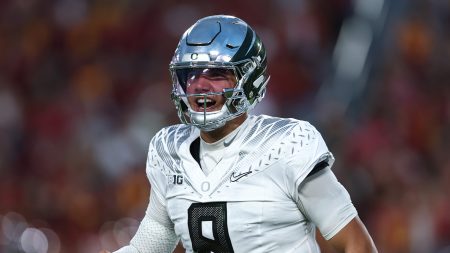
For every surprise, there is a disappointment, and Oregon has quietly become the most uncomfortable story in the Big Ten. The Ducks edged Michigan for the dubious title of most disappointing team. They entered the season with enormous expectations, a highly regarded class of transfers joining 14 returning starters, and a quarterback in Dante Moore projected to be one of the first players taken in the 2027 NFL draft. Their No. 2 preseason ranking was the highest in program history. But the season has not followed the script. A loss at Oklahoma State in the second game was an early red flag. They managed to beat Southern California on the road, but they lost Moore to a frightening injury during that game, an illegal hit to the head and chest by linebacker Desman Stephens II that knocked him out in the second quarter. Without their star quarterback, the Ducks lost last week to UCLA, 17-15, at home, dropping them to 3-2 and out of the Top 25. Moore threw 30 touchdowns while leading Oregon to the College Football Playoff semifinals last year, and the Ducks had pinned their hopes on him while chasing the first national championship in program history. He missed the UCLA game, and his status for this week’s game against Nebraska remained uncertain. Meanwhile, the hottest seat in the conference belongs to Maryland coach Mike Locksley, who has survived seven mostly underwhelming seasons but may be facing his worst yet. The Terrapins have just two wins, one against a second-tier Championship Subdivision opponent. If they do not beat Rutgers at home as a 6.5-point favorite, they might not win another game all season. College football can be brutally unforgiving. For every Chesney celebrating a turnaround, there is a Locksley feeling the walls close in. For every Hoover enjoying a renaissance, there is a Moore hoping his body lets him return. That is the nature of the sport, and it is what makes the midseason awards both a celebration and a reminder of how fragile success can be. As the second half begins, the Bruins will try to keep their dream alive, the Ducks will try to keep hope from slipping away, and everyone else will keep fighting for something, a title, a bowl game, or simply another Saturday to prove themselves.