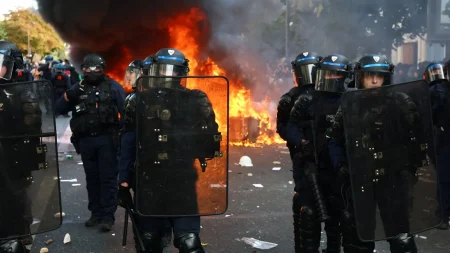






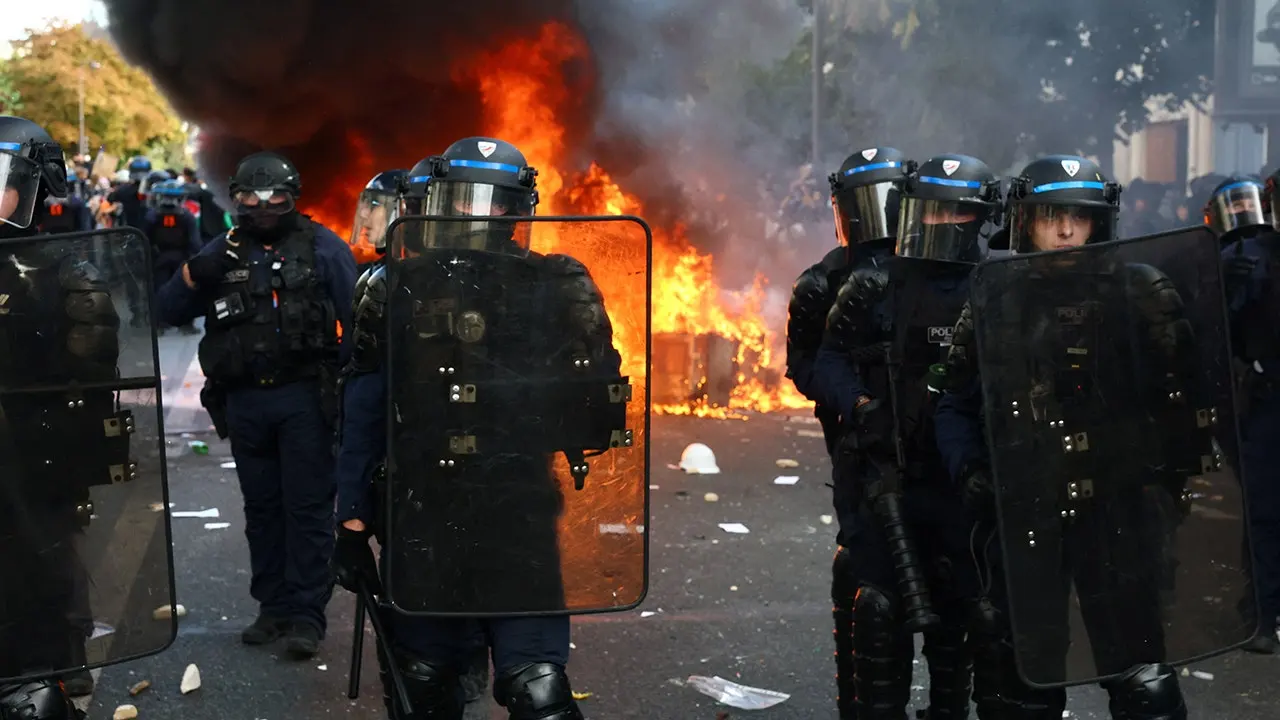
The streets of France have once again become the backdrop for a deeply emotional and politically charged confrontation, as high school and university students flood public squares to demand a better educational system. At the center of this storm is a government that finds itself defending its security forces against accusations of excessive force. French Prime Minister Sébastien Lecornu took to parliament on Tuesday to push back against these allegations, insisting that officers were not acting out of malice or following secret orders to harm young people, but rather reacting to a volatile situation that had spiraled out of control. The human cost is undeniable—a teenager has lost a hand, another has lost sight in one eye, and hundreds have been injured. But Lecornu’s message was clear: the state is not engaged in repression, and the term “police brutality” unfairly presumes a coordinated, deliberate campaign of violence by authorities. Instead, he framed the police response as a necessary reaction to urban violence, arson, and vandalism, acknowledging that accidents can happen in such chaotic environments, but insisting that the officers involved were acting within their legal authority. This is not a distant political debate for the people in the streets; it is a raw, personal crisis that has touched families, classrooms, and hospitals, and the nation is now watching to see how its leaders reconcile order with compassion.
Lecornu’s defense, as reported by Politico, was both forceful and careful. He argued that the phrase “police brutality” carries a heavy implication—that officers had been instructed by higher-ups to use violence, which he flatly rejected. Instead, he painted a picture of law enforcement reacting to escalating situations that included urban violence, arson, and vandalism. “What triggers police action is the occurrence of urban violence,” Lecornu said. “Can accidents happen? The answer is yes.” This line of reasoning was echoed by Interior Minister Laurent Nuñez, who insisted that the police response had been proportionate in “almost all cases.” Together, the two officials are trying to shape a narrative that acknowledges the tragic outcomes while absolving the state of systemic blame. Yet, for the families of the injured students, words like “accident” and “almost all” are cold comfort. The distinction between an intentional act and an accidental one may be legally important, but emotionally, the results are the same: shattered lives, permanent disabilities, and a younger generation asking why their government is responding to peaceful pleas with such a heavy hand. The prime minister’s comments reflect a broader struggle between maintaining public order and protecting citizens, especially minors, who are at the heart of this movement.
The most heartbreaking chapters of this unrest involve the youngest victims. In northern France, a 15-year-old boy lost his hand when a police grenade exploded during a protest. The prosecutor investigating the case said he could not “say for certain whether the student picked up the grenade or whether it was thrown at him.” Either way, a child is now facing a life altered forever by a device designed for crowd dispersal. In the city of Tours, a 16-year-old lost sight in one eye after being hit by a projectile, which investigators believe may have been fired from a sub-lethal riot-control weapon used by police. These weapons are intended to incapacitate without killing, but their use in crowded, chaotic settings can lead to catastrophic injuries. The teens’ stories have become rallying cries for a movement that is no longer just about classroom funding, but about the safety of young people in public spaces. The government’s insistence that these are isolated accidents does not sit well with those who see a pattern of escalating force. For every official who points to the arrest numbers and claims that order is being restored, there is a parent sitting in a hospital, wondering how a peaceful protest ended with their child being permanently maimed. The incidents have also reignited a national debate over the use of so-called sub-lethal weapons, with many arguing that no weapon should be allowed to rob a teenager of their sight or their hand.
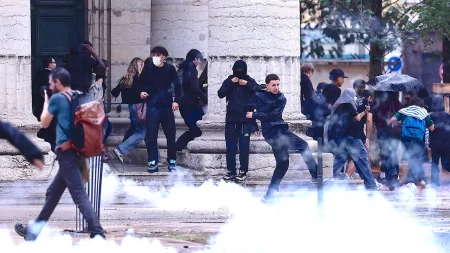
The scale of the protests is staggering, and the human toll is now being counted by the thousands. More than 6,500 people have been arrested, and hundreds have been injured, according to the Associated Press. Most of those arrested were minors, a fact that adds a particularly troubling dimension to the conflict—police officers are rounding up children in massive numbers, many of whom may have simply been swept up in the crowd. Lecornu’s office reported that 215 students and 85 school staff members had been injured since the movement began, while 715 police officers were also hurt. These numbers illustrate the chaos that has engulfed high schools and universities across the country. What started in the Paris region in mid-September has now become a nationwide phenomenon, with students venting their frustration over inadequate funding, deteriorating facilities, and a system that many feel is failing them. During Tuesday’s demonstrations, unions and teachers’ groups joined forces with high school and university students, and members of France’s left-wing parties were also present. The Interior Ministry estimated that 266,000 people took to the streets nationwide, including 56,000 in Paris. While the Paris demonstration was described as largely peaceful, smaller groups clashed with riot police later in the day, a familiar pattern in a country where protests often start with hope and end with tear gas.
Beyond the physical injuries, there is a deep political undercurrent to this crisis, and the French government is acutely aware of the stakes. President Emmanuel Macron convened an emergency meeting with senior ministers to discuss the nationwide student protests and what they could mean for the upcoming presidential election. The prime minister did not mince words when it came to the far-left opposition party France Unbowed, accusing it of exploiting the student movement to sow chaos and gain political advantage. This accusation highlights the bitter divide in French politics, where youth anger is often seen not as a genuine cry for help, but as a weapon to be used by ambitious politicians. Meanwhile, Boris Vallaud, the leader of the center-left Socialist group in parliament, announced that his lawmakers would introduce legislation to restrict the use of sub-lethal riot-control weapons at student demonstrations. Vallaud’s proposal comes in direct response to the horrific injuries suffered by the 15-year-old and 16-year-old, and it underscores a growing bipartisan unease with the tools of modern crowd control. The protests have thus become a three-way struggle: students demanding a better future, the government fighting to maintain order, and opposition figures trying to channel the anger into political momentum. In the midst of it all, ordinary citizens are being forced to ask complex questions about how far a state should go to preserve public safety, and at what point the cure becomes worse than the disease.
As the nation grapples with this crisis, there is a desperate need for something more than political posturing—there is a need for understanding. Lecornu himself admitted, “I hope we can provide a political response to a very real anxiety among high school students.” This is a rare moment of acknowledgment from a government official that the students’ concerns are legitimate, even if the methods of protest have been challenged. The teenagers flooding the streets are not simply troublemakers; they are the product of a system that has underfunded their schools for years, and their frustration has finally boiled over. The injuries, the arrests, and the angry rhetoric have all taken their toll, but beneath the conflict lies a profound social issue that cannot be solved by riot police alone. The young people of France are asking for more than just bodies to fill classrooms; they are asking for a government that hears them, that invests in their future, and that does not view them as adversaries to be subdued. The path forward will require a delicate balance between the need for public safety and the obligation to respect civil liberties, especially when those exercising their rights are teenagers. As the rallies continue and the political pressures mount, the hope must be that both the state and its youngest citizens can find a way to engage in dialogue rather than confrontation. With so much already lost—sight, limbs, trust—the only way forward is through empathy, open conversation, and a genuine commitment to healing the rifts that have brought France to this painful moment.