


-
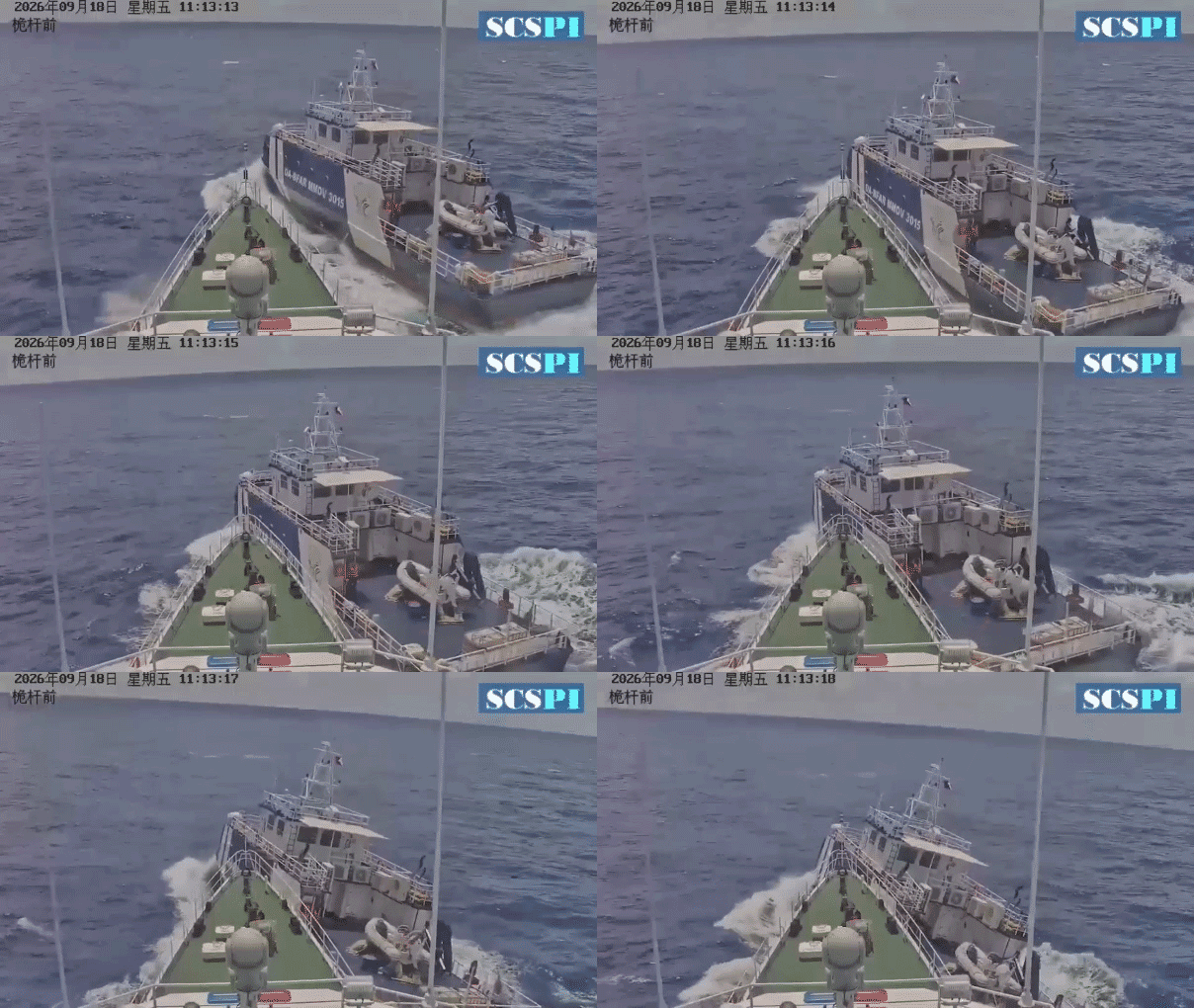
There are moments in international affairs that arrive not as formal declarations or carefully worded statements, but as sudden, terrifying bursts of noise and steel on open water. That is exactly what unfolded on a tense Friday morning in the South China Sea, when a Chinese Coast Guard vessel slammed into a Philippine government ship carrying fuel to local fishermen. The entire encounter was captured on video, and the footage is chilling in its immediacy. Aboard the Philippine Bureau of Fisheries and Aquatic Resources vessel BRP Datu Magat Salamat, crew members could be seen bracing themselves, shouting, “Brace for impact!” just before the collision. The impact itself was jarring enough to twist metal railings, snap support beams, and scatter debris across the deck. By some small mercy, no one was injured. But the images of bent steel and scattered wreckage tell a deeper story: a confrontation that could have ended in tragedy, and one that reveals how a vast geopolitical rivalry can suddenly manifest in the most personal and physical way possible. For the Filipino fishermen who rely on such government vessels to resupply them in distant waters, this was not an abstract dispute over maritime boundaries. It was a frightening reminder that their ordinary working day can be interrupted by the weight of a much larger conflict.
-
To understand what happened, we need to place ourselves on the water that morning. The Philippine vessel was not a warship, not a naval patrol boat, and not a military asset in any conventional sense. It was serving as a lifeline, carrying fuel to Filipino fishermen operating in waters that Manila considers well within the country’s exclusive economic zone, roughly 54 nautical miles off the coast of Palawan province. For the people on board, the mission was straightforward: keep the fishing boats supplied, keep the local economy alive, and allow Filipino workers to earn a living in waters they have long considered their own. That sense of purpose makes the collision feel all the more disturbing. Imagine being a crew member on a routine supply run, watching the horizon for weather or fishing boats, and suddenly seeing a Chinese Coast Guard vessel maneuver dangerously close. According to Philippine officials, the Chinese ship first crossed the Philippine ship’s stern at a distance of only about 33 feet, then repeated the maneuver minutes later, this time colliding with it. Whether the encounter was a deliberate act of aggression or a tragic miscalculation depends entirely on whom you choose to believe. But from the perspective of the crew members on the Philippine ship, there is no ambiguity about the fear they felt in those final seconds before impact.
-
As is almost always the case in the South China Sea, the two sides told wildly different stories. Manila presented the incident as a deliberate act of bullying against a civilian vessel on a humanitarian and livelihood mission. Jay Tarriela, the Philippine Coast Guard spokesperson for West Philippine Sea concerns, described a pattern of increasingly aggressive Chinese maneuvers, as if the Chinese vessel was intent on sending a message. Beijing, predictably, rejected that framing outright. Chinese Coast Guard spokesperson Jiang Lue insisted that the Philippine vessel was the one at fault, claiming that it had “intentionally adjusted its course and suddenly accelerated to cut across the bow” of the Chinese ship after ignoring repeated warnings. In Beijing’s account, the Chinese vessel was conducting lawful operations near Sabina Shoal, and the Philippine side was the provocateur. For anyone watching from the outside, this clash of narratives is deeply unsettling. It is not simply a matter of two governments exchanging accusations through diplomatic channels. It is a reminder that, in disputed waters, there is often no impartial witness, no neutral authority, and no agreed-upon version of events. The same video can be spun to support opposite conclusions, and the truth becomes a casualty of the larger struggle for influence in the region.
-
Friday’s collision was far from an isolated incident. It was simply the latest episode in a long and escalating series of maritime confrontations between China and the Philippines, many of which have involved real violence and genuine danger. Just months earlier, in July, Manila accused Chinese forces of firing water cannons at government vessels near Scarborough Shoal, a tactic that can knock people off their feet and send equipment flying across decks. Even more disturbingly, Philippine officials reported that a Chinese crew member struck a Philippine Navy staff member in the head with a wooden baton during a confrontation at Second Thomas Shoal. These are not abstract geopolitical chess moves; they are physical attacks on human beings, carried out by men and women who are often acting on orders from faraway capitals. The people caught in the middle are fishermen trying to feed their families, government employees trying to do their jobs, and coast guard personnel who must navigate the impossible tension between national duty and personal survival. Every incident raises the stakes, and every collision makes the next one more likely to end in death. The fact that Friday’s encounter caused only property damage feels almost like luck, but in a region where tensions are rising so quickly, luck is not a strategy.
-
The collision also drew Washington into the dispute, not that Washington was ever far away. U.S. Ambassador to the Philippines Lee Lipton issued a statement strongly condemning what he characterized as a “deliberate ramming” by the China Coast Guard, aligning the United States firmly with its treaty ally. Beijing responded with predictable fury, accusing the United States of backing Philippine “infringement and provocations” in the contested waters. This is the larger pattern: a skirmish between Chinese and Philippine vessels quickly becomes a diplomatic standoff between two superpowers, with smaller nations left to calculate their own survival. For the Philippines, the alliance with the United States provides a sense of security, but it also makes the country a front line in a global rivalry that extends far beyond the South China Sea. For China, the presence of American backing only hardens its resolve to challenge what it sees as foreign interference in its claimed territory. The result is a dangerous loop: every incident strengthens the resolve of each side, and every strengthened resolve makes a de-escalation that much harder to achieve. Diplomats speak of red lines and rules-based orders, but on the water, all that matters is the distance between two hulls and the judgment of a crew deciding whether to turn or hold course.
-
What does all of this mean for the people who actually live with these tensions every day? For the Filipino fishermen who spend weeks at sea, their boats bobbing in waters that both nations claim, the collision is more than a headline. It is a warning that the ocean they depend on is becoming more dangerous. For the crew members who watched the Chinese vessel approach, the memory of that impact will likely stay with them for years. And for ordinary people on both sides of the dispute, the repeated confrontations are a reminder that the gulf between rhetoric and reality can be measured in the distance between two ships on a bright Friday morning. The South China Sea is one of the most important waterways on Earth, a conduit for trade, energy, and food that sustains billions of people. It is also a place where national pride, economic ambition, and military power collide with terrifying regularity. The collision off Palawan was not an act of war, and it may not even change the larger course of the dispute. But it should serve as a wake-up call. Every time a vessel is rammed, every time a water cannon is fired, every time a sailor is struck with a baton, the chance of a catastrophic mistake grows. The world can argue about territorial claims and legal interpretations, but no argument can justify turning a human being’s ordinary workday into a moment of mortal fear. If there is any lesson from Friday’s collision, it is that the people who spend their lives in these waters deserve better than to be treated as pawns in a game of power. They deserve to come home safe, with their boats intact and their dignity intact, no matter which flag flies over the distant horizon.