






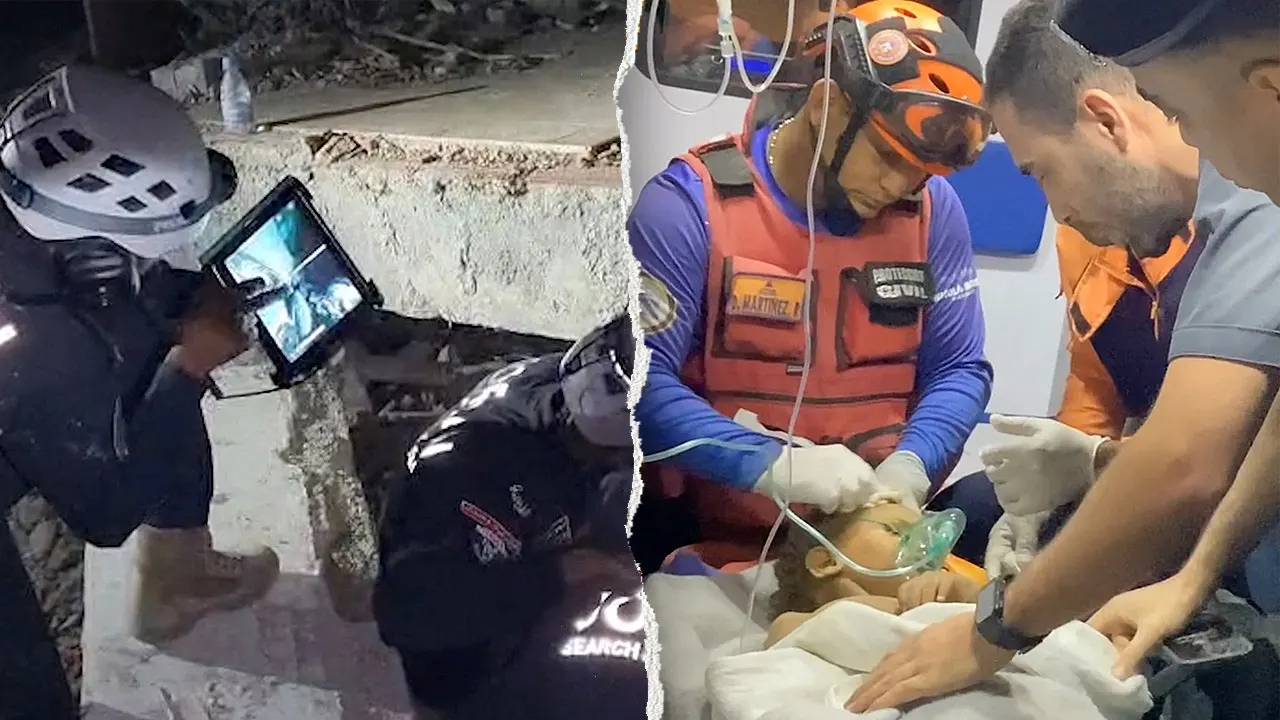
In the quiet, dust-choked ruins of La Guaira, Venezuela, where the devastating double-punch of magnitude 7.2 and 7.5 earthquakes had transformed a vibrant coastal community into a gray landscape of shattered concrete and twisted metal, a miracle unfolded on the sixth day of desperate search operations. Jordanian emergency workers, moving carefully through the highly unstable debris of what had once been a bustling residential building, heard a sound that seemed impossible after nearly a week of absolute silence—a soft, muffled whimper from deep beneath the rubble. Working with painstaking care, using their bare hands and light tools to avoid triggering a secondary collapse that could prove fatal, the rescuers managed to pull two-year-old Klieber Moran into the bright glare of the Tuesday sun. The toddler, who had spent an agonizing six days trapped in total darkness without food or water, was immediately wrapped in blankets and rushed to a hospital in Caracas, sporting a fragile but resilient spark of life that astonished the medical personnel who received him. His rescue stands as a solitary, shining beacon of hope on a day when many had begun to fear that the window for finding survivors had slammed shut forever. Acting President Delcy Rodríguez shared the news on Telegram, acknowledging the heroic efforts of the foreign rescue workers who refused to give up on the tiny voice buried beneath the weight of the fallen city. For a nation gripped by profound grief and trauma, the survival of little Klieber is not just an extraordinary medical marvel; it is a profound testament to the human spirit’s absolute refusal to yield to the dark, serving as a reminder that even when the earth literally tears itself apart, life can find a way to claw its way back to the light. It gave the exhausted searchers, who had been working with little sleep under grueling conditions, the emotional fuel they needed to keep digging when all logic screamed that survivor recovery was no longer scientifically possible.
The sheer scale of the devastation that has gripped Venezuela’s northern shore is difficult to comprehend, as the twin earthquakes have unleashed a humanitarian crisis of historic proportions. By Tuesday, the official death toll had climbed sharply to 1,943 people, a devastating jump from the 1,719 reported just twenty-four hours earlier, and authorities fear this number will continue to rise as heavy machinery begins to clear the most heavily compacted ruins, where thousands remain missing. More than 10,500 citizens have been treated for physical injuries ranging from severe crushing trauma to compound fractures, while countless others struggle with the invisible, psychological scars of losing their homes, their livelihoods, and their loved ones in a matter of seconds. In a national address that struck a delicate balance between mourning and determination, National Assembly President Jorge Rodríguez urged the public to maintain their faith, reminding a grieving country that every hour spent searching is an hour of potential salvation. His words, “We must hold onto the hope of continuing to find people alive beneath the rubble,” echoed through the quieted streets of Caracas and La Guaira, where families still gather at the edges of police cordons, clutching photographs of missing relatives and refusing to leave until they receive definitive answers. The atmosphere across the country is heavy with the scent of pulverized concrete and the collective anxiety of a population waiting for news, yet the relentless drive of local volunteers has transformed these disaster zones into arenas of quiet defiance. This collective hope, though strained by the mounting casualties, prevents the nation from collapsing under the sheer weight of its grief, reminding everyone that every recovery matters. Neighbors have formed chain links to pass buckets of debris, local bakeries are distributing free bread despite their own losses, and makeshift shrines with candles and prayers have sprung up in public parks, illustrating a deep-seated communal resilience that refuses to be crushed by the fallen masonry.
Faced with a disaster of this magnitude, the global community has mobilized in an extraordinary display of solidarity, bridging political divides to deliver life-saving assistance to the Venezuelan people. The United States government, setting aside long-standing geopolitical tensions, pledged a massive $150 million aid package and deployed Navy warships to assist with logistics, medical triage, and offshore support. Crucially, the elite Urban Search and Rescue (USAR) teams from Virginia, California, and Florida were rapidly dispatched to the disaster zone, bringing 312 highly trained personnel and 18 specialized canine teams to navigate the treacherous ruins. These American first responders, composed of seasoned firefighters, specialized structural engineers, trauma physicians, and canine handlers, arrived with more than 200,000 pounds of state-of-the-art rescue equipment designed to detect heartbeats through concrete and cut through structural steel with millimeter precision. Operating in grueling twelve-hour shifts alongside teams from Jordan, Spain, and neighboring Latin American countries, these international specialists have breathed new life into the search efforts, combining their highly technical expertise with the raw determination of the local Venezuelan civil defense forces. This massive international armada of goodwill serves as a powerful reminder that when human lives are hanging in the balance, the boundaries that divide nations dissolve, replaced by a singular, focused mission to pull survivors from the civilian structures that folded like accordions during the violent tremors. By working in tandem with the local Venezuelan emergency dispatch, these foreign teams have not only brought physical resources but also a profound sense of global companionship to a nation experiencing its darkest hour. The presence of the specialized search dogs, sniffing through the narrow crevices of collapsed apartment buildings, has particularly captivated onlookers, representing a non-verbal promise of rescue that transcends language barriers. These highly trained animals work until their paws are sore, guided by handlers who soothe them, showing that the empathy driving this effort extends to every creature involved in the monumental task of saving human life.
The miraculous rescue of Klieber Moran is not the only story of survival that has captivated a watching world and injected a vital surge of energy into the exhausted rescue crews. Over the weekend, a joint American search-and-rescue team pulled off another breathtaking feat when they successfully extracted a nine-month-old infant girl and her mother from a collapsed structure, a moment captured in a poignant video shared by the U.S. State Department. The infant, shielded from the crushing weight of the falling building by her mother’s own body in an ultimate act of maternal instinct, emerged from the dark ruins with only minor scrapes and bruises, an outcome that baffled and overjoyed the medical teams on site. As the State Department poignantly noted on social media, “Against impossible odds, hope endures,” a sentiment that has become the unofficial rallying cry for the thousands of volunteers working tirelessly in the dirt. These stories of survival, rare as they may be as the days wear on, provide the psychological fuel that keeps the rescuers digging through the night, ignoring their own physical exhaustion, blisters, and the constant threat of dangerous aftershocks. Each successful extraction is met with tears of joy, spontaneous applause, and a renewed sense of purpose, proving to the weary workers that their grueling efforts are not in vain and that beneath the silence of the debris, more miracles may still be waiting to be uncovered. It is these deeply personal triumphs of love and survival that humanize the sterile numbers of disaster statistics, reminding the global audience that behind every digit in the rising death toll is a human story, a family, and a life cut tragically short or miraculously preserved. For the family of the rescued infant, the moment she was pulled into the air was a resurrection, transforming an agonizing vigil of grief into an overwhelming celebration of life, showcasing the thin, fragile line that currently separates despair from ecstasy throughout the affected regions of Venezuela.
As the search for survivors continues, the focus is also shifting toward sustaining the millions of Venezuelans who have been left homeless, displaced, and vulnerable in the wake of the disaster. A vital lifeline arrived on Tuesday in the form of a United Nations Children’s Fund (UNICEF) cargo flight carrying 47 metric tons of critical humanitarian supplies, providing immediate relief to a severely strained healthcare system. This massive shipment contains specialized emergency health kits designed to facilitate safe births under makeshift conditions, provide essential neonatal care for newborns, and deliver vital medicines to prevent the outbreak of cholera and other waterborne diseases that thrive in the aftermath of natural disasters. With local hospitals overwhelmed and sanitary infrastructure severely damaged, these supplies are critical to preventing a secondary wave of mortality among the most vulnerable segments of the population, particularly young children and pregnant women. Humanitarian workers are working around the clock to distribute these kits directly to temporary shelters and field hospitals set up in school gyms, parks, and stadiums. For the families huddled in these shelters, who have lost everything they owned to the tremors, the arrival of these marked UNICEF boxes represents more than just medical aid; it is a tangible sign that they have not been forgotten by the rest of the world as they begin the monumental task of piecing their shattered lives back together. The distribution of clean, safe water and nutrient-dense food packets has brought a semblance of stability to children whose entire worlds were upended in a single, terrifying minute, helping to restore some sense of basic dignity amidst the pervasive chaos. Volunteers at the shelter sites have noted that even small things, like the dry diapers and clean blankets included in these packages, have brought immense relief to mothers who had been struggling to keep their infants warm and clean in dust-filled tents, illustrating how humanitarian aid manifests as small, essential comforts on the ground.
The road to recovery for Venezuela will undoubtedly be long and fraught with immense challenges, but the profound resilience demonstrated by its people offers a powerful blueprint for rebuilding. The catastrophic earthquakes of last Wednesday may have leveled entire neighborhoods, shattered vital infrastructure, and stolen nearly two thousand precious lives, but they have also revealed an unbreakable network of human compassion and global cooperation. As the search operations slowly wind down and transition into the difficult phase of demolition and reconstruction, the memory of those rescued—like young Klieber Moran and the nine-month-old baby girl—will serve as a lasting source of inspiration for a nation rising from the ashes. The rebuilding process will require sustained international funding, long-term engineering expertise, and continued psychological support for a traumatized population, demanding that the global community remain engaged long after the initial dust settles and the international media spotlight fades away. Venezuela’s future will be built on the foundations of the solidarity forged in these darkest hours, proving that even when the earth beneath our feet proves unstable, the bonds of human care, empathy, and collective resolve remain completely unshakable. In the quiet moments of reflection that follow this great tragedy, the triumph of life over destruction will stand as the ultimate victory, guiding the Venezuelan people as they look toward a horizon of healing, hope, and eventual renewal. It is this indomitable spirit of survival that will ultimately define Venezuela’s response to this disaster, ensuring that the legacy of this tragedy is not merely the destruction it sowed, but the incredible strength, love, and global unity it called forth in response. For years to come, the story of the two-year-old boy who survived six days in the dark will be told not just as a lucky escape, but as a symbol of a country that refused to stay buried under the rubble of its darkest day, lighting the path forward for generations to come.