





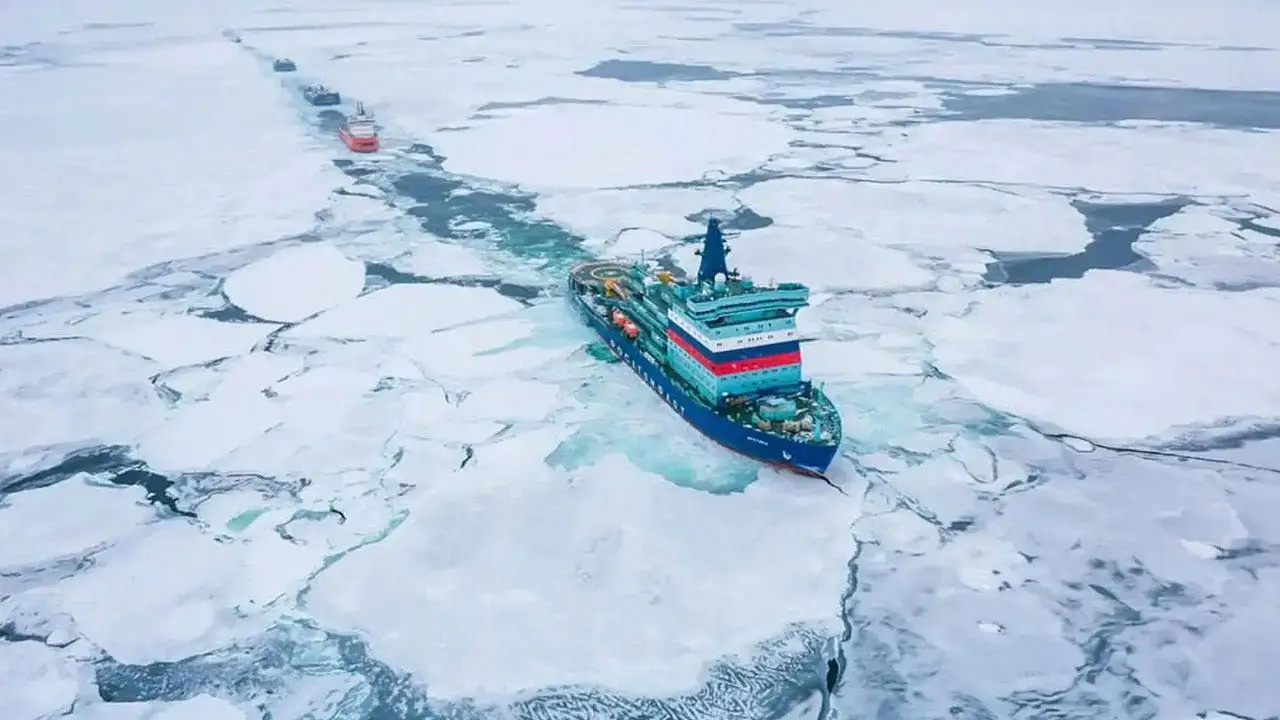
In an age when global trade routes are often taken for granted, a quiet but significant shift is happening at the top of the world. In mid-August, the container ship Dubai Tower left China’s bustling Ningbo-Zhoushan Port and pointed its bow toward Europe, not through the crowded Suez Canal or the pirate-plagued waters of the Red Sea, but along Russia’s northern coast—a frozen frontier that is rapidly becoming navigable as Arctic ice recedes. The voyage, bound for Felixstowe, England, was scheduled to take about twenty days, a handful of days shorter than traditional routes, and it is part of a new seasonal container service that China is testing with Russia. On paper, this is a modest operation, with just over eight voyages planned for the season, carrying a relatively small number of containers. But according to China analyst Gordon Chang, the significance of this experiment reaches far beyond shipping logistics. “China has a major strategic push on the Arctic for various reasons,” Chang told Fox News Digital. “Arctic ice is melting, and this means that the Northern Sea Route, which hugs Russia’s north coast, does become viable at least for a few months in the summer.” In other words, what looks like a niche commercial venture is really part of a much larger geopolitical chess match playing out in the white silence of the Far North, with implications for trade, energy, and military security that Americans cannot afford to ignore.
The stakes are not lost on Washington. A White House official, speaking on background, told Fox News Digital that the Arctic is “a critical region for U.S. national security and the economy” and emphasized that the United States will defend its interests “in the face of growing competition from China and Russia.” That competition has become more apparent in recent months, especially as Russia’s war in Ukraine has changed the calculus of Arctic cooperation. A fact sheet released on August 20 by the staff of the U.S.-China Economic and Security Review Commission (USCC) argues that Russia’s economic isolation from the West has “compelled Russia to accept a greater Chinese presence in the Arctic,” a region Moscow has historically guarded as a core sphere of sovereignty and security. The report highlights that Chinese state-owned enterprises now hold a combined 20 percent stake in the sanctioned Arctic LNG 2 project, a massive liquefied natural gas venture that Western countries have tried to isolate. Meanwhile, China and Russia are actively working on developing year-round commercial shipping along the Northern Sea Route and have formed a joint venture to build ice-class container vessels, with the first ship expected to enter service in 2027. The Pentagon’s own 2024 Arctic Strategy echoes these concerns, noting that climate change is making the region more accessible and warning that Beijing’s proposed “Polar Silk Road” could open the door to infrastructure and resource investments that would strengthen China’s hand. The strategy even cautions that growing Sino-Russian cooperation could “alter the Arctic’s stability and threat picture.” For American planners, the image of Chinese and Russian ships moving freely through the top of the globe is no longer hypothetical—it is happening now, and the United States is playing catch-up.
For China, the attraction of the Northern Sea Route is obvious: it offers a radically shorter path to European markets, and it avoids some of the world’s most volatile chokepoints. As Chang pointed out, this route bypasses the Strait of Malacca, the Bab el-Mandeb, the Suez Canal, and the Strait of Gibraltar, all of which are vulnerable to piracy, political instability, or great-power interference. “So this is important for China,” he said. But the commercial logic is only half the story. The deeper reality is an increasingly asymmetric relationship between Beijing and Moscow, one in which Russia needs China far more than China needs Russia. The USCC report makes this imbalance painfully clear: since Russia’s invasion of Ukraine in 2022, China has become indispensable to Russia, buying discounted energy and gaining access to Russian military technology without committing to a formal alliance. The numbers are staggering. China now purchases roughly half of Russia’s crude oil exports, while Russian crude represents only about one-fifth of China’s oil imports—meaning that Moscow depends on Beijing to keep its economy afloat, but Beijing could easily find oil elsewhere. Since the invasion, the report says, China has bought approximately $372 billion in Russian fossil fuels, a staggering sum that has helped underwrite Russia’s war effort while filling China’s strategic reserves. Moscow is increasingly using the very same Arctic passage to move its oil east, too. Reuters reported in August that Russia had already sent seven crude shipments—around six million barrels—toward Asia via the Northern Sea Route in the current season, with China as the principal destination. That figure represents nearly half of all the oil transported along the route during the entire previous season, underscoring how quickly the Arctic is becoming a working energy highway.
The military dimension is equally pressing, and it brings the contest uncomfortably close to American shores. The USCC fact sheet notes that China and Russia had participated in at least 119 combined military exercises as of April 2026, a jaw-dropping number that speaks to the depth of their growing partnership. Their joint naval operations in July included submarine, anti-submarine, and drone activity, and in 2024, Chinese bombers entered the Alaskan Air Defense Identification Zone for the first time during a joint patrol with Russian aircraft. For Americans, this is not a distant problem. Alaska sits just across the Bering Strait from Russia, and that narrow waterway—separating the Chukotka Peninsula from Alaska’s western coast—is the only gateway through which any ship must pass to use the Northern Sea Route. Chang called the Bering Strait a “choke point” that gives the United States some leverage, but he also warned that Washington is woefully unprepared to assert its presence in the region. “We need to be in the Arctic, and President Trump has authorized more icebreakers,” he said. “We are woefully short in that department.” The United States currently operates a small fleet of aging icebreakers, far smaller than Russia’s, and despite renewed attention to the Arctic, the gap remains a source of concern among national security experts. Tim Sheehy, a former Navy SEAL and advocate for strengthening American shipbuilding, has described the collapse in U.S. maritime capabilities as “scary,” leaving the country vulnerable to competitors who are rapidly expanding their ice-hardened fleets. The message is clear: if the Arctic is becoming a new strategic frontier, the United States cannot defend its interests with rhetoric alone; it needs ships, infrastructure, and a visible presence in the region.
What makes this moment so awkward for the United States is the temptation to dismiss the Arctic as a sideshow. “There are some U.S. national security strategists who say, ‘Oh, the Arctic is a distraction. There are more important places in the world,’” Chang acknowledged. It is true that the Middle East, the South China Sea, and the Indo-Pacific demand constant attention, and the Arctic may never become a full-scale rival to the Suez Canal for global container shipping. Ice, weather, and limited seasonal windows will likely keep the Northern Sea Route from replacing traditional routes anytime soon. The number of container ships traversing the Arctic this year is tiny compared to the thousands that pass through Suez annually. But Chang argues that dismissing the Arctic would be a grave mistake. “Even more important, regardless of what one thinks of the importance of the Arctic, the Chinese and the Russians are pressing us in the Arctic,” he said. “So we’ve got no choice to respond. Whether we think the Arctic is strategic or not, the Chinese and Russians are there in force. We have to be there too.” His point is a simple but powerful one: the Arctic is no longer a frozen afterthought, but an active theater where adversaries are testing boundaries, building partnerships, and establishing de facto control over new lanes of commerce and transit. Every cargo ship that successfully runs the Northern Sea Route, every barrel of Russian oil that reaches China through Arctic waters, and every joint military exercise in the far north chips away at the assumption that the region is too remote or too harsh to matter.
In the end, the story of the Dubai Tower is not just about a container ship taking a scenic route between Europe and Asia. It is about a world being reshaped by climate change, where melting ice is opening new frontiers for trade, energy, and great-power rivalry. It is about Russia, isolated by war, turning eastward and finding in China a partner willing to invest in infrastructure, buy discounted resources, and stand alongside Moscow in defiance of Western sanctions. It is about China, ever patient and long-term in its strategic thinking, methodically extending its reach into the far corners of the globe, including the polar ice caps. And it is about the United States, now forced to confront the reality that its own back yard is no longer assumed to be safe, as foreign vessels and bombers edge closer to Alaska and the broader North American continent. The Arctic is not the next great war, at least not yet, but it is the next great test of resolve. As Chang put it, the Chinese and Russians are there in force, and the United States has no choice but to answer the call. Whether that answer comes in the form of icebreakers, diplomatic pressure, military readiness, or a broader strategy to counter Beijing and Moscow on every front, the time to act is now. Fox News Digital reached out to the Chinese and Russian embassies in Washington and the White House for comment, but the broader question remains open: as the ice melts and the routes open, will the United States be left standing on the shore, watching the future sail past through waters it once considered its own? The answer will define Arctic security—and American power—for decades to come.