





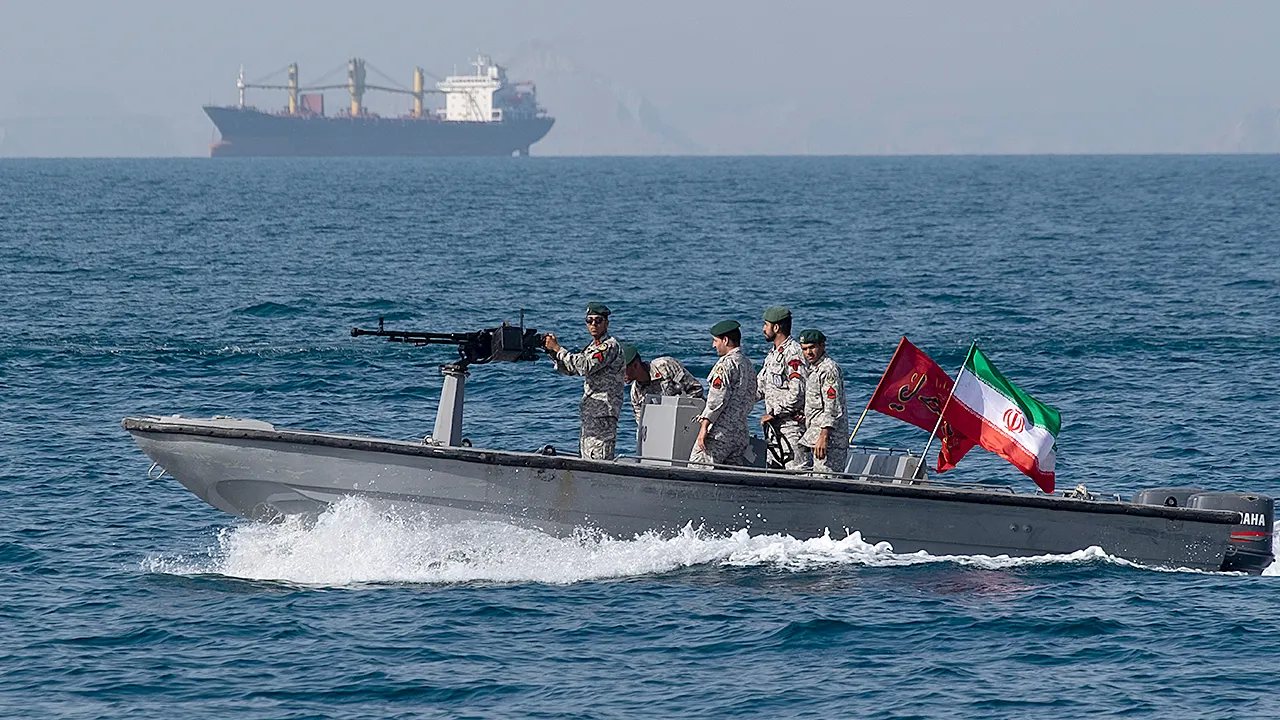
For four fleeting days, the world’s most notorious maritime tollbooth flickered back to life. Iran’s Persian Gulf Straits Authority, a sanctioned arm of the Islamic Revolutionary Guard Corps that has long been accused of extorting ships passing through the Strait of Hormuz, suddenly had its secure website up and running again, thanks to an unexpected ally: a Shanghai-based internet security firm. This wasn’t a hack or a covert operation, but something far more mundane—a routine digital credential, issued automatically by a company called TrustAsia, that briefly let the PGSA collect fees, vet vessels, and operate as if U.S. sanctions didn’t exist. To anyone watching, it was a jarring reminder that in the digital age, even the most powerful embargoes can be quietly bypassed by a few lines of code and a certificate nobody bothered to check.
The story begins with a digital breakdown. In August, the PGSA’s website suddenly became inaccessible to most browsers after the U.S. Treasury’s Office of Foreign Assets Control placed the authority on its sanctions list back in May. Without a valid SSL/TLS certificate—the tiny padlock that keeps internet traffic private—browsers like Chrome and Firefox refused to let users in, warning them that the connection wasn’t secure. Shipping companies, already nervous about crossing the world’s most strategically vital waterway, were forced to use clunky, unencrypted links, leaving their data exposed to anyone listening in. Alp Toker, CEO of the internet monitor NetBlocks, told Fox News Digital that this was “a class of vulnerability open to government exploitation,” raising fears that Iran could intercept and read communications from firms cooperating with the PGSA. For six days, the authority was effectively cut off from the digital world. Then, on August 17, it announced triumphantly: “The mentioned issue has been resolved, and the secure domain is now once again available for submitting requests using any browser.” The savior? TrustAsia.
How did a Chinese company end up helping a sanctioned Iranian entity? The answer lies in the quiet machinery of the internet. TrustAsia is one of the lesser-known “certificate authorities” that issue the cryptographic keys websites need to prove their identity. Most such firms are careful to screen for sanctions, but TrustAsia specializes in a “China-first” infrastructure that goes its own way, as Toker put it. And the certificate it issued to pgsa.ir was a “Domain Validated” certificate—a type that’s generated automatically, with no human review. It simply checks that someone controls the domain, not who that someone is or whether they’re on a U.S. blacklist. That automated process is exactly how the PGSA slipped back online. Jeremy Paner, a sanctions expert at Hughes Hubbard & Reed, was quick to point out the gravity of the move. “Restoration of the certificate is unequivocally sanctionable,” he said, explaining that U.S. law allows the Treasury to punish any company that provides services to a blocked entity, even unknowingly. “The automated nature of the service is irrelevant,” he added, making clear that TrustAsia was walking a very dangerous line.
The reaction from TrustAsia was a mix of defense and quick damage control. In a statement to Fox News Digital, the company confirmed it had issued the certificate but insisted the process was purely technical: “This process does not verify or assert the legal identity, affiliation, or sanctions status of the entity operating or benefiting from the domain.” In other words, they claimed ignorance, not malice. But after being alerted to the situation, TrustAsia said it had added the entire pgsa.ir domain to its “restricted-issuance list” to prevent any future certificates, and announced it would revoke the existing one within the week. That revocation took effect on August 21, and Toker confirmed that browsers would gradually stop trusting the PGSA’s website again. Yet even this move carried a hint of defensiveness—the company insisted the actions were “precautionary compliance and risk-control measures” and should not be taken as an admission that anything was technically wrong. For Paner, however, the damage was done. He warned that TrustAsia should treat the episode as a wake-up call, urging the firm to review its entire compliance program “before it is too late.” After all, the U.S. has incredibly broad authority to punish non-Iranian companies for any level of service, and the next time could result in full-blown sanctions.
Beyond the immediate drama, this episode exposes a fragile underbelly of global online trust. Because TrustAsia’s root certificates are recognized by major U.S. browsers—including Chrome and Edge–American systems would have automatically trusted the sanctioned Iranian portal, giving it a veneer of legitimacy. Toker warned that if the Treasury had chosen to retaliate, tech giants like Google and Microsoft might have been forced to revoke TrustAsia’s root certificates entirely. That could have “splintered the global chain of trust,” potentially rendering much of the Chinese web inaccessible from the West—a digital Iron Curtain nobody wants. The situation also highlights the cat-and-mouse game between Iran’s workarounds and U.S. enforcement. Losing a certificate is not the end of the road: as Toker noted, the PGSA can always find another authority willing to issue a new one, or fall back on unencrypted HTTP for those brave enough to use it. For Iran, the goal is simply to keep squeezing revenue from the roughly 20% of global oil that passes through the Strait of Hormuz. Every day the site stays up, even insecurely, is a day the IRGC can continue its “extortion racket,” as the Treasury called it.
The broader context only intensifies the stakes. This wasn’t an isolated incident; it’s part of a larger economic war. Treasury Secretary Scott Bessent has promised an “economic onslaught” against Iran under the banner of “Operation Economic Outcast,” and just days after the TrustAsia affair, Washington sanctioned nearly 60 Iran-linked individuals, entities, and vessels. The PGSA was specifically designed as a warning to the world: anyone who cooperates with it “may be exposed to sanctions risk.” In that light, TrustAsia’s stumble is a reminder that even neutral-looking tech companies can become pawns in geopolitical battlefields. Paner framed it as a lesson in risk management. “There’s always reputational risk involved in any company that decides to do business with the IRGC,” he said, adding that he would immediately audit all other IRGC-linked services if he were advising TrustAsia. The company, for its part, offered no further comment beyond its initial statement, and a Chinese embassy spokesperson said only, “I am not aware of the specifics you mentioned.”
For the shipping firms caught in the middle, the human cost is harder to measure. They simply want to move oil and goods safely without getting tangled in sanctions or exposing their data to eavesdroppers. When the PGSA’s site goes dark, they’re forced to choose between breaking the law or risking unencrypted communications—a terrible dilemma for any executive. The four-day reprieve offered by TrustAsia wasn’t about geopolitics; it was about doing business in a gray zone where automated software and human oversight collide. In the end, the certificate was revoked, the sanctions held, and the digital status quo was restored. But the episode leaves a lingering question: how many other automated systems across the world are quietly helping sanctioned actors, simply because no one thought to check? The internet was built on trust, but as this saga shows, that trust can be as fragile as a single certificate, expired and renewed, without anyone in Washington noticing until it’s too late. And in that quiet gap between a machine’s “yes” and a human’s “no,” the world’s most dangerous players find room to maneuver.