





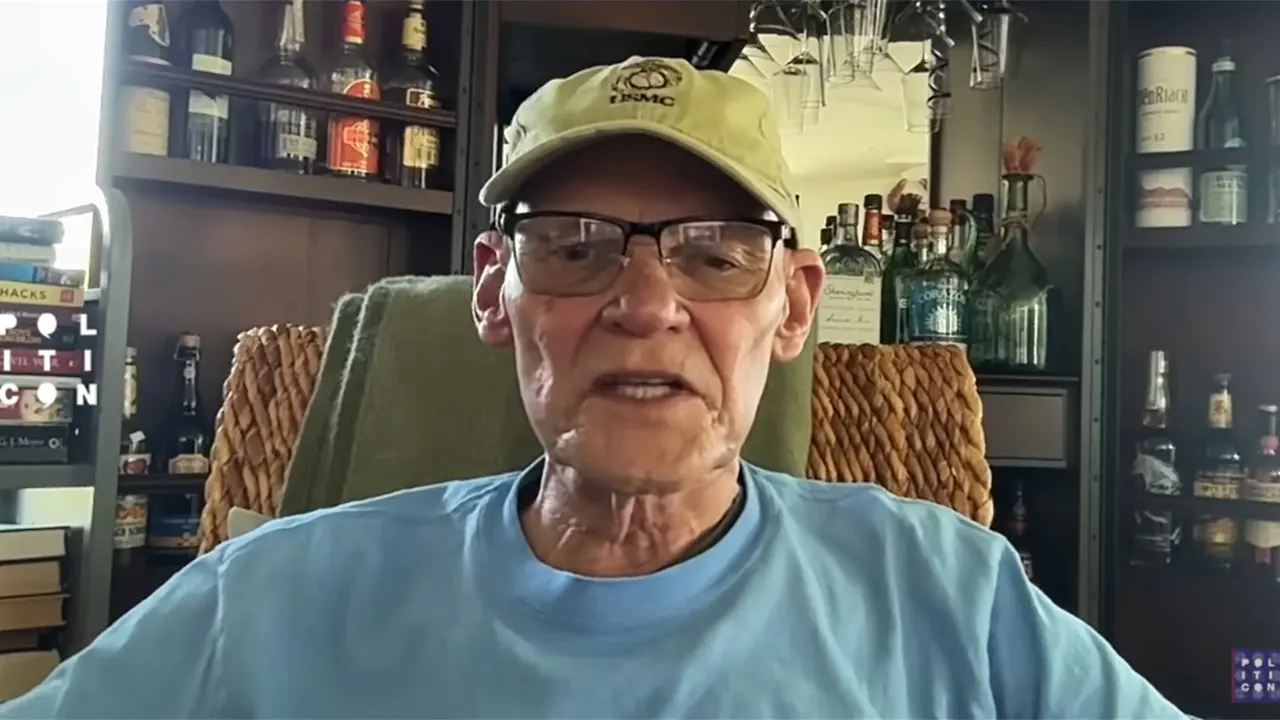
In the high-stakes, often theatrical world of American politics, there are moments when a veteran voice cuts through the carefully managed spin with a raw, unfiltered blast of frustration. Such was the case when James Carville, the legendary Democratic strategist who helped orchestrate Bill Clinton’s White House victories, unloaded on the far-left insurgency currently rattling his party’s foundations. Carville, a man known for his sharp tongue and political street-smarts, didn’t just disagree with the democratic socialists within the Democratic tent; he challenged their very right to wear the party’s label. With an exasperation that echoed the feelings of countless moderate voters and party stalwarts, Carville demanded, “I wish they’d take the word Democrat out of their name. I have no idea why the democratic socialists — if you hate the Democratic Party so much, well, then don’t use our god—- name. Go think of your own name.” His outburst was not born of mere ideological squabble but of a deep-seated, genuine fear that the loud, uncompromising voices representing a fringe are dictating the narrative for a party that the vast majority of ordinary Americans still associate with pragmatic governance, safety, and economic opportunity. Carville’s ire is the sound of a man watching his beloved political institution drift into perilous waters, guided by a compass pointing toward ideology rather than electoral viability, and his warning serves as a stark wake-up call to those who believe the path to victory lies in a radical leftward lurch.
The context for Carville’s fiery rant was a virtual media event promoting a new counter-movement engineered by two pragmatic House members, Rep. Tom Suozzi of New York and Rep. Adam Gray of California. This initiative, dubbed the “Promise to America,” is a clear-eyed, commonsense set of principles designed to wrestle the party’s identity back from the grip of the progressive social media machine. It is a manifesto built on what many would consider the bedrock of the “silent majority” of the party: capitalism, public safety, fiscal responsibility, effective governance, common purpose, and a love of country. By putting these words on paper, Suozzi and Gray are signaling to the American people that there is a home for those who believe in a strong economy that rewards hard work, streets that are safe from crime, a government that doesn’t recklessly spend their tax dollars into oblivion, and a patriotism that isn’t ashamed of the flag. It’s a direct appeal to the people who wake up, go to work, pay their taxes, and want their community to feel secure—the exact demographic that often feels alienated by the constant focus on defunding police, open borders, and a dismantling of the very capitalist structure that built the country. Carville, standing firmly behind this initiative, argued it is just “common sense,” reminding everyone that politics isn’t an academic exercise in purity, but a practical affair of making lives better. “Who’s not for lower crime?” he asked rhetorically, encapsulating the frustration of an entire wing of the party that feels the far-left often prioritizes socialist theory over the straightforward, tangible needs of constituents who just want to walk down the street without fear and afford their groceries.
This internal ideological struggle is not merely a theoretical debate; it is a fierce civil war that has already yielded significant political casualties and threatens to define the 2022 midterm elections. The tension between the “moderate” and “progressive” wings has become a central campaign weapon for Republicans, who gleefully point to the socialist wave overtaking the Democratic caucus as evidence that the party’s true colors are far too radical for the average American. The GOP argues that if Democrats were to seize majority control, they would push a vision of the country that is out of sync with the vast majority of the electorate—a vision of “defund the police,” runaway spending, and open borders that terrifies suburban moms and independent voters alike. Carville, with his decades of campaign wisdom, understands the lethal nature of this line of attack. He sees that the far-left, with its “lunacy of the highest level” policies, is essentially delivering opposition research to the G.O.P. on a silver platter, providing them with the exact soundbites needed to paint every Democrat with the same radical brush. The electoral calculus is brutal: while the progressive wing often claims to energize the youth vote, the realities of a midterm landscape demand that a party appeals to the moderate and disaffected voter whose primary concern isn’t ideological purity, but practical governance. Carville and the Promise to America authors are betting their political careers on the conviction that a party that abandons its broad tent to cater to a loud, vocal minority is a party destined for an electoral massacre.
A glaring piece of evidence against the moderates, however, is the paltry number of signatories to the Promise to America—just ten House Democrats have formally embraced the pledge, a fact that Republicans have swiftly weaponized. To critics, this measly number reveals a party too terrified of its own activist base to take a public stand, demonstrating that the far-left’s influence is far greater than just a few loud voices. Yet, Suozzi and Gray counter this by framing the lack of Washington support as a deliberate strategic decision rather than a failure of nerve. They argue that the movement is meant to be a ground-level uprising, not a top-down Washington mandate. “We only want 10 members of Congress because we don’t want to make it only about Washington,” Suozzi explained, suggesting that the real work is happening in state houses, county commissions, and local council chambers where the actual fabric of American life is governed. This perspective humanizes the political struggle, shifting the focus away from the cable news circuit and the D.C. swamp, and toward the car mechanics, school teachers, and small business owners who form the backbone of the nation. For Gray, representing a district in California’s Central Valley—a region far removed from the coastal liberal elite—the nationalized, highly ideological focus of the progressive left is an absurd distraction. He poignantly observed that the constant attempt to nationalize politics pretends that “somebody in some big city represents all of us,” which is simply not the reality of a diverse country where a farmer in the valley and a venture capitalist in San Francisco live in fundamentally different political worlds.
The most telling silence in this whole debate comes from the party’s senior leadership, who have yet to officially sign onto the pledge, opting instead for a strategic ambiguity. However, Suozzi and Gray brushed aside any suggestion of a leadership conflict, emphasizing that the top brass has a delicate balance to maintain, managing the concerns of a national caucus while fending off primary challenges from the left. Senior leaders like Nancy Pelosi and Chuck Schumer are walking a tightrope, needing the enthusiasm of the progressive wing to turn out the base while simultaneously appealing to swing voters in moderate districts. It is a fundamentally human act of political survival, navigating the tension between the ideological demands of the activist class and the practical need to win general elections. To expect the party command to openly embrace a document that might alienate a powerful faction of their donors and activists is to ignore the mechanics of coalition politics. The moderates proposing the Promise understand this reality more than most. They aren’t asking for a public endorsement from the Speaker’s office; they are asking for the space to talk directly to the American people about the values that used to hold the center together—pragmatism, safety, and a belief that government should be a reliable partner in solving problems, not a social laboratory for radical experiments. This is not a matter of abandoning the party, but of reclaiming its soul from the cacophony of the internet, where unrealistic purity tests often drown out the wisdom of local constituents.
Ultimately, the battle is not just about who controls the Democratic National Committee’s messaging, but about the very tone of American democracy and the visceral connection between citizens and their government. Carville’s exasperated pleas, the formation of the Promise to America, and the attendant political hand-wringing all point to a fundamental question: can a party that values diversity of thought reflect that diversity, or will it allow a vocal minority to force an ideological monoculture? The human impact is immense. When a family in a swing district looks at the news, they don’t care about the tax structures of socialist economic models—they care about whether their local school will open on time and if the neighborhood patrol will be adequately funded. They care about the price of gasoline and the safety of their children. The far-left’s obsession with identity politics and structural critiques often fails to offer the mundane, efficient government services that middle-class America craves. Carville knows this, which is why he insists that “80% of Democrats really want” the commonsense agenda of safety and capitalism. He is, in essence, begging the party to stop shouting past the ordinary voter. The midterms will be a brutal referendum, and if the Democrats lose badly, the blame will likely fall not on the Republicans, but on a party that spent more time fighting itself over righteousness than actually governing and communicating with the heartland. In the end, Carville’s desperation is a mirror for the nation’s own exhaustion—a yearning for a politics that feels sane, focused, and genuinely dedicated to the common good, rather than a never-ending, high-volume argument over who truly stands for the “right” version of progressive or moderate causes. The Promise to America offers a lifeline to those tired of the noise, a reminder that in the hustle of daily life, most people still find guidance in the simple, enduring values of fairness, safety, hard work, and national pride.