





The Disruption and the Debate
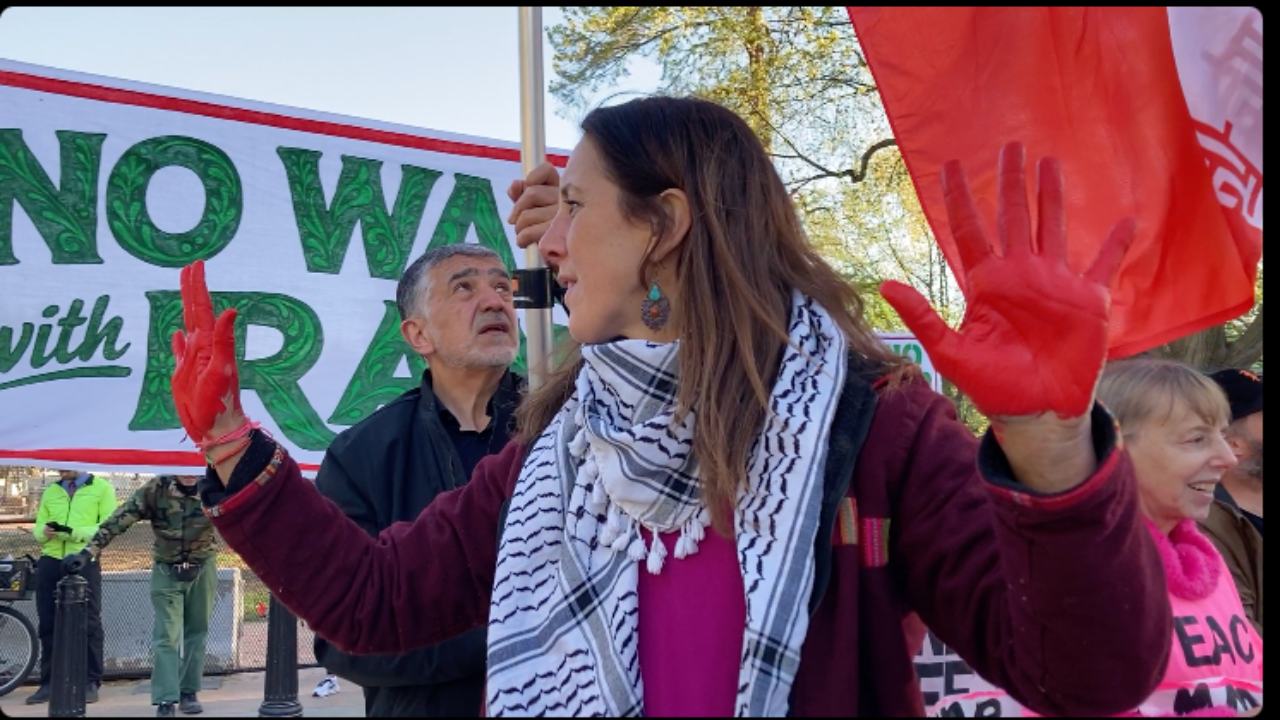
On a Tuesday evening in the nation’s capital, what was meant to be a serious, academic discussion on the geopolitical threat posed by Cuba’s communist regime was abruptly shattered by a cacophony of shouted slogans. At the Institute of World Politics, just blocks from the White House, Christine Balling, a former advisor to U.S. Special Operations Command South, was mid-panel with Michael Gonzalez of the Heritage Foundation, exploring the intricate national security challenges emanating from Havana. Their dialogue was interrupted as Olivia DiNucci, a young, athletic former college basketball star, sprang to her feet, clutching a hand-painted banner that read “SANCTIONS KILL IN CUBA.” Her voice rose over the panelists, a sharp, breathless shout about global solidarity with Gaza, Cuba, and ICE detainees, creating a jarring collage of progressive grievances. As security personnel moved in to confiscate her sign and escort her out a side door, her final, defiant cry echoed through the room: “because the liberation of our people is rooted in our neighbors!” Only in the small print at the bottom of her banner was the source of this carefully orchestrated chaos revealed: “CODEPINK.”
DiNucci, a professional organizer for the left-wing agitation group CodePink, had executed her role perfectly. She is a fixture in Washington’s political scene, a regular disruptor of dinners and hearings, acting as a protégé and sidekick to CodePink co-founder Medea Benjamin. The group’s portfolio is unambiguous in its sympathies: it vocally supports Cuba’s Communist Party, organizes “solidarity caravans” to the island, and has even drawn scrutiny from the Treasury Department for potentially violating the U.S. embargo. For Balling and Gonzalez—both staunch opponents of the Castro regime—this interruption was not a spontaneous outburst of passion, but a calculated act of political warfare. Balling describes CodePink and similar organizations as “Trojan horses,” engineered not for dialogue but for disruption and destruction from within. She argues that their goal is to fracture American society, convincing some citizens that the foundational ideas of the American dream are lies, and reframing adversaries as victims. The irony was not lost on the panel; Balling had just been about to mention CodePink’s affiliation with the National Network on Cuba, the largest pro-regime coalition in the U.S., when DiNucci’s performance provided a live, unwitting demonstration of their tactics.
The Rise of the “Red-Green Alliance” and Congressional Scrutiny
The incident, quickly edited and posted to CodePink’s social media channels under the tagline of DiNucci as a “media contact,” was more than just an isolated act of political theater. It served as a stark, timely illustration for a broader narrative that was about to be examined in the halls of Congress. Less than a week later, a House subcommittee chaired by Rep. Bill Huizenga convened a hearing titled “Trojan Horses: Covert Foreign Malign Influence Operations in America.” The central question posed was how adversarial nations—specifically China, Iran, and Cuba—are leveraging American activists, non-profits, and even social media influencers to launder their propaganda and advance their interests within the United States. The hearing aimed to pull back the curtain on a complex web of influence, where the loudest voices of dissent in American politics often parrot the talking points of the country’s geopolitical rivals.
The investigation highlights a potent ideological fusion, often called the “red-green alliance,” where the “red” of socialist and communist causes merges with the “green” of Islamist political movements, particularly those hostile to Israel, like Students for Justice in Palestine. This convergence is not just coincidental but strategic, with foreign powers and domestic activists finding common cause in opposing American dominance. Rep. Huizenga explicitly called out influencers like Twitch streamer Hasan Piker, who traveled to Cuba with CodePink, as proxies who “promote communism and push their false propaganda.” The hearing sought to expose these operations as a direct threat to national security, capitalism, and the American Dream, framing the ideological battle as being fought as much on social media feeds and at local protest rallies as it is in traditional diplomatic or military arenas.
The Financial Web: Unraveling the Singham Network
At the center of this suspected influence operation is a staggering financial network, meticulously documented by investigative reporting. The money trail leads to Neville Roy Singham, an American-born tech tycoon now residing in Shanghai, who has publicly lavished praise on the Chinese Communist Party and its leader, Xi Jinping. Singham’s connection to this world of leftist agitation is deeply personal; in 2017, he married Jodie Evans, the co-founder of CodePink, in a ceremony in Jamaica, attended by a veritable who’s who of pro-communist leaders. The investigation traced an extraordinary $591 million flowing through a complex labyrinth of organizations across five continents between 2017 and 2025, an interconnected network estimated to touch approximately 2,000 groups.
The first layer of this financial architecture consists of six core non-profits that directly received a combined $278 million from Singham. These include CodePink itself, the People’s Forum in New York, a hub for pro-communist organizing; Tricontinental, a think tank led by Singham’s close friend Vijay Prashad; and BreakThrough News, a media outlet that often serves as the first to broadcast anti-American protest footage. While these organizations deny any wrongdoing and dismiss the reports as “witch hunts,” the sheer scale of the funding suggests a coordinated effort to build a durable, well-resourced infrastructure for activist operations. The money is not merely being spent on stunts like the one at the Institute of World Politics; it is being channeled into think tanks that produce ideological frameworks, media outlets that disseminate propaganda, and activist groups that take to the streets.
Global Reach and Layered Funding
The machinations of this network extend far beyond the boardrooms and protest lines of Washington and New York. The financial analysis reveals that the six primary recipients subsequently distributed approximately $163 million to at least 52 other organizations. This is not a simple central fund; it is a deeply layered system designed for obfuscation and reach. The funds are pushed into different geographic regions, including a substantial $23 million directed towards Sub-Saharan Africa, indicating a global strategy to challenge American influence on multiple fronts. The network acts as a transnational ecosystem, connecting activists in the U.S. with movements in the Global South, creating a feedback loop of shared narratives and strategies.
This global footprint is crucial to understanding the threat. It shows that the goal is not just to stir up domestic dissent in the United States but to create a unified international bloc that opposes American policy and capitalist ideology. By funding projects in Africa, Asia, and Latin America, the network is nurturing a new generation of activists and thinkers who see their struggle as part of a larger war against Western hegemony. The financial structure, with its multiple layers and 501(c)(3) and 501(c)(4) entities, allows for careful laundering of the money’s origin, making it difficult to trace the ultimate source of a protest movement or a media campaign.
Ideological Symbiosis: From Havana to Gaza
The ideological currents running through this network are as fluid as the money. CodePink’s portfolio, for example, seamlessly moves between advocating for the Cuban regime, supporting the Islamic Republic of Iran, and leading anti-Israel campaigns. This demonstrates a unifying principle of opposition to the United States and its allies. The Palestinian cause, in particular, has become a powerful rallying point that synergizes the “red” and “green” elements of this alliance. It provides a potent emotional and political narrative that can be used to mobilize activists on university campuses and in city streets, serving as a vehicle for anti-American sentiment that can also be tied to broader socialist or communist ideologies.
The use of social media influencers like Hasan Piker is a calculated move to mainstream these views for a younger, digital-native audience. By having a popular Twitch streamer pose with CodePink leaders in Havana or spout pro-Hamas rhetoric, the network taps into a subculture that may be distrustful of traditional media but highly receptive to the authentic-seeming voices of online personalities. This marriage of old-school, street-level agitation with cutting-edge digital media is a defining characteristic of the new influence operations. They are adaptive, leveraging the aesthetics of grassroots activism while being funded and guided by a sophisticated, well-financed ideological apparatus.
A Tap on the Shoulder: The Human Stakes of the Investigation
For those on the front lines of this confrontation, such as Christine Balling, the events are deeply personal. She served her country in special operations and now sees an ongoing assault on the principles she defended. The disruption of her panel was a minor skirmish in a long war of ideas. She sees in CodePink not a legitimate opposition but a mouthpiece for anti-American causes that happen to be very pro-Chinese and pro-Cuban regime. The goal, as she articulates, is not a respectful dialogue but a constant, overwhelming disruption to drown out dissenting voices and create the impression of a monolithic opposition to American power. The fact that CodePink had the video edited and posted within an hour of the incident shows the professional, media-savvy nature of their operation, which is seldom interested in debating the merits of an argument.
As the congressional hearing convenes, the witnesses and lawmakers are tasked with confronting this sprawling, complex, and well-funded network. The cases of Singham, CodePink, and the dozens of other groups illuminated in the investigation point to a concerted effort to destabilize American society from within by funding the very voices that seek to delegitimize it. Rep. Huizenga’s goal to “raise the curtain” is a call for public awareness. The hope is that by exposing these financial pipelines and ideological connections, citizens can better recognize the sources of the subversive messages they encounter. The confrontation at the Institute of World Politics was a tiny, dramatic glimpse into a much larger, quieter war being waged for the hearts and minds of Americans, funded by those who wish to see the decline of the United States. The question for Congress is not whether these operations exist, but what can be done to counter them.