





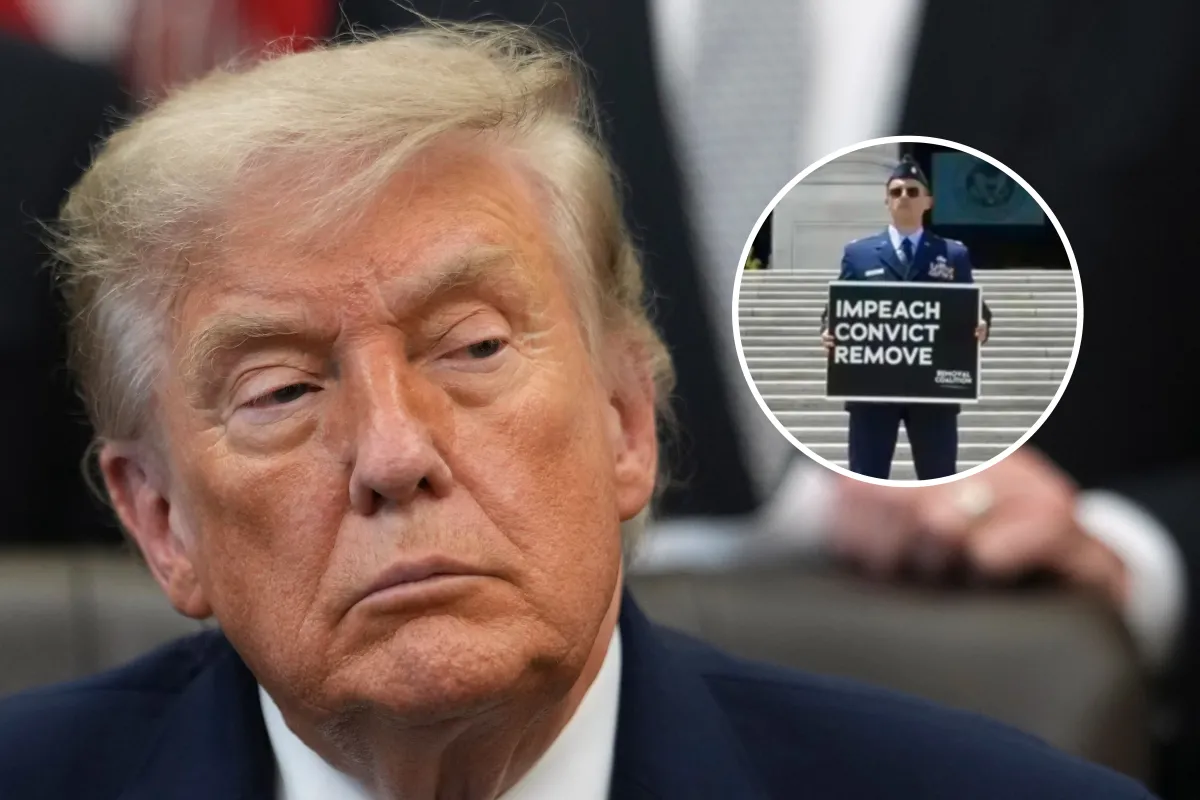
The grand marble steps of the United States Capitol have long served as the monumental stage for the unfolding drama of American democracy, but on a watershed Wednesday, they became the backdrop for a deeply personal and professionally devastating act of conscience. Major Jason Watson, a high-ranking active-duty officer in the United States Air Force, stood upon these imposing stone steps, elevated by the sheer weight of his moral convictions. Holding a placard that resolutely demanded the impeachment and immediate removal of President Donald Trump, Watson knew that every passing second drew him closer to an inevitable confrontation with both the law and his military superiors. The air in Washington, D.C., carries a perpetual political tension, but for Watson, that tension crystallized into a solitary, quiet defiance as tourists stared and colleagues walked by. He was not a career activist or a seasoned street protester; he was a disciplined sentinel of the skies who had traded the security of his military career for a cardboard sign and a public platform. As Capitol Police officers materialized to enforce the strict regulations governing the building’s exterior, the scene shifted from a peaceful demonstration to a poignant, agonizing arrest. Under longstanding Capitol guidelines, public protests are strictly prohibited on the steps unless participants are actively accompanied by a sitting member of Congress—a bureaucratic hurdle designed to maintain order, but one that effectively silenced Watson’s solitary vigil. The metallic click of handcuffs snapping around his wrists marked the end of his protest, but the beginning of a profound legal and personal ordeal. Watson’s arrest was not merely a routine municipal police action; it was a heartbreaking collision between an individual’s burning desire for political accountability and the rigid, unyielding machinery of the system he had sworn his life to protect, leaving onlookers to grapple with the disturbing image of an American soldier being led away in chains for exercising his voice.
This dramatic arrest brings to the forefront the agonizing conflict between an individual’s personal conscience and the ironclad, non-partisan obligations of military service. For active-duty personnel like Major Watson, the freedom of speech is not an absolute right; it is a heavily regulated privilege governed by the Uniform Code of Military Justice (UCMJ) and Department of Defense Directive 1044.10, which strictly prohibits service members from engaging in political activities while in uniform or representing the military. By staging a highly public protest calling for the impeachment of his own Commander-in-Chief, Watson deliberately stepped across a sacred, historic line that has separated the armed forces from partisan political struggles since the founding of the republic. This separation is crucial for maintaining civilian control over a lethal war machine, yet it imposes a heavy psychological tax on those who wear the uniform, forcing them to remain silent spectators to political actions they believe are tearing the country apart. To understand Watson’s actions, one must understand the unique internal torment of a soldier who believes his ultimate oath—to support and defend the Constitution of the United States against all enemies—obligates him to speak out against the very executive branch he serves. By placing himself in direct violation of both civil laws regarding Capitol demonstrations and military regulations forbidding political insubordination, Watson knew he was jeopardizing his rank, his pension, and his personal liberty. The bureaucratic technicality of requiring a congressional sponsor to protest on the Capitol steps highlights the isolating nature of his stand; he was a man entirely without a buffer, standing raw and exposed before the law. His arrest forces us to examine the thin, perilous boundary between a service member’s institutional obedience and their ethical duty to the democratic ideals they are trained to die for.
While Major Watson’s solitary protest was quickly silenced by law enforcement, the echoes of his defiance quickly reverberated through the halls of Congress, finding a powerful ally in Texas Democratic Representative Al Green. Green, a prominent legislator who has consistently championed the cause of impeachment from the congressional floor, took to the social media platform X to express his profound admiration for the arrested officer. In a deeply moving statement, Green wrote that Watson had demonstrated “the kind of courage necessary to inspire others to understand liberty for justice… is more than an ideal, it is something that is real for everybody in this country.” By framing Watson’s insubordination as an act of inspirational courage, Green elevated the major’s protest from a simple regulatory violation to a sublime, patriotic duty. This political endorsement humanizes the sterile legislative process of impeachment, showing how the abstract debates over high crimes and misdemeanors manifest as real, painful choices for everyday citizens and military personnel. Green’s words suggest that Watson’s willingness to sacrifice his own esteemed career was a necessary catalyst, a spark designed to wake up a complacent public to the urgency of constitutional preservation. To have a sitting member of Congress legitimize a protest that violated Capitol rules underscores the deep polarization within the government itself, where lawmakers are increasingly looking outside traditional channels to find moral authority. For Watson, knowing that a member of the very legislature he was trying to influence had publicly validated his sacrifice must have provided a sense of solace amidst the cold reality of booking cells and impending military discipline, transforming his arrest into a shared crusade for justice.
Beyond the corridors of Capitol Hill, Watson’s arrest struck a deep, resonant chord with prominent advocacy groups who saw in his actions a mirror of their own battles for systemic accountability. John Bonifaz, the president and co-founder of the influential advocacy group Free Speech For People, was quick to released a statement praising Watson’s extraordinary bravery. Bonifaz emphasized that Watson’s “willingness to risk his own freedom stands in stark contrast to those who continue to look away as President Trump commits unprecedented abuses of power.” This biting critique humanizes the political struggle by contrasting Watson’s self-sacrificing courage with the perceived cowardice of political elites who choose comfort and compliance over constitutional duty. Furthermore, support from organizations like About Face Veterans—a veteran-led group dedicated to peace and justice—highlights a growing subculture of military veterans who refuse to let their service serve as a muzzle on their civic conscience. These advocacy groups do not merely view Watson as a defendant in a criminal case; they view him as a modern-day truth-teller who exposed the hypocrisy of a system that demands absolute loyalty to a leader while ignoring that leader’s alleged transgressions. By rallying around Watson, these organizations are attempting to build a protective community of solidarity around him, ensuring that he does not face the terrifying might of the military justice system alone. Their public defenses of Watson serve as a powerful reminder that the fight for free speech is not just fought in courtrooms or legislative sessions, but is actively maintained through the solidarity of ordinary citizens who refuse to let their champions be quietly erased from public memory.
This explosive incident did not occur in a vacuum, but rather within the highly combustible atmosphere of a nation deeply fractured by the presidency of Donald Trump. To a large portion of the American public, Major Watson’s protest was a heroic, almost mythical act of patriotism—a tragic defense of democratic institutions by a man who had directly witnessed the erosion of democratic norms. These supporters saw him as a modern-day Paul Revere, sounding an alarm that was too loud to ignore, even if it meant his own professional demise. Conversely, to a massive segment of the population, Watson’s actions were viewed with deep hostility and alarm, perceived as a dangerous violation of the civilian-military divide that could pave the way for a politicized armed forces. Critics argued that if military officers are allowed to publicly demand the removal of the President, it damages the foundational trust that the military remains neutral and subservient to the democratically elected civilian leadership. This intense national divide highlights the tragic, human complexity of Watson’s situation; his act of profound personal conscience was instantly weaponized into a political battlefield, where his identity as a decorated officer was used by both sides to validate their opposing worldviews. The White House, when contacted by journalists at Newsweek for comment outside of normal working hours, remained conspicuously silent—a silence that spoke volumes about the sensitive, volatile nature of an active military officer openly rebelling against the administration. This silence from the executive branch underscores the tension that Watson introduced into the highest level of government, exposing the deep fear that his individual act of defiance could ignite a broader, uncontrollable rebellion among those who hold the monopoly on state violence.
As the dust settles over the Capitol steps and the media circus begins to fade, Major Jason Watson is left to face the harrowing personal and professional consequences of his fateful Wednesday morning. The future that awaits him is grim; he faces a potential court-martial, the stripping of his hard-earned military rank, the forfeiture of his retirement benefits, and even the bleak prospect of federal imprisonment. Yet, in choosing this path, Watson has written his name into the long, complex history of American dissidents who believed that some laws must be broken to protect a higher truth. His story is not merely a legal case or a political talking point, but a deeply moving human narrative about the limits of obedience and the terrifying price of personal integrity. It forces every citizen to look in the mirror and ask themselves what they would be willing to sacrifice if they believed the core values of their nation were in mortal peril. Long after the specific legal battles over his protest have been resolved, the image of a lone Air Force Major standing on the Capitol steps, clutching a simple sign, will endure as a powerful symbol of the recurring struggle for the soul of American democracy. Watson’s sacrifice reminds us that the preservation of liberty is not a passive inheritance, but an active, painful duty that occasionally demands everything an individual has to give. In the quiet of his confinement, Watson may find that while he has lost his freedom and his career, he has preserved the one thing the military could never give him and the state can never take away: his untarnished internal moral compass.