





Paragraph 1: The Silent Thud of Hope
There is a specific kind of silence that falls over an NFL practice facility when a dream dies. It isn’t a dramatic, wailing silence; rather, it is a quiet, sterile hush that follows a brutal, twisted knee and the collective intake of breath from teammates and coaches. That is the exact sound that haunted the Los Angeles Chargers on a sweltering Tuesday afternoon in El Segundo. The team had entered training camp with a renewed sense of purpose, a belief that they had finally solved the riddle of their cursed existence. A cornerstone of that belief was Tyler Biadasz, the 26-year-old center they had aggressively pursued and signed to a staggering three-year, $30 million contract. He was supposed to be the immovable object, the quarterback of the offensive line, the silent guardian who would keep Justin Herbert’s jersey clean and the running game humming. Instead, he became the latest casualty in what feels like the Chargers’ eternal dynasty of misery. When the NFL Network’s Ian Rapoport broke the news that Biadasz had suffered a torn ACL during a routine rep, the emotional fallout was immediate. It wasn’t just a player going down; it was the entire premise of their revamped, gritty, “we are going to win in the trenches” philosophy taking a critical hit before the season even began. The hearts of fans sank, not merely because of the lost production, but because of the nagging, familiar feeling that this franchise simply cannot have nice things without the football gods snatching them away. The sun may have been shining brightly over the facility, but for the Chargers, a dark storm had just rolled in.
Paragraph 2: The Voice from the Past
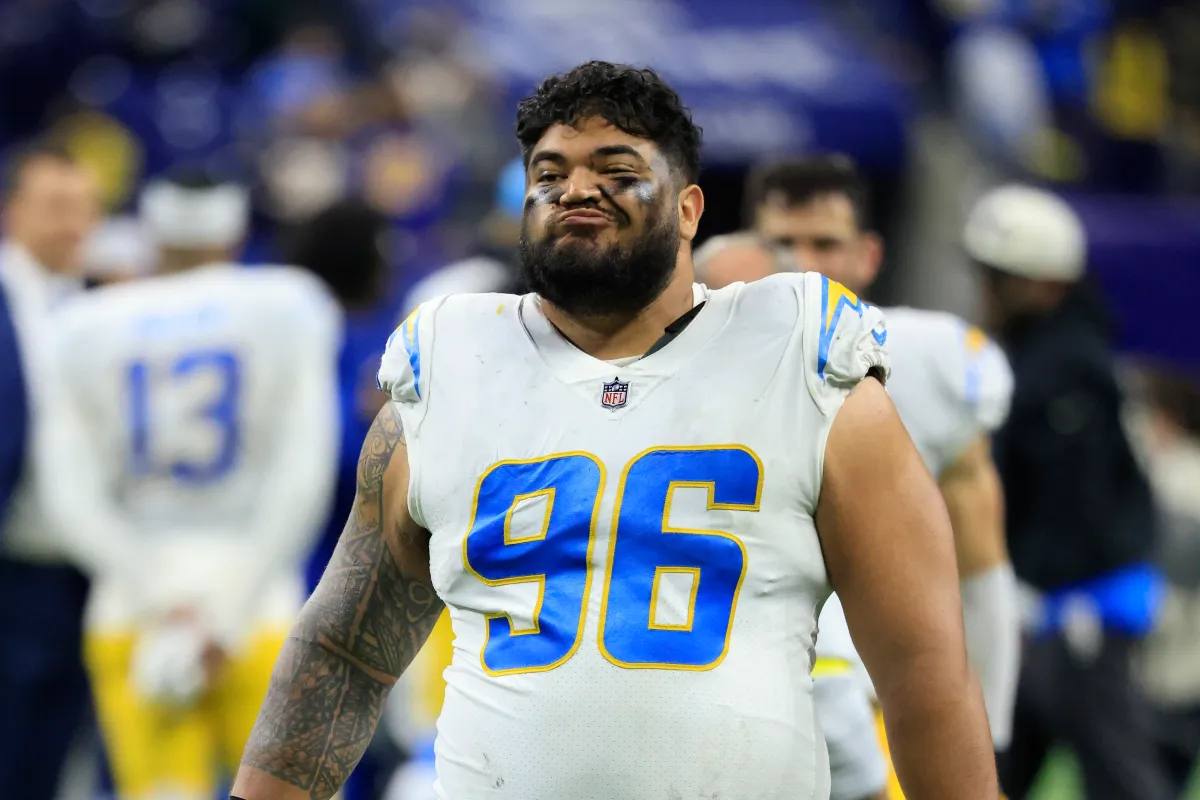
Into this void of despair and anxiety stepped a figure from the Chargers’ recent past, a voice that cut through the sterile team statements and the generic “next man up” clichés with the blunt force of a sledgehammer. Breiden Fehoko, the former nose tackle who logged three seasons in Los Angeles from 2020 through 2022, took to social media to express a very specific, very biting brand of frustration. Fehoko isn’t just some random fan living vicariously through highlight reels; he is a man who has bled on the same practice fields, who knows the taste of grass and turf in his mouth during brutal August camps. He knows the dynamics of that locker room, the physical toll of the trenches, and most importantly, he knows what it takes to win in the NFL. When he saw the news about Biadasz, his reaction wasn’t one of sympathetic sorrow but of furious vindication. He immediately scrolled through his mental rolodex of the free agent market, pointing out the glaringly obvious missed opportunities. The former Charger’s post was raw, unfiltered, and deeply personal. He didn’t offer soft condolences; instead, he offered a scathing indictment of the team’s front-office strategy. His words—”I don’t feel sorry for this team”—stung because they echoed the sentiments of a growing contingent of fans who feel that the organization consistently prioritizes flashy skill positions over the gladiators in the mud. For Fehoko, this wasn’t just an unfortunate accident; it was a predictable consequence of a philosophy that undervalues the most unforgiving positions on the field.
Paragraph 3: The Blueprint of an Accusation
To understand the venom behind Fehoko’s outburst, one must look at his specific gripe. He didn’t just say “you should have signed someone”; he called the team out by name, listing elite interior offensive linemen like Elgton Jenkins of the Packers, Wyatt Teller of the Browns, Isaac Seumalo of the Steelers, and others like Vera-Tucker and Braden Smith. “You just absolutely wanna be cheap for the position group that matters the most,” he wrote, his frustration boiling over. This wasn’t just about the starting five; it was about the absence of depth, the lack of real competition, and the fatal flaw of betting on health in a sport that actively destroys bodies. Fehoko understands that the offensive line is a caste system, a unit where one weak link can collapse the entire structure. Having a star left tackle like Joe Alt is beautiful, but if the interior is wounded, the entire scheme crumbles from the inside out. He argued that the Chargers had ample salary cap space—over $100 million—to have secured elite-level backups, or even better, upgraded starters at varying points. His list wasn’t random; it was a calculated callout of players who could have provided that “starter quality” insurance policy. In a league where injuries are inevitable, Fehoko was screaming at the front office from the rooftops: you cannot be cheap at the center of the line. His critique wasn’t born from jealousy or bitterness at being released; it was the frustration of a veteran who watches teams make the same fatal, myopic mistakes year after year—building a thin house of cards and then being surprised when the wind blows.
Paragraph 4: The Pushback and the Uncomfortable Truth
Predictably, the Chargers’ fanbase reacted with a mixture of defensiveness and vitriol. Some fans accused Fehoko of piling on during a moment of tragedy, while others insisted that injuries are simply an uncontrollable part of the sport, a stroke of bad luck that no amount of foresight could have prevented. Fehoko, however, was having none of it. His response to the critics was unapologetic and laced with the frustration of a man who has seen the inner workings of the league. He lashed out at those willing to “sugarcoat” the situation, arguing that his critique wasn’t about disrespecting Biadasz, but about exposing a front-office failure. He made a brilliant point: the Chargers boasted a massive amount of salary cap space this offseason, and they chose to remain frugal specifically at the most impactful level of the offense—the line. Fehoko’s stance is rooted in the gritty reality of football. He knows that while elite quarterbacks and flashy receivers sell jerseys, Super Bowls are won in the muck of the interior. When you allocate resources, you don’t just pay for the starting five; you pay for the insurance policy. He highlighted cheap, depth-level options like Spencer Burford who could have provided valuable reps and competition. By neglecting this, the front office gambled on the health of a notoriously fragile unit conjured from a 17-game season. His anger wasn’t just about the missed tackles; it was about the mindset. It’s a mentality that prioritizes staying under the salary cap over fortifying the foundation, a mistake that he has watched cripple teams year after year.
Paragraph 5: The Silver Lining and the Grim Math of the NFL
Of course, no story is without its counterpoints. The Chargers’ front office and a segment of their fanbase are quick to point out that the offensive line, while thin, is not entirely devoid of talent. The return of Joe Alt, their franchise left tackle who missed significant time last year, is a legitimate beacon of hope. Alt is a unicorn—a massive, athletic, generational talent who can anchor the blind side for a decade. The team’s brass can argue that with Alt healthy alongside a competent scheme, they can still protect Herbert. However, this optimistic outlook ignores the brutal arithmetic of an NFL season. The offensive line is a unit of five, functioning as a cohesive, choreographed wave. Losing your starting center, the lineman responsible for making all the pre-snap protection calls, is akin to a ship losing its navigation officer. It disrupts communication, timing, and trust. While Joe Alt’s return is certainly a welcome boost, football is a game of attrition. Depth isn’t a luxury; it’s a necessity. Fehoko’s list wasn’t just a wishlist; it was a roadmap of the exact types of players that could have absorbed this blow without the season spiraling out of control. His anger, therefore, is not just about one player’s injury—it is about the systemic hubris of assuming the health of starters is a given.
Paragraph 5: The Counterpoint and the Weight of a Season
Of course, in the interest of fairness, the Chargers could argue that the injury to Biadasz is an anomaly, a tragic twist of fate that no amount of depth could fully account for. They could point to the return of Joe Alt, their phenomenal franchise left tackle, and argue that the core of the line is still intact河北. Alt’s presence alone changes the entire complexion of the unit; he is a generational talent who controls the edge with the grace and power of a seasoned veteran. With Alt anchoring the blindside, the argument goes, the Chargers can survive a hit at center because the overall architecture is still sound. Yet, Fehoko’s point digs deeper, looking beyond the starting five. Football is war by attrition; the players who start the season are rarely the same ones who finish it. The route from August to January is paved with strains, sprains, and tears. While the Chargers might have a competent backup waiting to step in for Biadasz, the fear is the cascading domino effect. When the center goes down, the guard has to shift, the tackle has to adjust, and suddenly you have a third-stringer facing an All-Pro defensive tackle on a critical 3rd-and-long. Fehoko saw a roster built with tightrope-thin margins, a gamble where they assumed their starters would hold up. Football, however, is a war of attrition, and the Chargers just lost the general of their infantry before the first real battle.
Paragraph 5: The Counterargument and the Season Ahead
Yet, in the midst of this emotional chaos, there is a sliver of rational hope. The Chargers’ offensive line, even without Biadasz, isn’t devoid of talent. The biggest beacon of light remains Joe Alt, their monstrous, generational offensive tackle who was drafted in the top ten to be the franchise’s left tackle for the next decade. Alt is a once-in-a-generation prospect, a wall of granite who is widely considered the best offensive lineman from his draft class. His health and performance will be paramount, and if he anchors the left side with the ferocity expected of him, the unit might not completely collapse. Furthermore, the Chargers still have other serviceable veterans and young players on the roster who can compete for the center role. The coaching staff, led by an offensive-minded head coach, will have time during the preseason to scheme around the loss, adjusting the blocking schemes to be more tight, more compact, and less reliant on a dominant interior mauler. But even in this silver lining, Fehoko’s warning rings true. The NFL season is a marathon of collisions, and the offensive line is a revolving door of attrition. Depth isn’t a luxury; it’s a necessity. Even with Alt playing at an All-Pro level, the unit is only as strong as its weakest link, and expecting a backup center to seamlessly fill in for a $30 million free-agent acquisition is a gamble that borders on arrogance. The coaching staff can scheme around a player, but they cannot scheme around a deficit in raw power and technique at the point of attack.
Paragraph 5: The Brutal Math of the NFL
Fehoko’s frustration highlights a fundamental truth about the modern NFL economic structure. Teams are forced to allocate a finite amount of resources, and they often choose to prioritize the quarterback, edge rushers, and receivers—the positions that generate highlights—over the heavy lifting of the interior offensive line. It’s a subtle, often ignored position group until a sack happens or a running back is stuffed at the line of scrimmage. By ignoring the depth at that specific position during the free agency period, Fehoko argues that the Chargers took an unnecessary risk. Think about the window of opportunity for a franchise quarterback like Justin Herbert. His prime is precious and fleeting)Skip injuries and contract ambiguities. Every single time general managers cheap out on line depth, they are effectively shortening that windowcause they are risking the health and production of their most valuable asset. The injury to Biadasz wasn’t just a football play gone wrong; it was a manifestation of that risk. When you fail to sign players who can fill in seamlessly, you introduce instability into the huddle. The chemistry between a center and a quarterback—the silent snap count, the subtle line adjustments, the pressure recognition—takes months to build. Losing that continuity in training camp creates a ripple effect that can haunt an offense well into November. The front office may have looked at their cap space and seen flexibility; Fehoko looked at it and saw a dereliction of duty. By choosing not to bring in veteran depth when it was readily available, they essentially gambled with the health of their entire season, and the roulette wheel has already landed on black.
Paragraph 6: A Warning Unheeded
In the end, Fehoko’s outburst serves as a profound reality check for a franchise perpetually trapped in a cycle of “what ifs.” The Los Angeles Chargers have long been celebrated for their flashy offense and their loyal, long-suffering fanbase, but they have consistently failed to get over the hump precisely because of moments like this. The story of their season is often written by the injuries that befall their most critical but unglamorous players. While the team scrambles to find a replacement, they would be wise to listen to the voice of a man who knows what it feels like to fight in those dark, claustrophobic trenches. Fehoko isn’t a hater; he is a realist. He has been the guy on the defensive side who has watched opposing offensive lines dictate the flow of a game文革, and he knows that champions are forged in the ugly, 300-pound scrum at the line of scrimmage. The Chargers’ immediate future now rests on the shoulders of practice squad players and newly signed cast-offs, forced to learn a complex playbook on the fly. If they manage to weather the stormutfør, if Alt and company rally and the scheme works, then perhaps Fehoko’s words will fade into the background noise of the internet. But if the Chargers’ season crumbles in January under the weight of a missed block in a crucial third-down situation, his bitter tweet will be remembered as the prophetic warning that fell on deaf ears. For now, the Chargers have to solve a puzzle they created themselves, hoping against hope that their offensive line doesn’t become their tragic flaw for the third consecutive season. The harsh reality of the NFL is that you cannot buy back a healthy knee in December, and the lesson of Biadasz’s injury is one of brutal, unforgiving financial and strategic accountability.