


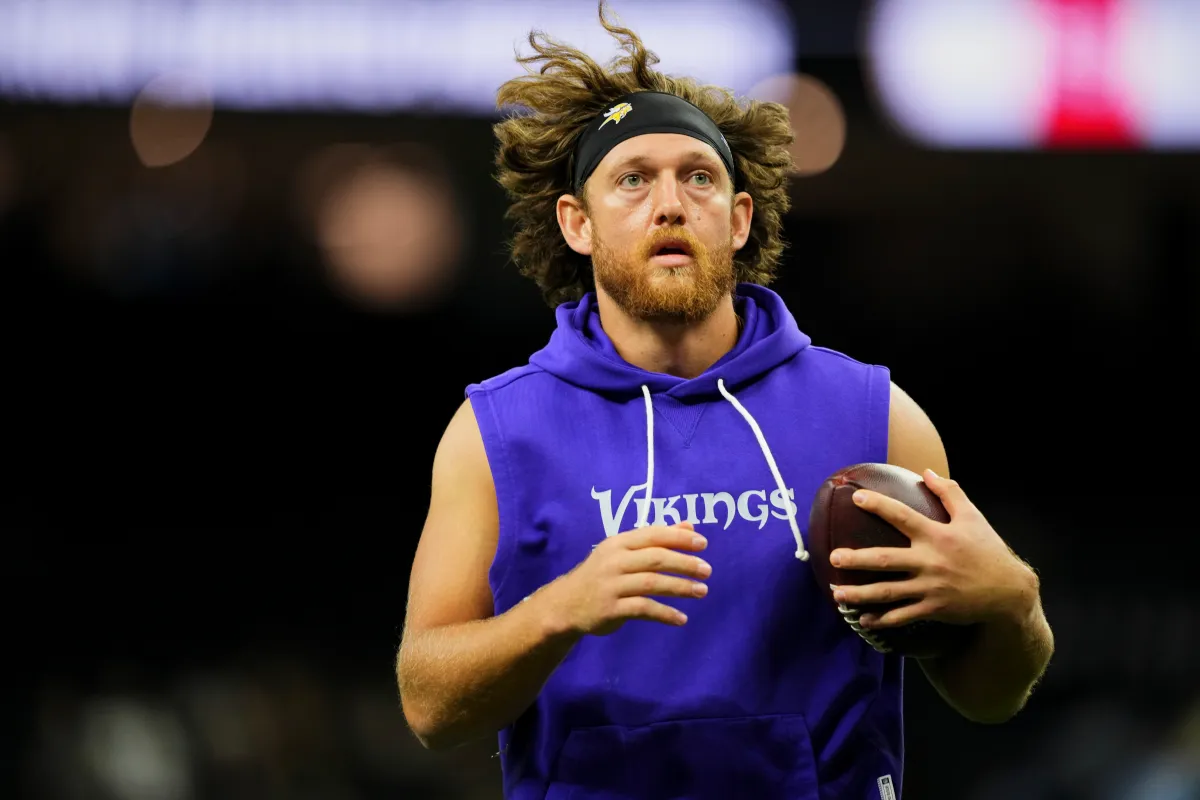
Football has a way of making a season turn in a single afternoon, and the Minnesota Vikings were reminded of that truth before the first quarter of their Week 5 meeting with the New Orleans Saints had even settled into a rhythm. The team arrived at kickoff with a list of absences that would have made most coaches anxious: Jordan Addison and Odell Beckham Jr., two vital pieces of the passing attack, were already sidelined, leaving the offense thinner than planned. Still, there was something encouraging about the way the day had begun. Justin Jefferson was active, his presence alone enough to give the entire sideline a sense of belief. The game plan was not perfect, but it had a pulse. Then, in an instant, that sense of control dissolved. T.J. Hockenson, the tight end who had become the group’s most reliable third-down target, went down during the first quarter. It was not a twisted knee or a pulled muscle, the kind of visible injury that players can shake off after a few minutes on the training table. It was something quieter and far more serious. As the medical staff gathered around him, the crowd seemed to hold its breath. Within moments, the news filtered through the sideline and out to the broader NFL world: Hockenson had suffered a concussion and had been downgraded to out. NFL insider Ian Rapoport was among the first to report it, and with that single update, the optimism that had carried the Vikings to the start of the game began to give way to something heavier, the realization that a team already running on limited resources had just lost one of its most important players.
The loss stung because Hockenson had been in the middle of one of his best stretches of football. A week earlier, in Week 4, he had delivered a performance that felt like a turning point: 13 receptions for 119 yards, a stat line that echoed through fantasy football lineups and highlighted his importance to the offense. He was not the kind of player who won with pure speed or acrobatic leaps. His advantage was more subtle, more intuitive. Hockenson had a knack for finding the soft spots in a defense, for sitting down in open spaces when the pocket broke down, for making sure the quarterback always had a safe place to throw. That kind of trust is not built overnight. It is earned through practice and pain and the quiet willingness to do thankless work over the middle. Against the Saints, with Addison and Beckham Jr. already unavailable, he was supposed to be the player who kept the chains moving, the big-bodied target who could absorb the physical toll of a NFL defense and still hang onto the football. For the quarterback, Sam Darnold, Hockenson had been a comfort in chaotic moments. Now Darnold would have to find someone else, and the ease with which the offense had operated in its best moments suddenly felt a long way away.
The truth is that the Vikings had no choice but to move forward, and they did so in the only way teams ever do in the NFL: by turning to the next man up. The receiving corps, already thinned by injuries, suddenly looked unfamiliar. There were other tight ends on the roster, other wide receivers in the locker room, players who had spent the week preparing for a smaller role and who were now being asked to carry a much larger one. The original report mentioned reinforcements like Jauan Jennings and Tai Felton, but the exact names mattered less than the overarching reality: Minnesota’s depth was being tested in a brutal, public way. The one piece of genuinely good news, the single bright spot that kept hope alive, was Jefferson. He was active, and he is the kind of player who can alter a game all by himself. With Hockenson gone, the offense would flow through Jefferson even more. Every route, every throw, every third-down passing concept would likely be built around him. But that is also exactly what the Saints would expect. They could bracket Jefferson with a safety, roll coverages toward his side of the field, and force another player to prove he could win one-on-one. This is the part of a football season that does not show up in the box score: the moment when a second-year receiver has to run a route he has only reped a handful of times, when a tight end’s backup must make a block and catch under the kind of pressure that defines careers. The Vikings had believed they were prepared for those moments. Now they were going to find out.
To understand what Hockenson means, it helps to look at the full story of his career. He was not an overnight sensation. He was a first-round pick in the 2019 NFL Draft, chosen out of the University of Iowa, where he had built a reputation as one of the most complete tight ends in the country. In 2018, his final collegiate season, he was named a first-team All-American and won the John Mackey Award and the Ozzie Newsome Award, two honors that carry weight among people who truly understand the position. Those awards did not fall into his lap. They were the result of countless hours of film study, of blocking defensive ends on one play and finding seams in the secondary on the next. His transition to the professional game was not always smooth, but it was steady. Over the years, he developed into a reliable pass catcher, appearing in Pro Bowls and putting together numbers that most tight ends only dream of: 455 catches, 4,635 receiving yards, and 27 touchdowns. But statistics, even beautiful ones, do not tell the whole story. Hockenson plays with an unglamorous intensity. He does the dirty work, the kind that rarely makes the highlight reel. He fights for extra yards after contact. He runs across the middle, knowing that safeties are waiting, and holds onto the ball anyway. It is precisely that courage that made him valuable, and it is that same courage that left him vulnerable on a ordinary play in the first quarter of a Week 5 game.
Injuries are an accepted part of football, but a concussion feels different. There is no clean explanation, no obvious breaking point. A torn ligament can be seen in an MRI and measured with a timeline. A broken bone can be cast and counted down. But a concussion is mysterious and frightening, a reminder of the fragile machinery that carries every player from the field to the locker room. When the news came that Hockenson had been downgraded to out, the language was clinical, but the weight was emotional. His teammates had to keep playing. The game continued, the clock kept moving, the Saints kept coming. But for a while, at least, the focus was less on the score and more on the sight of a peer, a friend, a leader, standing somewhere in the tunnel trying to remember where he was. The Vikings entered this game already short-handed, and the loss of their tight end made them even more vulnerable. This is the reality of the modern NFL: rosters are stretched, depth is an illusion, and one play can change everything. Teams talk all week about the idea of “next man up,” that familiar phrase meant to inspire confidence in the roster’s ability to absorb losses. But that phrase does not capture the loneliness of a young receiver standing in a huddle, realizing the ball might now be coming his way in the most critical moment of the game, or the responsibility that falls on a quarterback who has to trust someone who hasn’t earned that trust yet.
For the rest of the afternoon, the Vikings had to find a way to survive. They still had Jefferson, and that meant they always had a chance. They had a quarterback in Sam Darnold who had shown poise in tough situations, and a defense that had the ability to create turnovers and keep games within reach. But they also had to face the uncomfortable truth that their margin for error had become almost nonexistent. Every third down would be harder. Every contested catch would carry extra meaning. The coaching staff would have to call a game with more creativity than execution, perhaps, and the players would have to find something within themselves to fill the void left by Hockenson. That is what football asks of a team when the injury report grows longer and the opponent remains tough. It asks for grit. It asks for resilience. It asks for a group of men to come together in a moment of crisis and find a way to make a play that no one expected them to make. But even as the game went on, there was a larger reminder in the background. Hockenson’s health matters more than any single win. Concussions are not just setbacks in the season; they are concerns for a life beyond football. The same determination that made him a two-time Pro Bowler is the quality that puts him in danger, and the hope is that he recovers fully, not just for the Vikings, but for himself. Football will move on. The season will continue. But some losses are not measured in the final score, and the quiet sight of a teammate leaving the field with his head down is one of them.