


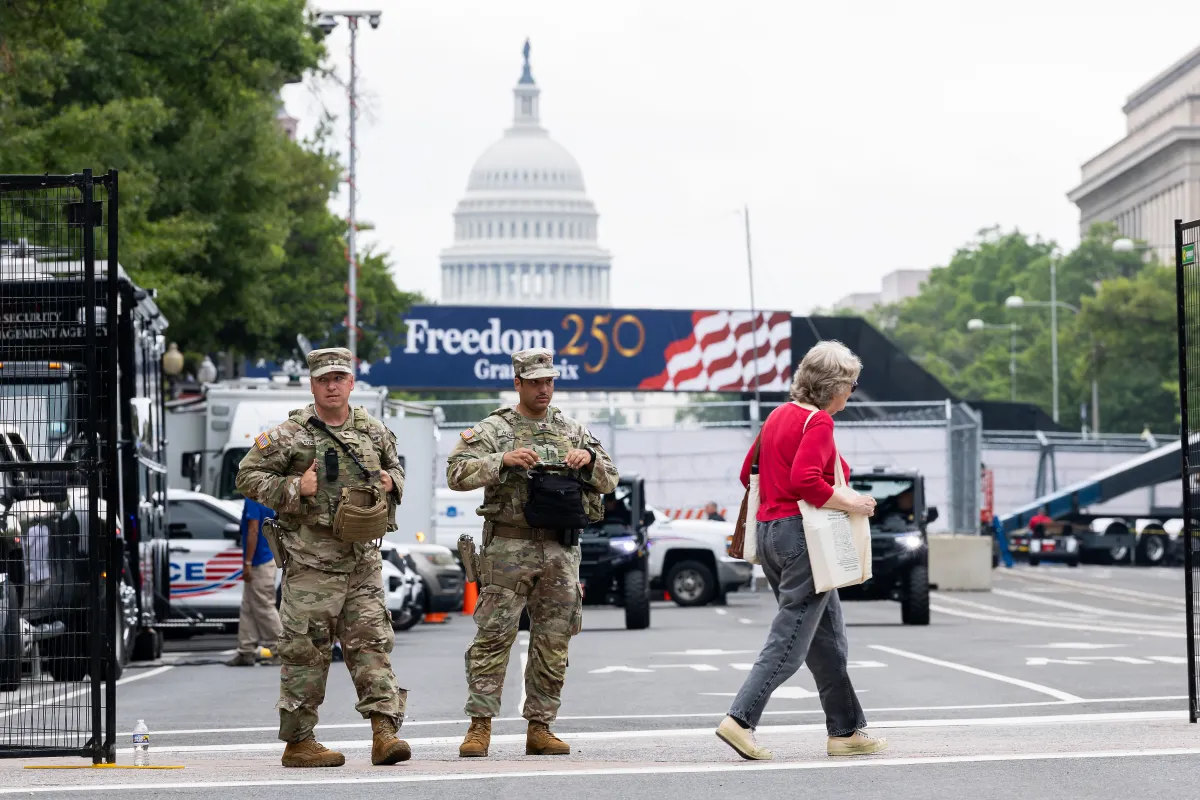
Last summer, I walked out my front door and stopped short. There was a soldier in camouflage, standing on the sidewalk, rifle across his chest. More soldiers were gathered near the corner. I had lived in Washington, D.C., for years, but I had never seen anything like this in my own neighborhood. This was not a photograph from some distant conflict. This was my street. At the height of this summer’s deployment, more than 4,000 National Guard troops from more than fifteen states were sent to Washington, D.C.—my home. Thousands remain here today, even though there is no emergency requiring their presence. There is no natural disaster, no ongoing insurrection, no imminent threat that would justify turning the nation’s capital into an armed camp. There is only a political decision, a manufactured emergency designed to project power and dominate the news cycle. I am a Washingtonian. This is my home. I should not have to walk past armed troops to buy groceries, to take my dog for a walk, or to meet a friend for coffee. In recent weeks, Arkansas and Michigan have withdrawn their troops, joining other states that have ended their participation in President Donald Trump’s manufactured emergency. I am glad to see those soldiers going home. But their departure leaves Washingtonians with an obvious question: why are so many still here? The remaining troops should go home, too. There is no justification for keeping them deployed in the nation’s capital. The longer they stay, the more we lose—not just in dollars, but in something far harder to recover.
Let’s start with the financial cost, because it is staggering. This deployment has already cost taxpayers well over a quarter of a billion dollars. That is an astonishing amount for a mission that was never necessary. And if the president continues to station National Guard troops in D.C. for years, as planned, the cost to taxpayers could climb to $3.4 billion. To understand what that number actually means, consider what $3.4 billion could do if it were invested in communities instead. According to the National Priorities Project, over three years, that amount could fund paid parental leave for more than 12,000 people. It could pay for medical care for more than 7,000 veterans. It could hire more than 5,000 registered nurses. Those are real people with real needs—parents who want to stay home with a new baby, veterans who have served their country and now need health care, nurses who could be caring for patients instead of watching their hours being cut. Instead, the money would be spent on a spectacle. But the costs are not only financial. The National Guard members themselves are not abstract symbols. They are people with civilian jobs. Some are students. Some are parents. Some own small businesses or work in hospitals or teach in classrooms. They have families and communities that depend on them. That matters to me, because my objection is not to the people wearing the uniform. National Guard members perform important roles for communities across the country, especially during natural disasters and other major emergencies. They deserve our gratitude for that service. That is part of what makes this deployment so frustrating: they are needlessly deployed to our nation’s capital, where there is no emergency needing a military response. They are being used as props in a political performance, pulled away from their real lives and real responsibilities not because they are needed, but because someone wants to look strong. It is a waste of their time, their service, and their sacrifice.
But what worries me most is something harder to calculate. It is the possibility that we will simply get used to this. The longer troops patrol D.C. without an immediate emergency, the easier it becomes to stop noticing how extraordinary it is. Human beings are adaptable. That is one of our strengths, but it can also be our weakness. When we see soldiers on our streets every day, they begin to blend into the scenery. What should be exceptional begins to feel routine. Children grow up thinking it is normal to see military vehicles at traffic lights. Adults stop flinching when they see a uniformed soldier with a rifle outside a Metro station. I catch myself doing it too, and that is exactly what frightens me. The other day, I walked past a group of Guardsmen and barely looked up. It took me a moment to realize what I had just done. I had accepted their presence as ordinary. We should not become accustomed to this. Troops should not patrol American communities, full stop. The presence of military personnel in civilian neighborhoods is not a small thing. It changes the character of a city. It changes how people feel in their own homes. It changes the relationship between the government and the people. When the military becomes a familiar part of daily life, it is much harder to recognize the line that has been crossed. And once that line is crossed, it is much harder to draw it again. This is not about safety. Washington, D.C., is not safer because soldiers are standing on street corners. In fact, the presence of armed troops can create a sense of intimidation rather than security. It tells residents that their own city is not fully their own, that the federal government can bring armed force into our neighborhoods whenever it wants to make a point. That is not what democracy looks like. That is not freedom. That is something else entirely.
For those of us who live in Washington, the deployment reflects something deeper. We already lack the same democratic rights and freedoms as residents of every state. Washington, D.C., is not a state. Its residents pay federal taxes, serve in the military, and raise families, but we do not have voting representation in Congress. Congress has the power to overturn our local laws and dictate how we spend our own locally raised tax dollars. We cannot govern ourselves the way other Americans do. Our mayor and city council can pass laws, but Congress can override them. That is not democracy. That is a colonial arrangement, and it leaves us vulnerable in ways that residents of other places can hardly imagine. This democratic inequality is one reason why what happens here matters beyond this particular deployment. D.C. has long been vulnerable to federal interference because the people who live here do not have the same political power as other Americans. We are, in effect, a place where the federal government can test the limits of its authority without facing the political consequences it would face in a state. What is allowed to become normal in Washington, D.C., can become a model for broader abuses of power elsewhere. That is not speculation. We have already seen it happen. Before Immigration and Customs Enforcement flooded the streets of Chicago, the administration sent ICE and other federal agents into the District. They tested the tactics here first. They used D.C. as a proving ground. If an extraordinary use of federal power becomes routine here, Americans elsewhere should not assume it will always stay here. The precedent is dangerous, and it should alarm every American who cares about civil liberties, about the limits of executive power, and about the basic idea that the military and federal police should not be used against our own people.
The recent withdrawals should be the beginning of the end of this deployment, not an opportunity to keep a smaller military presence in place for years. Governors have the authority to decline requests to send their National Guard troops to D.C., and a growing number have done so. I hope more will follow. ACLU-D.C., together with ACLU National and every ACLU affiliate across the country, has called for all National Guard troops to leave our nation’s capital. That would address the immediate problem. It would not, however, fix the democratic inequality that helped make this possible in the first place. D.C. residents deserve the same democratic rights as residents of every state. That means meaningful control over the decisions that shape our lives. It means the ability to hold those who exercise power over us accountable. It means statehood. Statehood is not a symbolic request. It is the only lasting remedy for the kind of abuse we are witnessing. Without statehood, Washingtonians remain vulnerable to the whims of whoever controls the White House and Congress. Without statehood, our local laws can be overturned, our budgets can be dictated, and our streets can be filled with troops by a president who wants to look tough. Statehood would give us the democratic power necessary to prevent abuses like this from happening again. It would make D.C. residents equal citizens, with the same rights and responsibilities as everyone else. It would end the strange and unjust arrangement in which more than 700,000 people—more than the populations of some states—are denied full representation in their own government. We are not asking for a favor. We are asking for what we are owed as Americans.
Washington is often talked about as a symbol of the country. It is the seat of our national government, a place meant to embody American ideals of freedom and democracy. Tourists come here to see monuments and museums. Schoolchildren learn about the Capitol, the White House, the Supreme Court. But to me, Washington, D.C., is not a symbol. It is my home. My friends, my neighbors, and my loved ones live here. I look forward to the day when I can walk through my neighborhood without seeing military personnel stationed on our streets. I look forward to the day when the question is not “why are troops still here?” but “why were they ever here?” Washingtonians should not have to learn to live with an extraordinary military presence. The rest of the country should not learn to accept one either. We need to say this clearly and often: the troops should go home. The statehood should come. The democracy should be real. Until then, we will keep asking the uncomfortable questions, and we will keep refusing to accept what is unacceptable. Because if we accept it, we risk losing something even more valuable than the money being wasted or the trust being broken. We risk losing the idea that in America, the military is not a tool for controlling our own people, and that no community should have to live under the shadow of armed force simply because the federal government wants to make a point. That idea is worth defending. And in Washington, D.C., we will keep defending it—for ourselves, for our neighbors, and for every American who believes that democracy should mean something real.