


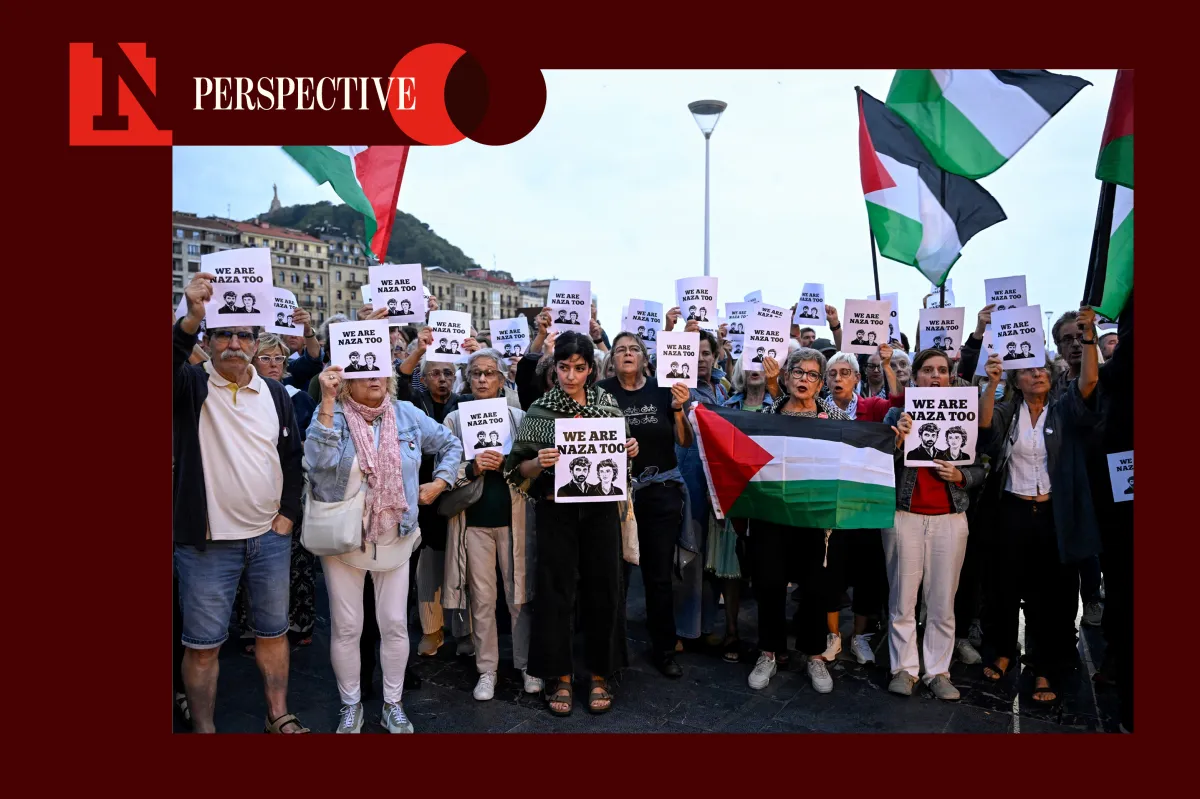
As if the war in Gaza, the political convulsions it unleashed around the world, and the still-raw trauma of October 7 were not enough, we now have another reason to fight about all of it: NAZA. The 80-minute documentary, directed by Israeli filmmakers Yuval Abraham and Rachel Szor, features testimony from 24 anonymous Israeli military and intelligence personnel about Israel’s targeting practices in Gaza. Its title refers to nezek agavi, Hebrew for collateral damage, and it examines allegations about how civilian casualties were calculated and accepted during Israeli strikes. After winning the Special Jury Prize at the Venice International Film Festival, NAZA is now opening across the United States and producing protests, denunciations, and a detailed rebuttal from the IDF. It’s pretty easy to see why. The film touches the rawest nerve of the entire conflict: whether Israel’s campaign in Gaza crossed a line, and whether the people who planned and ordered the strikes knew exactly what they were doing. The filmmakers say their reporting drew on more than 100 sources and was corroborated with documents and previous reporting. The IDF argues that the film contains “substantial factual errors,” strips military decisions of essential context, and elevates speculation by anonymous interviewees into conclusions about Israeli policy. It disputes the film’s account of AI targeting and categorically denies one especially shocking allegation: that a strike was approved knowing it could kill 500 civilians. These disagreements are clearly not around the margins but go right into the meaning of the war itself, and that is exactly why NAZA is so frustrating.
Here is where I have to be honest about my own reaction, because I suspect I am not alone. I watched parts of NAZA with a knot in my stomach. Some of what the witnesses describe is genuinely chilling: a military bureaucracy that seems to process human life as a statistic, an intelligence apparatus that uses technology to generate targets at a speed and scale that no human review can keep up with, a culture in which the phrase “collateral damage” becomes a routine part of the language. There is material here that deserves examination. A democracy at war should be able to investigate accusations about civilian deaths and military technology without treating the questions themselves as treason. Especially in the current cultural climate—where any criticism of Israel is immediately labeled antisemitic, and any defense of Israel is immediately labeled genocide denial—we need more spaces for uncomfortable evidence, not fewer. Threatening the filmmakers or trying to silence the film may prove to be self-defeating. It doesn’t make the allegations go away; it makes them more credible to people who already suspect the worst. But it is also true that serious allegations demand serious scrutiny, and NAZA too often packages its case in a way that seems to tell viewers what moral conclusion to reach before the evidence has finished speaking. The film is not a neutral inquiry. It is a passionate indictment. That is not automatically a problem—some of the most important journalism ever made has been passionate—but when you are making life-and-death accusations, the way you present them matters. The filmmakers say they did the work, that they talked to more than 100 sources, that they have documents. I believe them. Yet the film’s style, its editing, its music, and its visual choices all seem designed to produce an emotional verdict rather than an analytical one. That doesn’t make it propaganda. It makes it something more complicated: a work that contains allegations too serious to ignore, wrapped in choices too manipulative to accept without resistance.
Consider the central visual device, because it tells you a great deal about how the film works. The anonymous witnesses sit in darkness on rooftops in Tel Aviv, their identities and voices disguised. Behind them, the city glitters at night. The camera drifts away from their testimony toward apartment buildings, toward lit windows, toward glimpses of comfortable domestic life. You see a family eating dinner, a person moving around a kitchen, the ordinary rhythm of a city that is only forty miles from Gaza. The effect is deliberate: these are people who are safe, living normally, while Palestinians in Gaza are being killed. Even a sympathetic reviewer at the Guardian described the imagery as evoking Tel Aviv’s “heedlessness and heartlessness.” I understand that reaction. There is something obscene about normal life continuing while a few miles away people are being blown apart. But stop and ask yourself: what does an Israeli family having dinner actually prove about a targeting decision? Nothing. It is atmosphere doing argumentative work. It is a way of telling you that the people responsible are morally disconnected, that they don’t care, that they are complicit because they go on living their lives while others suffer. That may be true in some broad moral sense. But it is not evidence about a specific military operation. It is a mood, a judgment, a verdict delivered through cinematography. And that matters because the film is asking us to accept extremely serious claims: that the Israeli army used an AI system to generate targets, that it loosened the rules of engagement, that it knowingly accepted massive civilian casualties. Those claims deserve to be examined in the open, with names and documents and cross-examination. Instead, they are often presented through shadowy figures and ominous music. The problem is not necessarily that the witnesses are lying. The problem is that the packaging makes it too easy for skeptics to dismiss them. If some of these allegations are true—and they might be—they are too important to be weakened by presentation that gives critics an excuse to look away.
The context problem is even more consequential, and it is where the film’s limitations become impossible to ignore. The IDF argues that the documentary gives insufficient weight to October 7, to Hamas’ decision to embed fighters and weapons in civilian areas, and to the Israeli measures intended to reduce civilian casualties. The filmmakers are entitled to dispute those claims. They can argue that the Israeli military’s own practices made civilian casualties inevitable, or that the precautions were meaningless in practice, or that the scale of destruction proves the official explanations were never sincere. But those questions cannot simply be aesthetic background in a documentary that claims to explain how and why civilians died. If you are going to accuse the army of deliberately killing civilians, or of treating their deaths as an acceptable price, you need to engage with the strongest version of the army’s defense: that it was fighting an enemy that used human shields, that it warned civilians to evacuate, that it dropped leaflets and made phone calls and sent text messages, that it was striking tunnels and command centers hidden under neighborhoods. You may think those defenses are lies or rationalizations. The film seems to think so. But it does not really argue the point. It just places the audience in the position of assuming that any Israeli justification is a bad-faith excuse. That is a political choice, not a documentary one. And it is a shame, because the questions at the heart of NAZA—how does a modern army calculate acceptable civilian deaths? What does it mean when technology makes targeting faster and less human? When does “collateral damage” become something closer to a war crime?—are important enough to survive real engagement. By treating context as irrelevant, the film makes it harder for its own evidence to be taken seriously. It hands its opponents a ready-made rebuttal: look, this isn’t a documentary, it’s a polemic. And once that label sticks, the truth it contains becomes easier to ignore.
The response to the film has mirrored the film itself, which is fitting in a terrible way. Israeli politicians have called its directors traitors; activists have made appalling threats; American screenings have drawn protests from people who believe it erases the reality Israel confronted after October 7. Elsewhere, its reception has been rapturous. It is being celebrated as a brave act of conscience, a necessary reckoning, a masterpiece of witness. Everyone is talking past everyone else. The same footage that feels like proof to one side feels like slander to the other. So NAZA has become another front in the Gaza war before many people have even seen it. It is the post-October 7 world in miniature: something tangentially connected to the attack—or sometimes barely connected at all—becomes another vehicle through which we relitigate October 7. We are not arguing about the documentary anymore. We are arguing about whether Israel’s war was justified, whether Hamas is the ultimate cause of the suffering, whether the Palestinian death toll is a tragedy or a crime or a necessary cost. Those questions are real, but they are not answered by a film. They are answered, if they are answered at all, by the slow, painful work of looking at evidence without assuming you already know the outcome. And that is exactly what we have stopped doing. We increasingly approach evidence by first asking which side produced it. Every image becomes advocacy. We have come to believe that every image is advocacy—and perhaps it is. We have come to believe that every objection is denial—and perhaps it is. But if that is true, then we have also given up on the idea that evidence can change anyone’s mind. And that is the deepest tragedy of this whole argument: not that we disagree, but that we have stopped even trying to persuade each other.
NAZA may contain things that Israel and its supporters need to confront. I say “may” because I haven’t independently verified its claims, and neither have most of the people shouting about it. But the allegations are serious enough that they deserve a real answer, not just a rebuttal from the military and condemnation from politicians. The Israeli state, if it has nothing to hide, should be able to open the relevant files or explain why it cannot. The filmmakers, if they have nothing to prove, should be willing to engage with the IDF’s specific objections without dismissing them as propaganda. The critics, if they have nothing to fear, should be able to watch the film and argue with it rather than trying to stop people from seeing it. None of that is happening. Instead, the movie has become a Rorschach test. Its critics may be right that the framing distorts what it asks us to confront. Its admirers may be right that it exposes something essential about the war. At the risk of infuriating both sides, those ideas can coexist. A film can be both a genuine act of moral courage and a manipulative piece of storytelling. An army can be both responsible for terrible civilian deaths and engaged in a war against an enemy that deliberately sacrifices its own people. A society can be both traumatized by October 7 and capable of committing atrocities in response. We do not have to choose between these truths, but we do have to hold them together—and that is the one thing we seem unable to do. If we cannot do that, then NAZA has exposed something larger than the machinery of this war. It has exposed why, three years after October 7, almost nobody is listening. And probably never was. That should terrify us more than any documentary ever could.