


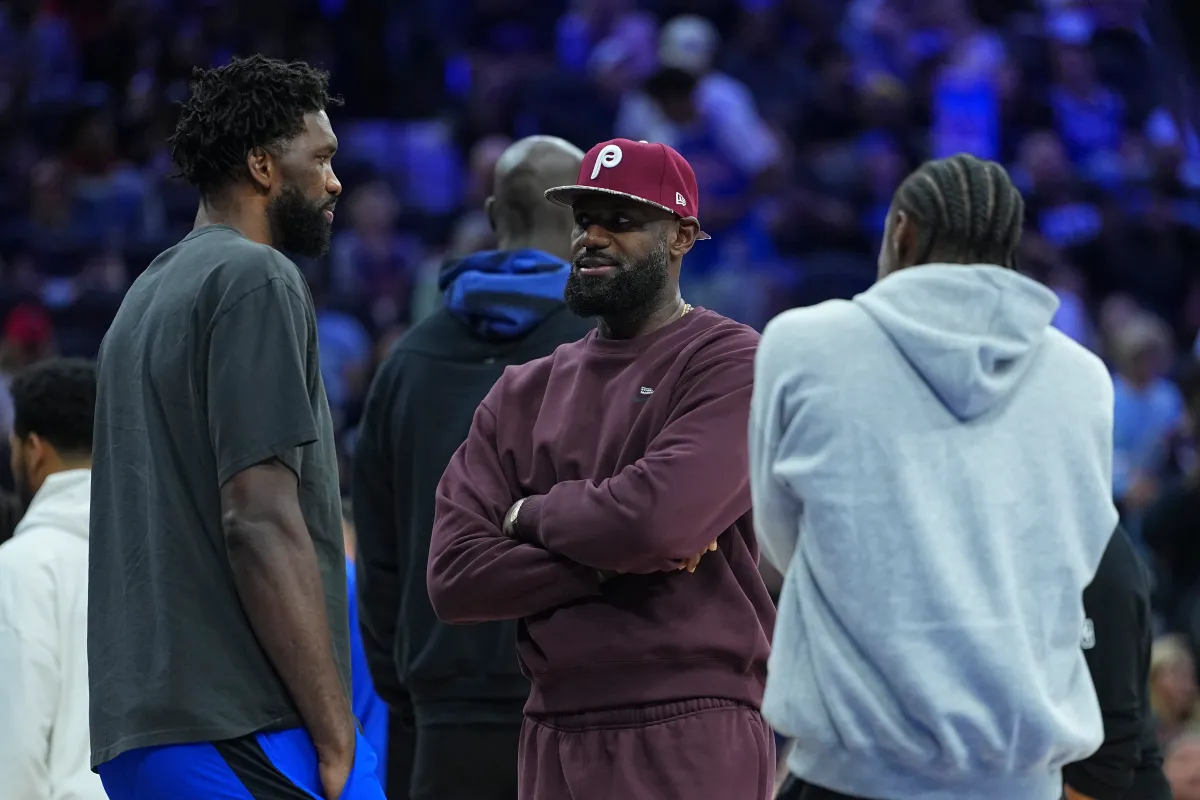
On Thursday night, Joel Embiid and LeBron James stepped onto the same court wearing the same uniform for the first time, and for a few fleeting moments, the Philadelphia 76ers’ future felt less like a theory and more like a heartbeat. The stage was Brooklyn’s Barclays Center, a neutral enough battleground for a preseason game that would otherwise have been forgotten by morning. Philadelphia fell to the Brooklyn Nets, 114-108, but the scoreboard did not tell the story that mattered. This was a glimpse of the new-look 76ers, a lineup featuring James and Embiid alongside Jaylen Brown, Tyrese Maxey, and VJ Edgecombe—five names that could make a franchise relevant again in ways that go beyond wins and losses. James played 18 minutes and delivered 10 points, five assists, and four rebounds. Embiid logged 24 minutes and finished with six points, three rebounds, and three assists. Neither stat line was spectacular, and neither needed to be. The goal was not to win a preseason game. The goal was to begin building something. Yet even in that early, imperfect chemistry, the noise that has followed Embiid for years was already there. After the final buzzer, he was asked about a rumor that had swirled through the NBA world for days—a story that claimed James had yelled at him for arriving late to practice. Embiid did not smile, did not roll his eyes, but his response carried the weight of a man who has learned to answer for things he did not do. “I don’t know where that came from. It never happened,” he said. “One, it’s not true. And then again, it’s like, ‘Why me?’ But I guess I’m Joel Embiid, I’ve been in this situation.” The words were simple, but they captured something essential about the strange space Embiid occupies: he is not just a basketball player, but a character in an ongoing story written by everyone except himself.
The rumor itself was born on the broadcast of Philadelphia’s first preseason game against the New York Knicks on Monday. During that telecast, veteran announcer Mike Breen mentioned that someone had told him Embiid was a few minutes late to practice and that James “let him hear it.” The anecdote was delivered as a throwaway, the kind of inside-baseball nugget announcers love to share to show that a veteran superstar is already holding teammates accountable. But in today’s media ecosystem, a throwaway line can become a breaking news headline before the broadcast even ends. Social media did what social media does: it amplified the story, stripped it of nuance, and turned a possible misunderstanding into a perceived feud between two of the most important players on the team. James, never one to let a false narrative breathe, responded quickly with a direct post: “He ain’t been late so stop the lies.” There was no passive-aggression, no cryptic message—just a flat rejection of the story. Embiid’s postgame comments echoed that denial, though with a more personal tone. His “Why me?” was not just rhetorical. It was the voice of a star who has been the subject of trade rumors, injury speculation, and personality critiques for years. Being late to practice, being a difficult teammate, being too funny or too serious or too sensitive—all of it becomes part of the caricature. Embiid knows this. He has made peace with it, sort of. But hearing him say “I guess I’m Joel Embiid, I’ve been in this situation” is a reminder that behind the MVP trophies and the social media jokes is a human being tired of explaining himself. The fact that he and James both denied the rumor should have ended it. But in the NBA, the truth often has to compete with a better story, and a story about LeBron James disciplining his new teammate was always going to be juicier than the reality that nothing happened at all.
Mike Breen, to his credit, stepped forward and owned the mistake. The longtime play-by-play voice, widely respected as one of the most measured and professional announcers in basketball, said he was “disappointed how the story was interpreted.” He explained that he thought the anecdote would illustrate LeBron’s leadership already on display in Philadelphia. “I thought it would be an interesting anecdote to show LeBron’s leadership already on display in Philly,” Breen said. “I don’t know why the person who told me the story would make it up, but if LeBron says it never happened then I believe him and apologize for putting it out there.” That apology matters, not just because it corrects the record, but because it reminds us how quickly a careless word can travel. Breen is not a gossip columnist. He is a broadcaster who spends his career calling games with precision and care. Yet even he repeated something without checking it, and the result was a national story about tension between Embiid and James that apparently never existed. The episode is a useful lesson in the way modern sports media operates. Information moves faster than verification. A rumor whispered in an arena hallway can be on every social platform within minutes. By the time the truth arrives, the lie has already been shaped into a narrative. The fact that both players responded publicly and firmly helped stop the bleeding, but it also highlighted how often they are forced to do that. Embiid has spent his entire career in Philadelphia under a microscope. James has spent two decades under an even bigger one. Together, they are now the most watched duo in the league, and every interaction—or absence of interaction—will be read like a text message from a complicated relationship. Breen’s apology may have cleared the air, but it cannot clear the memory of the story itself. That is how it goes now. The rumor is the event; the denial is the follow-up; the apology is the footnote. What gets lost is the actual basketball, and what actually happens between the players behind closed doors.
On Thursday, the basketball was there, waiting to be remembered. The 76ers did not beat the Nets, but they did something perhaps more important: they looked like a team that is still learning how to be a team. Embiid’s final line was modest—six points, three rebounds, and three assists in 24 minutes—but preseason numbers are almost meaningless for a player of his caliber. What mattered was that he moved without hesitation, found his spots, and shared the floor with James without any visible friction. James, for his part, looked comfortable in his new surroundings, distributing the ball with the calm authority that has defined his career. He played only 18 minutes, but he did not need more. The goal was to establish a foundation, not to chase a victory. Jaylen Brown, Tyrese Maxey, and VJ Edgecombe added layers of speed and creativity, making the 76ers look like a team with options. There were moments of chaos, moments of miscommunication, and moments when the offense stalled—all expected for a group playing together for the first time. But there were also flashes of what could be: James pushing the pace, finding a cutter; Embiid setting a screen, rolling to the basket, demanding attention; Maxey attacking the rim, forcing the defense to collapse. It was not a masterpiece, but it was a start. And for a franchise that has spent years chasing a championship with Embiid at the center, the start matters. The rumor about practice could have poisoned the atmosphere, but both players chose to address it directly and move on. That is a sign of maturity, and it is also a sign of focus. They know what this season is supposed to be. They know the stakes. They know that every missed shot, every awkward timeout, every late arrival will be dissected in public. The only way to survive that pressure is to build trust, and trust is not built in a single game. It is built in the quiet moments—the film sessions, the bus rides, the conversations that never make it onto television. The preseason game against Brooklyn was not a statement. It was a beginning.
LeBron’s decision to join Philadelphia was never just about basketball, though it certainly includes that. On his “Mind the Game” podcast, he explained that one of the reasons he chose the 76ers was to help Embiid win his first NBA championship. That sentence deserves a moment of reflection. Here is a player who has won four titles, who has nothing left to prove, who could have chosen any destination to close out his career. Instead, he chose to spend his final years in Philadelphia, with Embiid, in part because he believes the big man deserves a ring. It is a mentor’s statement, a friend’s statement, and a competitor’s statement all at once. James knows what it feels like to carry a city on his shoulders. He knows what it feels like to be blamed when the team fails and praised when the team succeeds. Embiid has experienced the same, but without the championship payoff. He has the MVP trophy, the scoring titles, the highlights, and the respect of his peers. What he does not have is the one thing that defines so many legacies: a title. James wants to help him get that. It is a noble goal, but it is also a complicated one. Embiid is no longer a young star in need of guidance. He is a veteran, a former MVP, a player with his own ideas about how the game should be played. The arrival of a legend like James could be a gift or a threat, depending on how the two navigate their relationship. The early signs, despite the rumor, are encouraging. James has publicly defended Embiid. Embiid has publicly welcomed him. Neither has shown any indication of ego getting in the way. That is not always easy in the NBA, where pride is as much a part of the game as a jump shot. But if the two can genuinely share the spotlight, they might create something rare: a partnership that makes both of them better. For James, it is an opportunity to add one more chapter to a legendary career. For Embiid, it is a chance to finally climb the mountain that has been right in front of him for years.
Plenty of media attention will be on Philadelphia this season, and not just because of the star power. The 76ers are now a team with a built-in narrative: a legendary player nearing the end of his career, a dominant big man chasing his first title, and a roster built to make that dream real. Every game will be analyzed, every lineup change debated, every quiet moment between James and Embiid studied for hidden meaning. The rumor about practice was just the first test. There will be more, because there always are. What matters is how the team responds. Embiid has already shown a remarkable ability to endure the noise, even when the noise is unfair. James has spent twenty years perfecting the art of ignoring the outside world and focusing on what happens on the court. Together, they have the chance to set a tone that will define the season. The loss to the Nets will be forgotten. The apology from Mike Breen will be forgotten. But the way James and Embiid handle each other, and the way they handle the pressure, will be remembered. There is something deeply human about watching two great players try to make something work in the final act of a career, especially when one of them has been through so much disappointment. Embiid has laughed through injuries, cried through losses, and somehow kept coming back. James has redefined what longevity looks like, refusing to accept the end that age keeps whispering. Together, they represent hope. Not the hope of a perfect season—there is no such thing—but the hope of a team that cares about something bigger than itself. The rumor was nonsense. The apology was sincere. The season, however, is real. And for the first time in a long time, Philadelphia has a reason to believe that this year might be different. Not because the names are big, but because the commitment seems genuine. That is the story worth telling, and it is just beginning.