


The New Orleans Saints had a night to forget on Monday, a game that was supposed to be a statement of resilience but instead turned into a reckoning under the glare of national television. The Superdome, that cavernous and raucous cathedral of black and gold, felt less like a fortress and more like a mausoleum by the fourth quarter, as the Atlanta Falcons, their most despised division rival, rolled to a 45-24 victory in front of a hometown crowd that had come expecting a dogfight. The score itself was bad enough, but it was the manner of the defeat that stung: the defense, which had been the team’s proudest unit in previous years, was gashed, gored, and left in shambles by a Falcons offense that seemed to move the ball at will. Long after the final whistle, the echoes of missed tackles and broken coverage lingered in the aisles, while the fans trudged home, not just disappointed but searching for answers. The primetime stage, with every eye in the football world watching, only magnified the debacle, turning a division loss into a public autopsy. And at the center of it all was defensive coordinator Brandon Staley, a man whose scheme, once praised as innovative, now looked hopelessly stale against a Falcons team that seemed to know exactly what was coming. The game was not just a loss; it was a revelation that something was deeply amiss on that side of the ball, and the fallout would begin before the stadium lights even dimmed.
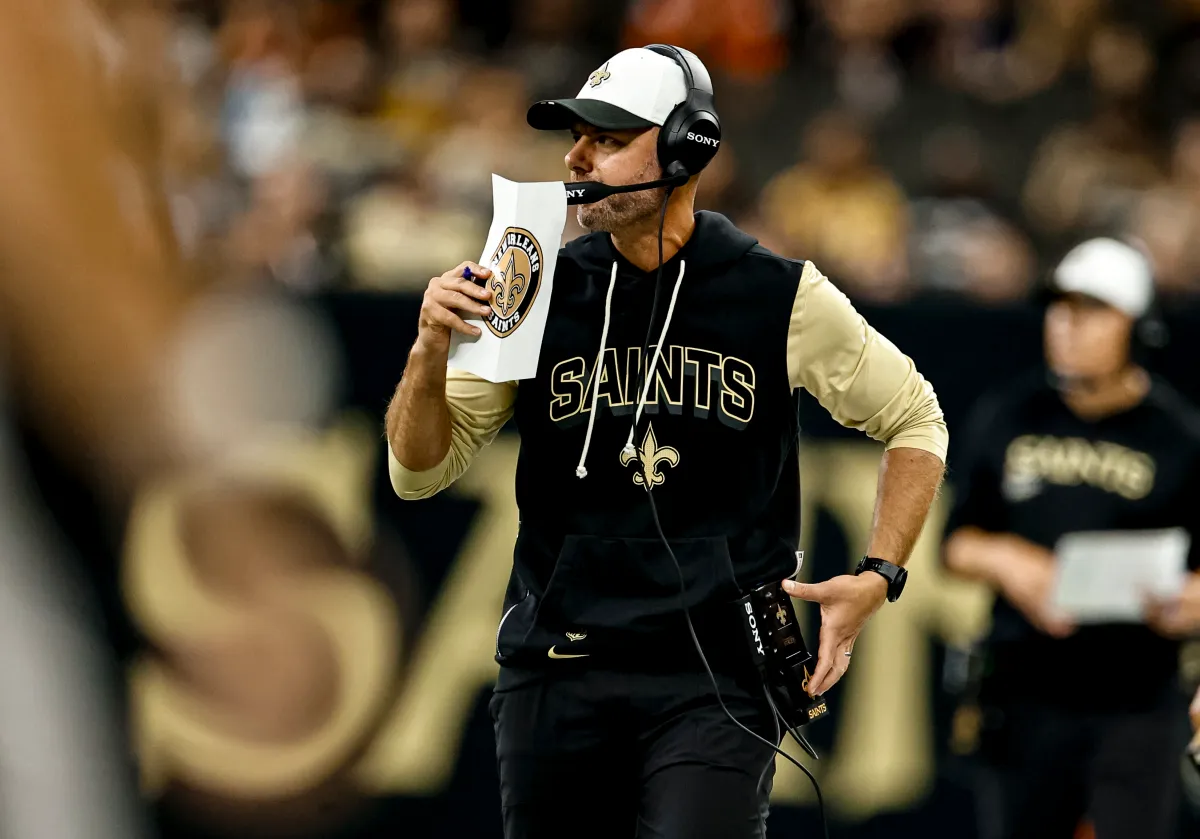
The national broadcast had barely settled into its second quarter when ESPN analyst Troy Aikman, a Hall of Fame quarterback known for his measured and thoughtful commentary, delivered a line that would send ripples through the entire Saints fanbase and the broader NFL world. “Brandon Staley just doesn’t have any answers [for the Falcons offense]. And I think he knew it when he talked to us,” Aikman said, referring to a pregame interview that he and play-by-play partner Joe Buck had conducted with Staley earlier in the week. It was the kind of comment that belongs in the pantheon of broadcast zingers—stark, undeniable, and delivered with the authority of someone who has seen every defensive scheme imaginable. To hear Aikman, a man who rarely goes out of his way to pile on a coach, say that Staley seemed to lack confidence even before kickoff was a devastating indictment. The camera cut to the Saints sideline, and there was Staley, headset on, clipboard in hand, his face a mask of concentration that seemed to betray an inner unease. Aikman’s words were not just an observation about a single game; they were a diagnosis of a deeper issue, a suggestion that the man in charge had already run out of ideas and was hoping, desperately, that his players could somehow compensate for a scheme that was being torn apart. In the world of NFL analysis, few voices carry more weight than Aikman’s, and when he speaks about a defense, coaches and executives listen. That Monday night, his comment became a rallying cry for critics and a dagger in the heart of Staley’s supporters.
When Staley stood at the podium on Thursday, wearing the same expression of guarded determination he always wears, the first question was inevitably about Aikman’s words. The defensive coordinator, a man known for his cerebral approach and occasional stubbornness, did not flinch. “I did hear those comments, and I have no idea what he’s talking about,” Staley replied, his voice flat but not defensive. The “no idea” was a calculated pushback, an attempt to dismiss Aikman’s assessment as uninformed chatter, but he quickly pivoted to the undeniable reality. “It was a tough night for us. And certainly, I’m responsible,” he continued, taking ownership of the disaster in a way that coaches often avoid. That combination of resistance and accountability captured the essence of Staley’s position: he would not accept the characterization of his preparation, but he would not hide from the results. In that brief exchange, he showed a human vulnerability that fans rarely see—a man caught between defending his own competence and acknowledging that his unit had failed its city. The coaches, after all, are not detached robots; they invest their egos and their livelihoods in every play call, every alignment, every hour of film study. To hear a respected voice like Aikman say you were lost before the game even started must have stung on a personal level. Yet Staley chose to focus not on the insult but on the work ahead. “We’ve got the right guys to bounce back. That’s what we’re going to focus on.” Those words were as much a plea to the public as they were a promise to himself.
The Falcons’ ground game was the physical embodiment of the Saints’ malaise. Bijan Robinson, the electrifying second-year back, ran with a vision and power that left Saints defenders grasping air, racking up 145 yards and two touchdowns on the ground. His cuts were sharp, his acceleration sudden, and by the time he broke into the secondary, the angles were already lost. But the true indignity came once the game was decided: with a comfortable lead, the Falcons handed the ball to backup running back Brian Robinson Jr., who proceeded to churn out 62 yards and three touchdowns of his own. That stat line was a death knell for the Saints’ pride—allowing three scores to a backup after your defense had already been shredded by the starter is the kind of stat that keeps coordinators up at night. Watching that fourth quarter, the defensive front looked tired, fragmented, and fundamentally out of sync. Missed tackles became a recurring tragedy; gaps that should have been sealed were open highways. It was not just about scheme—though the scheme certainly left players in bad positions—but also about the emotional collapse that happens when a game spirals out of control. The body language on the sideline spoke volumes: heads down, helmets off, eyes avoiding one another. A defense that had once been the identity of the Saints, the backbone of the “Dome Patrol” tradition, was now being mocked by a division rival that treated them like a practice squad. Every run was a reminder of how far they had fallen.
The broader context of the season makes this loss even more troubling for New Orleans. Through four weeks, the Saints defense ranks dead last in points allowed per game, surrendering an average of 32 points to every opponent they face. This is not an isolated Monday night implosion; it is a disturbing pattern that has been building since the season opener. The pass rush has been inconsistent, the secondary has struggled to maintain coverage, and the run defense, once a rock-solid unit, has become a liability. Injuries have played a part, as they always do, but the excuses ring hollow when a team is this far off the pace. Staley’s scheme, which was supposed to bring flexibility and aggression, has been exploited by opposing quarterbacks who seem to know exactly where the soft spots are. The numbers are damning: no team in the league has been more generous to opposing offenses, and the confidence that once defined this group is visibly eroded. It is one thing to lose on a missed field goal or a last-minute drive; it is another to be blown out week after week while the rest of the league watches and takes notes. The fans, who have weathered so many seasons of heartbreak, are beginning to ask if Staley is the right man to fix a problem that may require a fundamental shift in philosophy. The blame is not entirely his—players need to make plays—but the buck stops with the coordinator, and the weight of that accountability is crushing.
Yet the NFL is a league of redemption, and the calendar offers no pity. This coming Sunday, the Saints will face the Minnesota Vikings, a team with a potent offense led by the dynamic Kirk Cousins and a cadre of explosive weapons. For Staley and his defense, it is a chance to silence the critics, to prove that Aikman’s words were a snapshot of one terrible night rather than a permanent truth. The preparation for this game will be suffocating: endless hours of film, pointed conversations, and the quiet desperation that comes from knowing that another blowout could seal a coaching change. Staley’s message will likely be one of resilience, a reminder that the season is not defined by a single opponent, that the talent in the locker room is still capable of great things. But the mental scars of a 45-24 humiliation do not heal quickly. The players, too, will be searching for their own redemption, eager to restore a sense of pride that was stripped away in front of a national audience. And as the kickoff approaches, the entire city of New Orleans will hold its breath, hoping that the defense finds its footing before it is too late. For Staley, Monday night’s criticism may have been the lowest point of his coaching career, but it also offers a strange kind of liberation: when you have been publicly written off, there is nothing left to lose. Football, after all, is a game of failure and rebirth, and the only way to wash away the taste of a blowout is to find a way to win the next one. The Vikings will bring their own challenges, but for one week at least, the Saints’ defensive coordinator will have a chance to write a new narrative—one that begins with silence on the sidelines and ends with a long-awaited embrace from a fanbase desperate for a reason to believe again.