


October baseball has a way of reducing an entire season to a single, suspended breath. On Wednesday, October 7, Yankee Stadium was that breath, held tight by tens of thousands of fans who had not come to watch their team surrender quietly. The New York Yankees were facing elimination against the Tampa Bay Rays in the decisive Game 3 of the American League Division Series. The Rays had seized a 4–2 lead, and the sixth inning had arrived with the kind of tension that makes October so unforgiving. The Yankees needed a spark, something to ignite the crowd and shift the momentum. Then Anthony Volpe, the young shortstop with the weight of the franchise on his shoulders, stepped into the batter’s box and connected with a pitch that seemed destined to change everything. The ball soared toward deep left field, climbing higher and higher, and for a brief, glorious moment, the entire stadium believed it was gone. The ball was close to clearing the fence, close to becoming a two-run home run, close to giving the Yankees a lifeline. But baseball is a game of inches, and sometimes those inches are decided by hands that have no business being in the game.
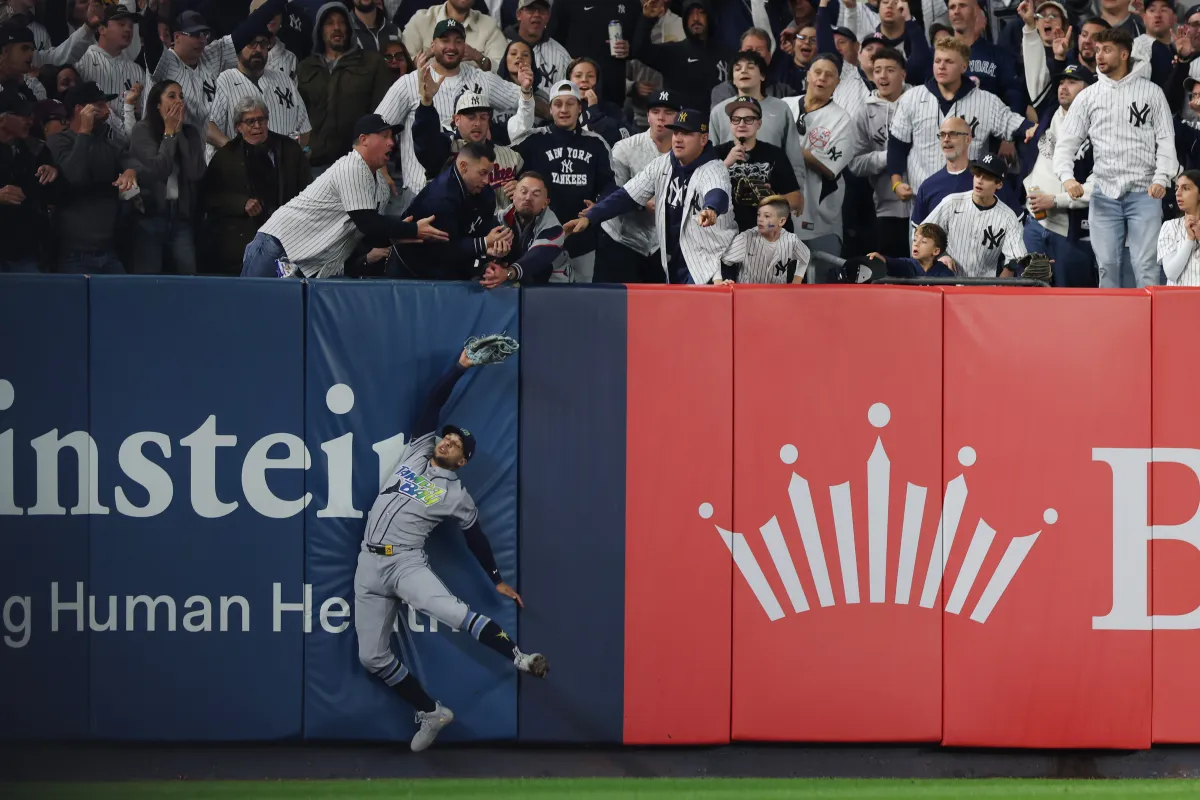
What happened next unfolded in a blur of hope and confusion. As the ball descended toward the left-field wall, a fan sitting in the front row leaned over the railing and reached out. The ball did not clear the fence on its own. It did not hit the wall, bounce back onto the field, or settle into the glove of a waiting defender. Instead, the fan’s hand came into play, and the ball disappeared into the stands, pulled down before it could complete its natural trajectory. In the Yankees’ dugout, on the bases, and across the stadium, there was an eruption of celebration. Volpe, believing he had just delivered the go-ahead home run, began to round the bases with the adrenaline of a player who had suddenly become a hero. He touched first, then second, then third, and headed for home with the kind of joy that defines a postseason comeback. The Yankees’ fans screamed, high-fived, and hugged strangers. But the celebration was premature. The umpires immediately huddled, and the familiar signs of a review appeared. Everyone in the ballpark understood that the play was not over, that the fan’s hand had altered the flight of the ball, and that the game’s outcome now rested on a replay screen and a judgment call that would break hearts.
The verdict came down from Major League Baseball with a cold, definitive clarity. After reviewing “all relevant angles,” the league announced that it had “definitively determined the spectator interfered with the ball over the field of play.” The ruling was blunt: the ball would not have left the playing field, and it would not have been caught. In other words, it was not a home run, and it was not an out. It was an act of interference, and the play was overturned. Volpe, who had thought he was circling the bases in triumph, was sent back to second base with a double. George Lombard Jr., who had been on base and scored on the play, was credited with a run. The score became 4–3, and the Yankees had a runner in scoring position, but the emotional whiplash was staggering. One moment, the season had been saved; the next, it was hanging by a thread. The fan, wearing a Yankees windbreaker, had reached over the railing and into the field of play, and in doing so, he had not only robbed Volpe of a home run but also changed the texture of the entire game. Baseball rules are strict about this: the field of play belongs to the players, and any intrusion from the stands, no matter how innocent or passionate, carries consequences.
By the time the replay official had spoken, the focus shifted to the fan. Security officers made their way through the stands, and the man in the Yankees windbreaker was escorted out of Yankee Stadium. Videos of the ejection circulated on social media within minutes, and the internet did what the internet always does—it turned a human moment into a spectacle. Some fans called him a villain, others a scapegoat, and still others simply a man caught up in the heat of the moment. It is easy to understand how it happened. A fly ball heading for the wall, the roar of the crowd, the instinct to reach out and grab a piece of history—these things can override rational thought. But in the cold light of the replay, his gesture was an illegal one. He had reached over the railing, into the field of play, and interfered with a live ball. The umpires had no choice but to apply the rule. The fan did not mean to hurt his team, but his actions did more damage than any opposing pitcher could have hoped for. He was not a villain with malice in his heart; he was a fan who forgot, for one split second, that he was a spectator and not a player. Still, the rules do not care about intent, and the Yankees were left to deal with the aftermath.
Rays left fielder Victor Mesa Jr. had the clearest view of the play, and he did not hide his feelings. In an interview after the game, Mesa insisted that he had been interfered with from the moment Volpe made contact. “On that play, I feel that the ball carried a little bit more than it should,” he said. “In my opinion, I feel that I could catch the ball or at least could have touched my glove. But it is what it is.” Mesa’s words carried the calm confidence of a player who knew his team had escaped disaster. He believed the ball was catchable, or at least that he could have reached it, and his frustration was visible despite the victory. For the Yankees, Mesa’s quote only added to the sting. The Rays had not only avoided a two-run home run; they had managed to get out of the sixth inning without allowing another run. The score remained 4–3, and the Yankees could not push another runner across the plate. The game slipped away, and with it, the series. The Rays completed the sweep with a 3–0 victory in the best-of-five series, ending the Yankees’ season and sending the Tampa Bay team onward in the postseason. It was a bitter, brutal ending for the home team, and the image of the fan reaching over the wall would be replayed for days.
In the end, this was a story about passion and rules colliding at the worst possible moment. The fan in the Yankees windbreaker did not set out to sabotage his team. He was caught up in the moment, just like everyone else in the stadium. He wanted the ball to be a home run. He wanted to be part of the celebration. Instead, he became the symbol of a season-ending loss, a cautionary tale about the thin line between fandom and interference. The Yankees’ players were gracious in defeat, but the frustration was unmistakable. They had fought all season, survived injuries and slumps, and reached the playoffs with dreams of a championship. In the bottom of the sixth, with the season on the line, they had a chance to change the narrative. Then a hand reached over the railing, and the narrative changed in a way no one could have predicted. Baseball is often called a game of inches, but on that night, it was a game of hands—one hand that reached too far, and another that could not reach the ball. The Rays moved on, the Yankees went home, and the fan was left to live with a moment he probably wished he could have back. It was a harsh reminder that in baseball, as in life, the difference between a hero and a villain is sometimes nothing more than a single, impulsive gesture.