



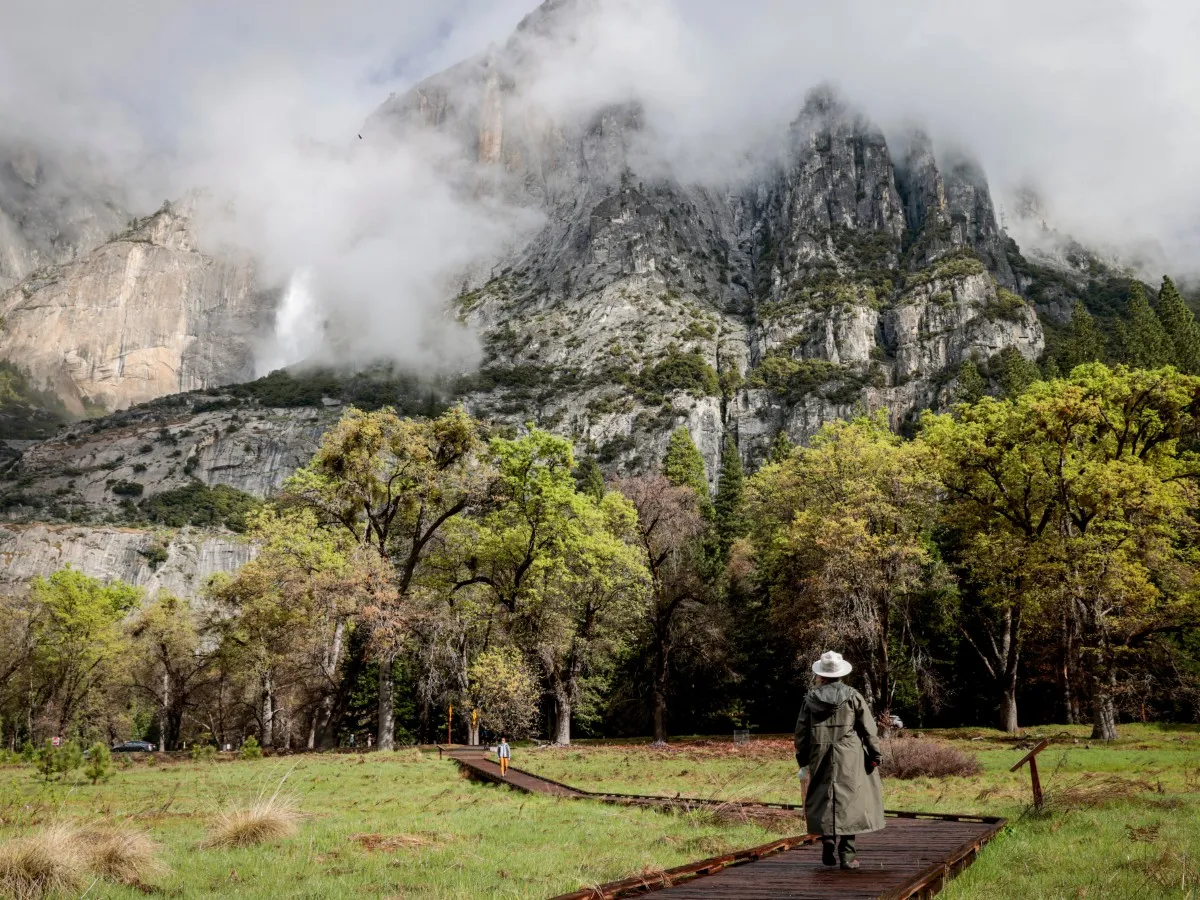
Nestled among the granite domes and winding trails of Yosemite National Park, Tuolumne Meadows has long been one of America’s most beloved high-country landscapes, a place where wildflower-filled alpine wetlands stretch out beneath vast Sierra skies. But beneath that beauty, the meadow is in trouble, and not in a way that is immediately obvious to a passing hiker. The meadow is slowly losing its living foundation: the dense, native sod that once held the soil together and kept the entire ecosystem functioning. For more than a century, historical disturbances—most likely intensive sheep grazing in the late 1800s—stripped away the key plant species that should dominate this landscape, and the damage has been compounding ever since. To try to reverse that decline, researchers from Colorado State University planted 40,000 sedge seedlings across Tuolumne Meadows, hoping to rebuild what was lost. “Tuolumne Meadows is declining because the native dominant plant species that should form a dense sod is uncommon due to historical disturbances – most likely very heavy sheep grazing in the late 1800s that removed the key plant species,” lead author David Cooper, a senior research scientist at Colorado State University, told Newsweek. The effort is not just about making the meadow look pretty again; it is about trying to repair the intricate web of soil, water, plants, and carbon that underpins one of the park’s most iconic ecosystems.
The hidden crisis beneath Tuolumne’s surface is carbon. Healthy meadows are extraordinary at holding carbon in their soils, storing away organic matter that makes the earth dark, moist, and fertile. But when the native plants that build those soils disappear, the balance shifts. According to Cooper, carbon is absolutely essential to maintaining the meadow’s ability to hold water and support plant life. Right now, the meadow’s soil is losing far more carbon than it is gaining, because the decomposition of soil organic matter is racing ahead of plant production. “At present the decomposition of soil organic matter and loss of carbon far exceed plant production resulting in this net loss of soil carbon each year,” Cooper explained. That may sound like an abstract soil chemistry problem, but the consequences are real and visible. As soil organic matter disappears, the meadow dries out, becoming far more vulnerable to conifer tree invasion. Trees begin marching into open spaces where they never used to grow, transforming a lush, waterlogged meadow into a drier, less diverse landscape. The very characteristics that draw people to the meadow—its openness, its lushness, its sense of wild, water-rich serenity—begin to fade. And because this damage has been accumulating for roughly 150 years, the meadow’s trajectory has been quietly declining for longer than anyone alive has been watching it.
That is where the sedge seedlings come in. Sedges are grass-like plants that once formed a continuous, dense turf across Tuolumne Meadows, holding the soil together and feeding it with organic matter through their roots and rhizomes. Cooper and his team planted tens of thousands of them with the specific goal of restoring that vital underground cycle. “They shade the meadow soil and its roots and rhizomes provide the organic carbon that builds the meadow soil,” Cooper said. Three years after planting, the researchers found early signs that the approach might be working. Soil health was beginning to improve, and the seedlings were establishing themselves. But there was a sobering catch: the meadow was still releasing carbon. Even with new plants taking root, the old soil organic matter continued to decompose, meaning the meadow had not yet flipped from a carbon source to a carbon sink. The scientists believe full recovery is possible, but it will not happen quickly. Given that the damage has been unfolding for roughly a century and a half, they estimate it could take another 25 to 30 years of careful restoration work before Tuolumne Meadows truly recovers. The findings, published in the Journal of Geophysical Research: Biogeosciences on October 6, offer a rare combination of hope and humility, showing that nature can heal, but only on its own timeline.
Experts outside the project say the effort is impressive, precisely because it is so difficult. Christine Sprunger, an associate professor of soil health at Michigan State University, told Newsweek that this is “an ambitious restoration effort, and it is encouraging that the researchers are seeing early signs of improved soil health after just three years.” But she was careful not to overstate the significance of those early gains. “Restoring vegetation is an important first step, but rebuilding the soil processes that sustain a healthy meadow takes longer,” she added. “Continued carbon losses underscore how difficult it can be to reverse the effects of historical degradation.” Randall Jackson, a professor of grassland ecology at the University of Wisconsin-Madison, framed the work in broader terms, describing the restoration of ecosystem function as a “critical part of planetary health and wellbeing.” He applauded the effort to restore vegetation that could lead to higher water holding capacity and soil organic matter accumulation—benefits that extend far beyond the park boundary. Healthy wetlands and grasslands, he noted, historically accumulated and retained carbon, acting as natural buffers against flooding, water pollution, and climate change. The fact that Tuolumne Meadows is losing carbon to the atmosphere is therefore not just a local problem. “It reflects a broader problem that we’ve observed in grasslands of the Midwest,” Jackson said, where most of the tallgrass prairie has been converted to row crops for the past 150 years and is now losing soil carbon as the climate warms—something that may be nearly impossible to reverse through management alone.
The deeper question, of course, is whether planting native seedlings can truly bring these meadows back. Sprunger believes it can help, but only as part of a longer process. Restoring native sedges, she said, can “help rebuild the processes that historically sustained these meadows,” because their extensive root systems contribute organic matter below ground, hold soil in place, and support a whole community of soil organisms, including microbes and free-living nematodes. Those organisms help process plant inputs and cycle nutrients, and some of the carbon they help create may eventually become stabilized in the soil. But how much carbon is retained depends on a delicate balance between new plant inputs and losses through decomposition and erosion. That is why Sprunger stressed that “continued restoration and long-term monitoring are essential.” Three years is enough to see whether plants are establishing, but it is “a short window for evaluating soil carbon recovery.” To truly know whether the early improvements turn into lasting carbon storage, she said, researchers would need to monitor the site for a decade or longer. Joseph Blankinship, an associate professor of agricultural and life sciences at the University of Arizona, agreed that the project is an “encouraging effort” because it addresses a fundamental part of meadow recovery—rebuilding living root systems. But he cautioned that “restoring vegetation is only the beginning.” A meadow can begin to recover biologically before it stops losing carbon, and restoration success cannot be measured by plant cover alone. Blankinship emphasized the importance of quantifying both the new carbon introduced by the planted sedges and the stability of “old” carbon that has been stored in the soil for centuries. He also recommended tracking effects on water dynamics deep in the soil profile, including water-holding capacity. “I would recommend tracking plant establishment, groundwater, soil carbon, and greenhouse-gas exchange against unplanted controls,” he said. “Success should also include habitat, erosion control, and water-related functions—not solely whether the meadow has already become a carbon sink.”
In the end, the story of Tuolumne Meadows is one of patience, science, and a belief that damaged landscapes can still be brought back. The planted sedges are not an instant cure, and the meadow will not regain its former glory within a few years or even a single decade. But the researchers and outside experts agree that this kind of restoration is a vital first step, one that could slow the loss of soil carbon and protect the meadow’s health while the longer process of soil recovery unfolds. Jackson put it plainly: bringing past vegetation back may “slow the loss of soil carbon by improving sensitive soil health indicators, but whether it will reverse it and make the meadows an atmospheric carbon sink as the climate continues to warm is a long-term question that will require decades of monitoring to determine.” That may sound like a cautious conclusion, but for a landscape that has spent a century and a half quietly unraveling, it is also a hopeful one. Every sedge that takes root is a small act of repair, a thread being woven back into the meadow’s fabric. The carbon that has been lost cannot be replaced in a single season, and the soil organisms that once thrived there will need time to return. But the meadow is still alive, still holding on, and still capable of healing if given the chance. The work underway at Tuolumne is part of a much larger global effort to restore wetlands and grasslands, to bring back the ecosystems that stabilize our climate and sustain life. It will take years, maybe decades, to know if this particular experiment fully succeeds. But for the hikers who wander through those meadows beneath the enormous Sierra sky, the hope is that one day, the ground beneath their feet will be as rich and resilient as it once was—and that the meadow will be there for future generations, not just as a memory, but as a living, breathing landscape.